
This circuit can be used by scout groups or campers who require an "emergency communications" system for long distances and who wish to use the Morse Code. It is a good project for STEMers.
The Universal Telegraph Code tends to fall into disuse by the adoption of more modern systems, but still today it is an important resource for emergencies and this is revealed by the requirement of its knowledge in the examinations of radio operators and amateurs.
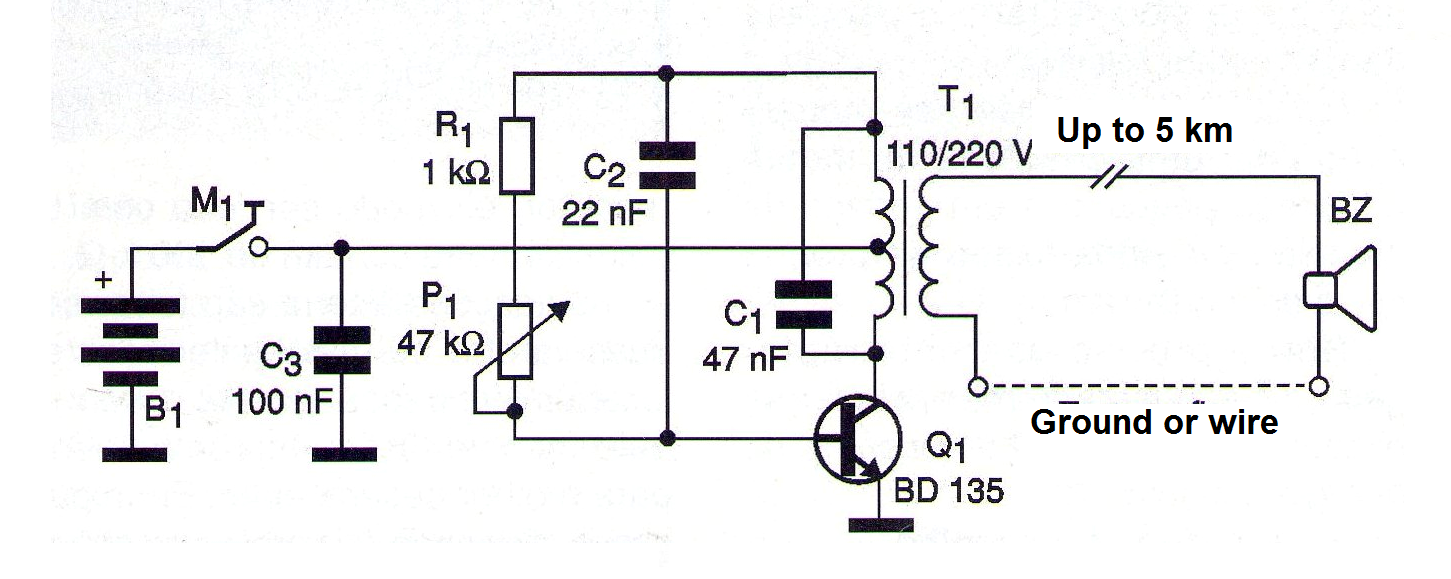
The circuit we describe operates with a pleasant audio tone and as its transmission is made with high impedance line, for a sensitive receiver, the connection wire between the stations can be more than 5 km in length.
With two similar systems and using the same cable (a transmit/receive switch is added), communication can be maintained bilaterally.
The circuit is battery powered and compact enough to be charged to the backpack, both transmitter and receiver.
With the use of grounding (a small metal bar buried in moist soil) the interconnecting wire between the stations may be unique.
Using a thin wrapped wire it can be loaded onto a reel of very large length, sufficient to join two camps, for example.
The circuit also has a tone adjustment for the signal which makes it more pleasant to use.
In figure 1 we have the complete diagram of the system, since the receiver consists of a simple piezoelectric transducer.
In figure 2 we have the arrangement of the components of the transmitter in a terminal strip.
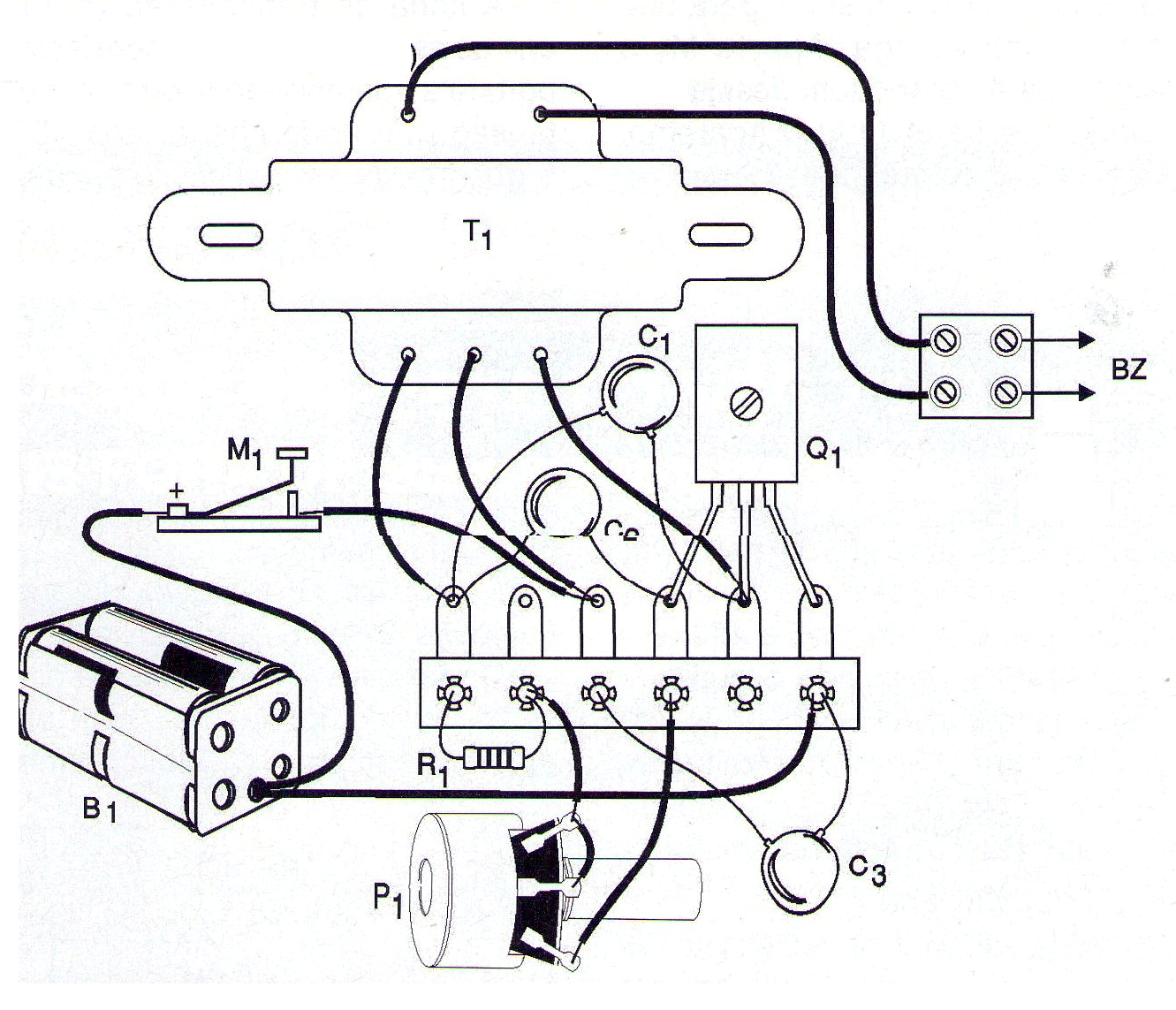
This terminal strip, together with the batteries and the manipulator, must be installed in a small plastic box.
The transformer, of the type used in primary power supplies of 110 or 220 V or the two voltages and secondary of any voltage between 4.5 + 4.5 V and 9 + 9 V and current in the range of 100 to 300 mA ( The smaller the transformer, the better the assembly).
The capacitors are polyester or ceramic and the resistor from 1/8 W.
As receiver we have two alternatives: one is the use of a small piezoelectric transducer (the size of a coin) and therefore very easy to carry or even a headset or ceramic microphone.
The second alternative is the use of a piezoelectric tweeter from which the small internal transformer has been removed.
The manipulator can be improvised with a metal plate, a small nail and a piece of wood or even fixed in the assembly box itself.
No need to use a general switch because, when the handler is open, there is no power consumption.
To test the device, connect the transducer to the output, but with a 47k ohm resistor in series so that there is no overload.
Press M and set P1 to the desired tone.
Then just install the device. If you want a volume control on the receiver, it can be done with a common potentiometer of 100 k ohm.
Earth connections are made with two metal rods buried in a humid place. These rods should be at least 40 cm long.
The transmission line (wire) that joins the stations must be well insulated, as the transmission occurs with a voltage that can reach 400 V which means the danger of small shocks in those who touch bare parts.
To convey, remember that a short touch represents a point and that a long touch, a dash. Dots and dashes form the letters, numbers, and various symbols according to the Morse Code.
The reader should memorize the code well and then, with some training, be able to receive and transmit messages efficiently.
MATERIAL LIST
Semiconductors:
Q1 - BD135 or equivalent - general purpose NPN transistor
Resistors: (1/8 W, 5%)
R1 - 1k ohm - brown, black, red
P1 - 47 k ohm - potentiometer
Capacitors:
C1 - 47 nF (473 or 0.047) - ceramic or polyester
C2-22 nF (223 or 0.022) - ceramic or polyester
Miscellaneous:
M1 - Manipulator - see text
B1 - 3 or 6V - 2 or 4 medium or large batteries
T1 - Transformer with primary 110/220 V and secondary 6 + 6 V x 100 mA - see text
BZ - Transducer - see text
Terminal strip, battery holder, mounting box, wires, terminals, ground rod, material for the manipulator, etc.


