
The wattmeter or electric power meter we describe can be used in the measurement of power (and consumption) of household appliances and electronics up to about 1000 watts, depending only on the transformer used.
As the circuit takes advantage of the very energy of the equipment being analyzed to power an instrument, it does not require a power supply. This is quite interesting equipment to make the comparison of consumption of ordinary household appliances.
As can be seen from Figure 1, a transformer with a low voltage and high current winding is used to derive a small portion of the energy consumed by the appliance under analysis for a measuring instrument.
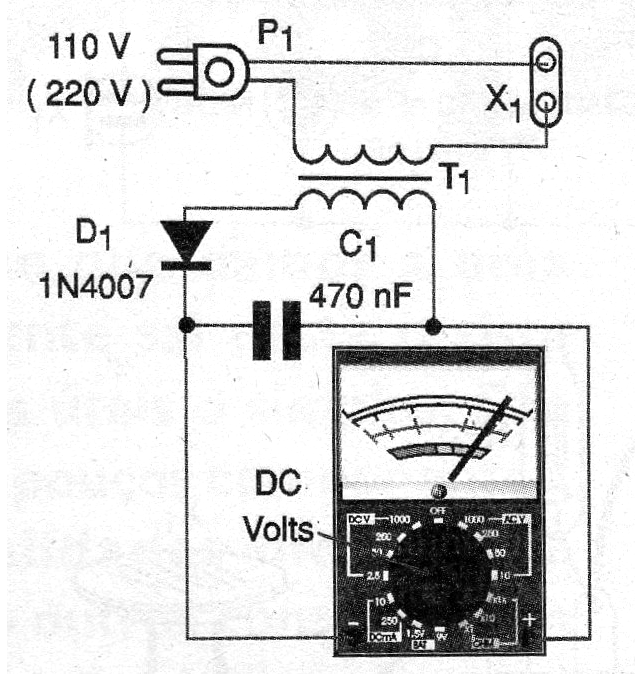
This energy is of the order of a few per cent of the energy demanded by the equipment, so that it does not affect its operation and allows to obtain with good precision an indication of its consumption.
The indicator instrument can be a common multimeter or a microammeter that will be connected as shown in figure 2.
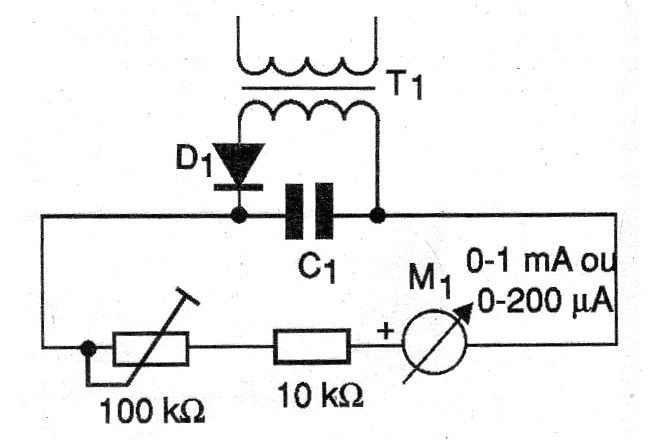
For calibration it is possible to use common incandescent lamps of different powers, noting the measured voltage in the multimeter and the equivalent power. Lamps from 5 to 100 W can be used for a good calibration.
The transformer has a primary winding of 110 V or 220 V. Regardless of the local network, this winding will be used for power sampling.
The secondary can be from 5 to 12 V with currents of 1 to 5 A. This current will determine the maximum power of the tested electro-electronic equipment.
For example, for a 2 A transformer in the 220 V network, we have a maximum tested power of 2 x 220 = 440 W. In the 110 V network the maximum power will be 110 W.
We note that the primary winding will be directly connected to the power grid, and proper precautions must be taken against shocks. The voltmeter is used on a high continuous voltage scale, obtained after calibration tests.
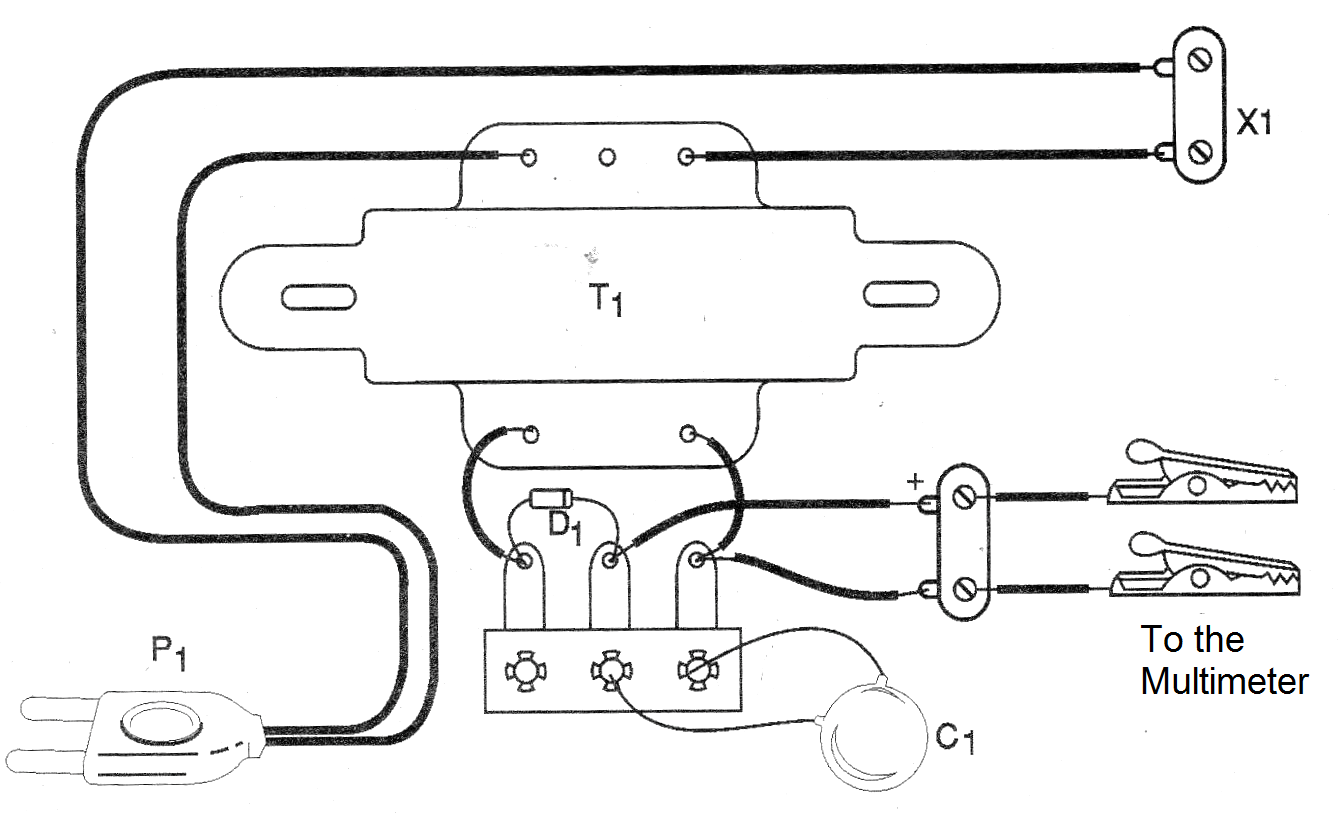
In figure 3 we have the final appearance of the assembly that can be installed in a small box of wood or plastic.
Material list
D1 - 1N4007 - silicon diode
C1 - 470 nF x 400 V - polyester capacitor
P1 - Common Plug
X1 - Common Socket
T1 - Transformer - see text
M1 - Common multimeter or microammeter and trimpot / resistor - see text
Miscellaneous:
Power cable, mounting box, wires, solder, etc.


