
Many animals can be trilled with ease to meet the call of certain sounds such as dogs in the case of whistling. But the biggest advantage of the dog lies in the fact that it can listen to ultrasounds, that is, sounds much higher frequencies than we can hear.
In this way, there are the "dog call" whistles, which produce ultrasounds that those animals hear and we do not. Our electronic version produces an ultrasonic whistle that you can use to call your dog, evidently after training him.
The device is powered by batteries and has excellent range, and can be carried in the pocket.
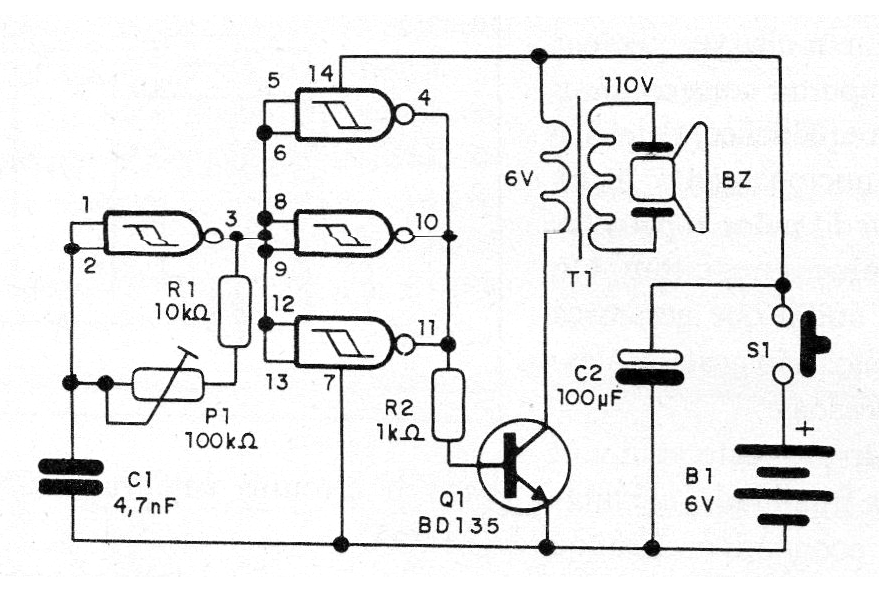
What we have is an oscillator that can be tuned to produce ultrasounds between 18,000 and 30,000 Hz, which are reproduced a piezoelectric common transducer or piezoelectric tweeter.
In figure 1 we have the complete diagram of the device that is based on a CMOS 4093 integrated circuit.
In figure 2 we have the arrangement of the components on a printed circuit board.
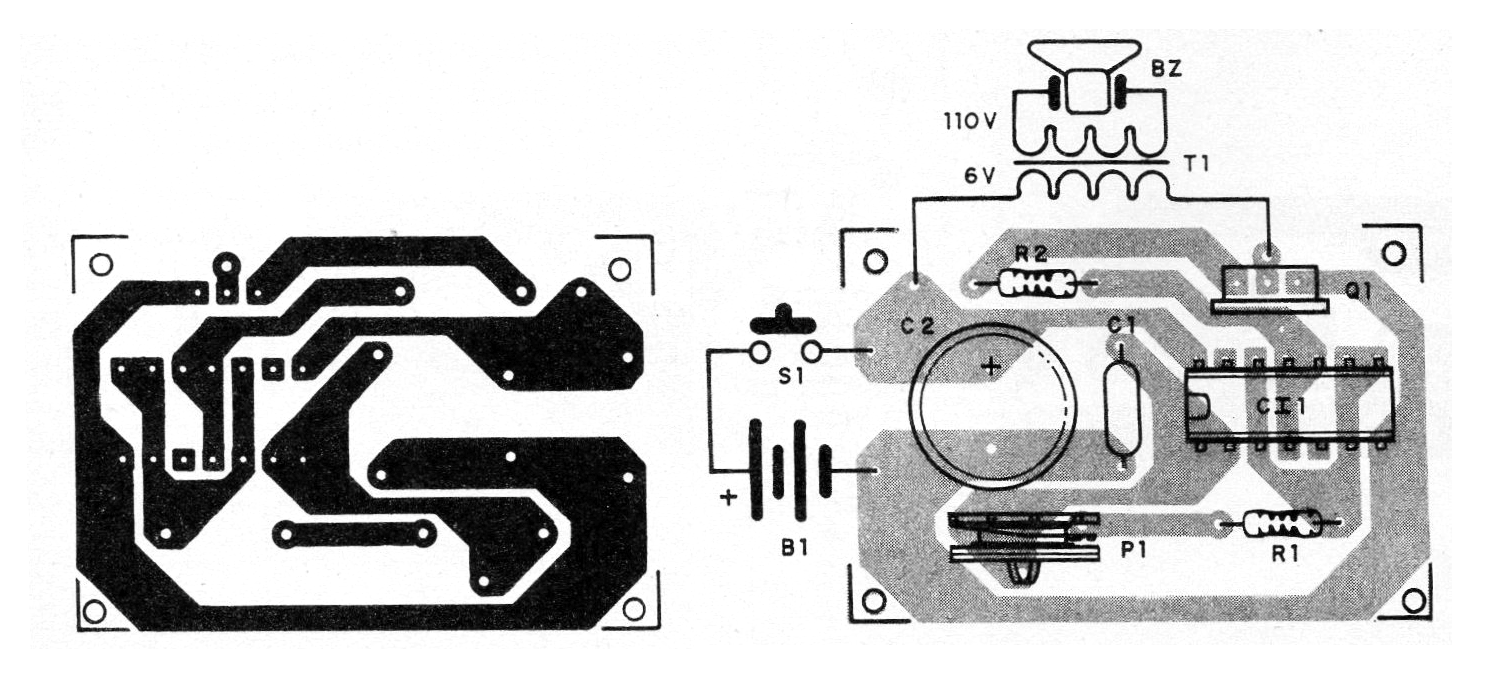
The transformer is of the type used in small primary power supplies of 110 V and secondary of 4.5 to 9 V with current between 50 and 250 mA. A piezoelectric tweeter directly connected to the Q1 collector can also be used.
The transducer is a piezoelectric capsule or a tweeter. To use the unit, turn it on and adjust the tone until it becomes very sharp and disappears from your hearing. Then train your dog to answer the call when you press S1.
Material list:
CI-1-4093 - CMOS integrated circuit
Q1 - BD135 or equivalent - NPN transistor
R1- 10k ohm- resistor - brown, black, orange
R2 - 1 k ohm - resistor - brown, black, red
P1- 100 k ohm - trimpot
C1 - 4.7 nF - ceramic capacitor or polyester (reduce to 2.2 nF - if ultrasound is not reached)
C2- 100 uF- 12 V - electrolytic capacitor
T1 - Transformer - see text
S1 – Push Button
B1- 6 V - 4 small batteries
Miscellaneous:
Printed circuit board, mounting box, battery holder, wires, solder, etc.


