
Here's an interesting project for science fairs or even demonstrations that involve electronics but do not use components. Yes, that's right, all parts of this project can be obtained from scrap material. Not all readers have easy access to an electronic component store and in addition there are those who would like to set up some kind of experimental component to learn their working principle as well as demonstrate it at a trade show. What we describe is the assembly of a simple relay that can be used to control some circuits without much commitment. Newton C. Braga
Read more:
With this relay the reader shows that the power supplied by a single battery is sufficient to control a high power circuit connected to the power grid.
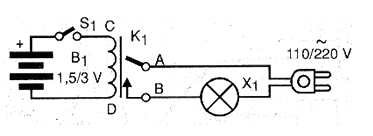
This demonstration circuit may be a lamp or a fan, for example. In figure 1 we have the circuit in which it is used.
The details of the experimental relay assembly are shown in figure 2.
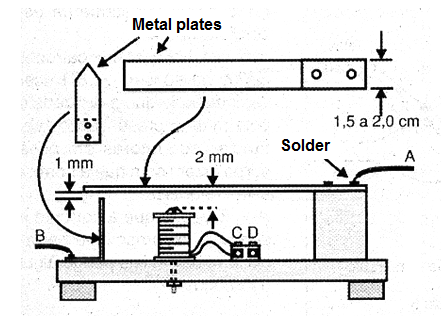
The metal parts are obtained by carefully cutting a can of edible oil.
In the electrical contact contacts the paint covering the can must be well scraped, as it is insulation.
The electromagnet, made from a screw, is rolled up with fine enameled wire (32 or so) obtained from some transformer or other disused component.
We roll 300 to 1000 turns of wire for good sensitivity. The entire assembly should be mounted on a wooden base as shown in the figure itself.
To prove and use the circuit we start from the circuit of Figure 1. The lamp is connected between terminals A and B that function as a switch.
The reader, however, must take the utmost care of the connections, which must be well insulated, because the controlled circuit is connected to the power grid and therefore there is a danger of shocks.
To activate the circuit we can use one or two small, medium or large batteries.
Use the relay at short intervals because with the battery connected the electromagnet heats up and the battery itself runs out quickly.
Adjust the blade distance by approximately 1mm for maximum sensitivity.
If there is a tendency for the "sticking" contacts to move them away slightly.
WHAT TO EXPLAIN
Relays are used in a multitude of electronic applications as electromechanical switches. Relays can be embedded in the curriculum of physics teaching as a cross-cutting theme of electromagnetism. The relays can be found in various household and industrial appliances and even in the car. You can search and explain the following topics related to relays
Explain the operating principle of the relays.
* See how electromagnets work.
* Give examples of common appliances and appliances using relays.
* Arrange a common relay and analyze it by disassembling it if necessary.
MATERIAL LIST
B1 - 1,5 Volt - 1 battery - see text
S1 – Single pole switch (On/Off)
K1 - Experimental relay - see text
X1 - 5 to 40 watt power grid lamp
Several:
Power cable, enameled wires, battery holder, can and relay material, welding, etc.


