
This project serves to show how the power plants work, converting mechanical energy into electrical energy. The reader can use it for demonstrations in science fairs, in school work on the subject or for other purposes (STEM). For the project, the only material that is more expensive is the bicycle dynamo, but if someone has one, he can only "lend" it to the experiment, since it will simply be fixed through bolts without being modified to prevent it be used in its original function.
The basic idea is to spin the dynamo with a wooden wheel with a rubber strip on its edge and fixed to a base as shown in the drawings, but the reader can imagine any other means of rotating the dynamo, for example:
• From a water fall
• From the wind with a propeller
• From a steam engine
In Figure 1 we have the circuit that serves to power three LEDs that will light up with the energy produced, and eventually a small motor.
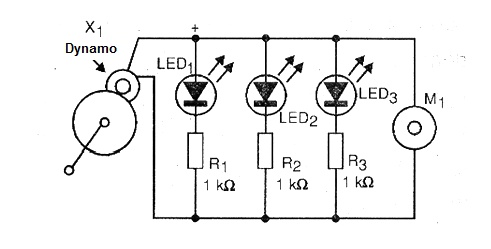
Of course, the dynamo will need to be turned in the right direction for the LEDs to light, as they are polarized components.
In figure 2 we have the arrangement of the LEDs on a small terminal bridge.
The same circuit may be mounted based on other techniques such as, for example, a contact array.
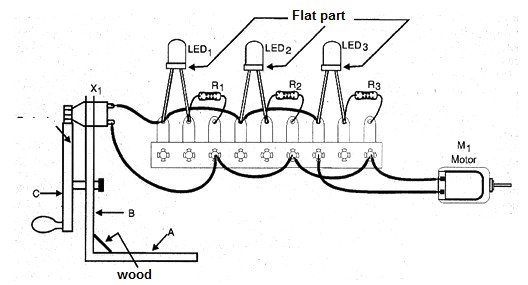
Any LED can be used, but be careful with its position because if they are inverted they do not light.
We do not recommend the use of small bulbs, because as the voltage of these lamps is fixed and the dynamo generates a voltage that depends on its speed, an uncontrolled rotation, which can easily occur, will burn them.
If the LEDs light up brightly, which can mean an overload, increase the resistors to 1.5 k ohms or even 2.2 k ohms. For a more beautiful mount, use LEDs of different colors, including white LEDs that are already available in the market with certain ease.
One suggestion is to assemble a model from a small city and place the LEDs on top of small poles simulating the public lighting system, and some of them in houses.
The dynamo can easily feed more than 20 LEDs which would give a good effect to a mock job.
Note: in place of the dynamo a small permanent magnet type DC motor can be used. Other motors will not work because they do not have the internal magnets to generate the fields. The small motors, however, do not have as much power as the dynamos which means that the amount of LEDs that can be fed is smaller.
WHAT TO EXPLAIN
This work is directly related to the conversion of energy (physics) and distribution of electric energy in cities (energy use).
As a transversal theme for sciences and physics the project admits several approaches such as:
* Look in the physics books for the working principle of dynamos and prepare an explaining poster.
* Show that the amount of energy generated depends on the mechanical force, so you do not create energy, but only if you do your transformation (principle of energy conservation)
* Explain the differences between DC and AC.
MATERIAL LIST
LED1, LED2, LED3 - Common LEDs of any color
R1, R2, R3 - 1 k ohms - 1/4 W resistors - brown, black, red
M1 - 6 V motor (from any electric toy)
X1 - Bicycle dynamo
Several:
Terminal strip (or solderless board), wooden base, wires, solder, etc.


