
This circuit uses only passive components and a relay to flash ordinary lamps or LEDs. It can be used for emergency signage or as an arrow or direction indicator for bicycles and other vehicles.
We describe the assembly of a single flashing or 6 V or 12 V blinker, depending on the relay, capable of triggering lamps or LEDs.
The circuit is very simple, because it uses few components and has the same principle of some circuits of arrow found in old cars.
The electronics used are practically nil because we do not need transistors, integrated circuits or other components.
The circuit is based on the discharge time of a capacitor through the winding of a relay.
The higher the capacitor used and the greater the resistance of the relay winding, the lower the frequency of the circuit.
6 or 12 V relays with 50 to 100 mA coils will work in the circuit and the ideal capacitor value for the application must be obtained experimentally.
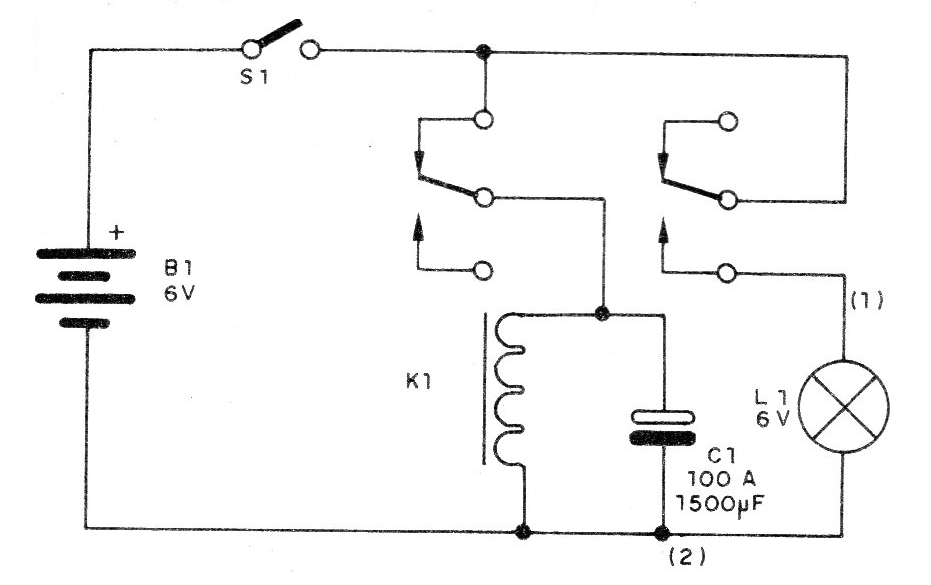
In figure 1 we have the simple intermittent diagram.
The assembly is very simple and a small terminal bar serves to secure the connections and the capacitor.
This assembly is shown in figure 2.
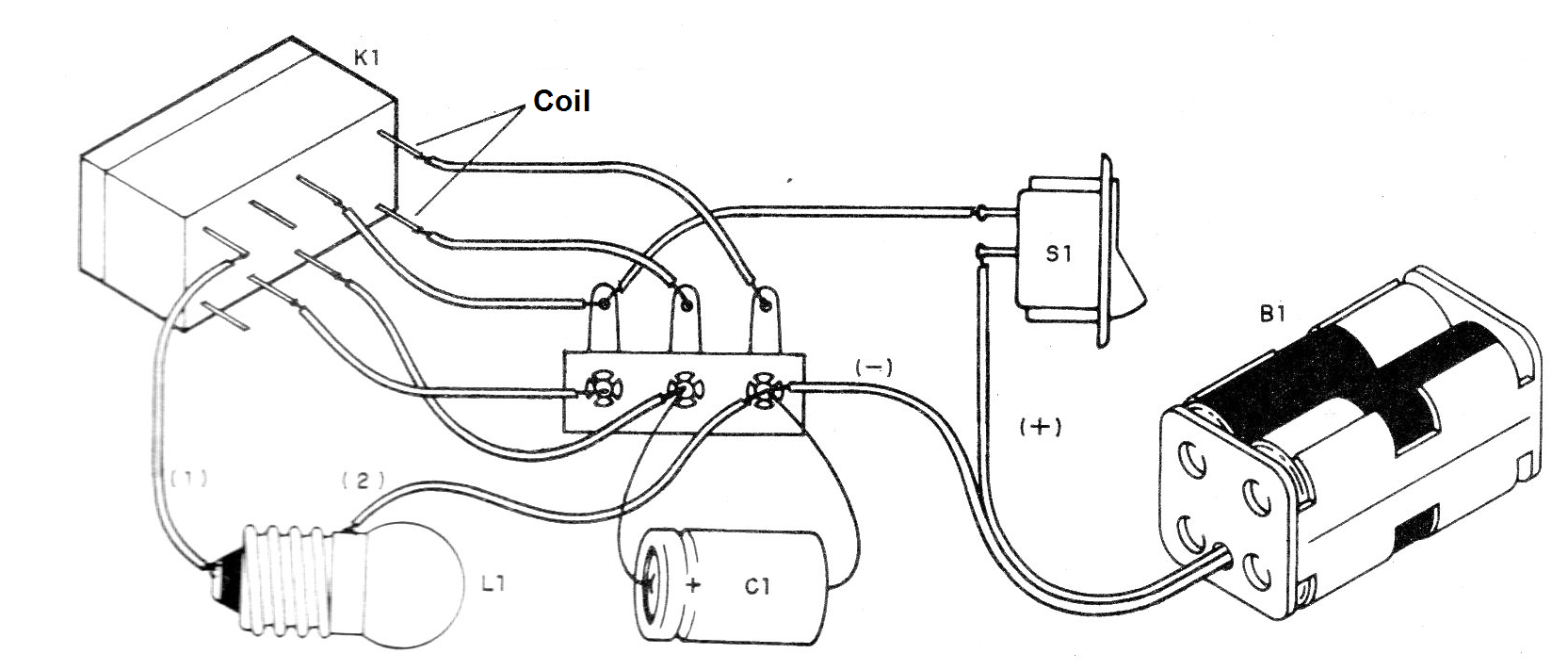
In the drawing we show a 4-battery holder for the 6 V relay case, but the circuit can run on 12 V relays, then it is installed in a car or powered by a source.
To use LEDs, the connection is the same as the light bulb just remembering that the LEDs need a convenient resistor in series.
The relays must be of the type with two reversible contacts as shown in the figure.
Material list
K1 - 6 or 12 V relay with two reversible contacts
C1 - 100 uF at 1 500 uF x 16 - electrolytic capacitor
S1 – On-Off switch
B1 - 6 or 12 V - batteries or battery
X1 - Lamp or LEDs - see text
Several:
Terminal strip, battery holder or power supply, wires, solder, etc.


