
Nicad rechargeable batteries (NiqueI-Cadmium) can be found easily. These batteries can be recharged several times, which compensates for the initial investment in their acquisition, since they cost much more than ordinary batteries. However, to enjoy all the advantages of using this type of battery, you need to have a charger, and a charger involves the presence of another form of power. For homes where there is no electric power in the conventional way because they do not charge from solar energy!
What we describe below is a very simple process for recharging small, medium and large cells from a Nicad type solar cell since other types of batteries (common and alkaline) do not allow recharges.
Leaving the batteries connected to the solar cell for a whole day, we can have a medium charge (half charge), which will ensure the operation of radios for many days, flashlights for many hours and other appliances for a time that depends on their consumption.
HOW IT WORKS
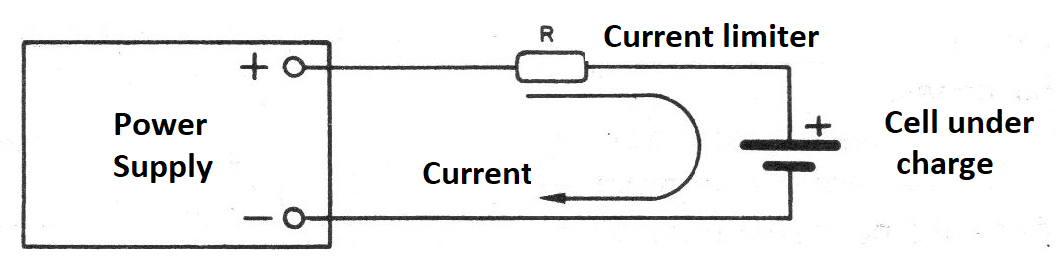
In order to charge a Nicad heater, it is necessary to force a current of intensity determined by the manufacturer in a direction opposite to that of the discharge current when in normal operation, as shown in figure 1.
A simple process, which we have described in other editions, is to connect a source of constant current to the battery or to the battery pack, by circulating a current in reverse for a time that depends on the specifications given by the manufacturers. (figure 2).
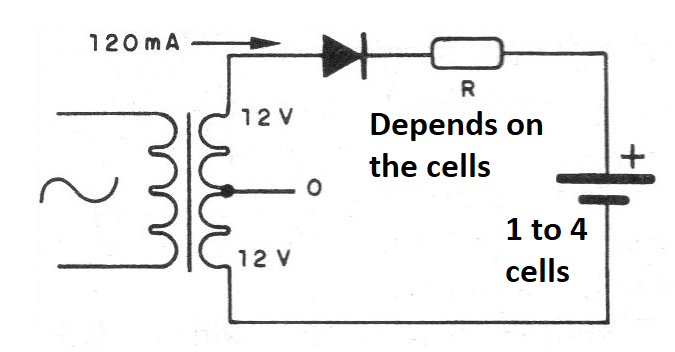
Note that we must always have a voltage higher than that of the battery at full load, or set of batteries, so that the current can flow in the reverse direction.
This fact is a limitation for the use of the solar cell in the direct charge of more than one NiCad battery Considering then that our cell provides at most 1.8V and that a cell needs at least 1.2 volts per unit for a recharge, we can only initially charge one at a time.
An interesting solution would be to "load" their batteries or go to the solution that will be given in a timely manner. A large Nícad stack, for example, requires CADNICA for 16 hours of charging for a current of 120 mA. Medium and smaller cells have smaller currents. Based on the current 500 mA of our cell, we must make the following considerations:
With the battery completely discharged it represents practically a short circuit to the cell that will then circulate the maximum current of 500 mA which is not recommended. A limiting resistor can then be connected in series.
We calculate this resistor so that the battery placed in the recharge still has a voltage of at least 1.0 V. In this case, an initial current slightly greater than the average of 120 mA for large batteries may be allowed. We then use a 2.2 ohm resistor for large cells.
We note that since the cell is not a source of constant current, the charge current falls as the Nicad cell charges. For medium cells the resistor can be 4.7 ohms and for small batteries of 10 ohm..
This leads to an extremely simple circuit shown in Fig. 3.
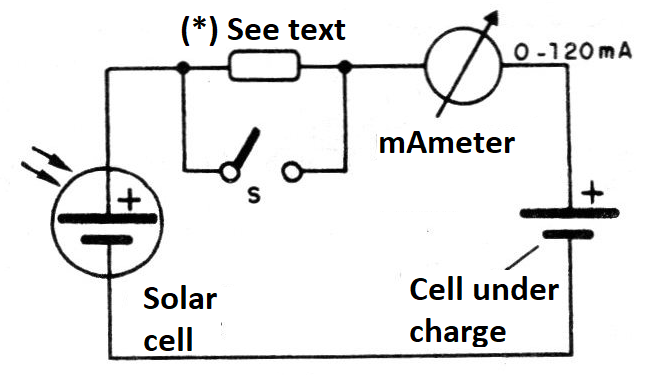
A single cell holder is used and it is very important to note its polarity. A point can be provided in the circuit for connection of the multimeter for monitoring the charging time.
This time will depend not only on the characteristics of the battery but also on the degree of illumination. An additional suggestion is to put a small chain for direct current when the battery is near full charge.
We do not recommend charging in parallel because it would be necessary to use diodes to separate the load currents and to avoid problems due to unbalance of one of the batteries of the set, and the diodes cause a strong voltage drop (even those of germanium) that in this circuit functioning of the system.
The current would be appreciably reduced. Nothing prevents, however, that you research other means of using your cell in recharging your Nicad cells.


