
A very simple and useful type of power supply is one that does not use the transformer. Although this component is highly recommended, given the insulation it provides, there are cases where, due to economy, limited space or even the need for such a large security, a power supply without transformer can be used.
These sources take advantage of the capacitive reactance of a capacitor, usually high voltage polyester, to reduce the voltage of the power grid. After that, rectification, filtration and regulation are performed.
Typical transformerless power supplies are used to power low-consumption devices such as calculators, clocks, and other similar equipment typically in the 1.5 to 9 V range. The currents required by these devices must not exceed 20 mA. With larger currents, the required capacitors would be very large, in which case the transformer starts to become more interesting.
In figure 1 we then have the circuit of a source without transformer for currents up to 20 mA.
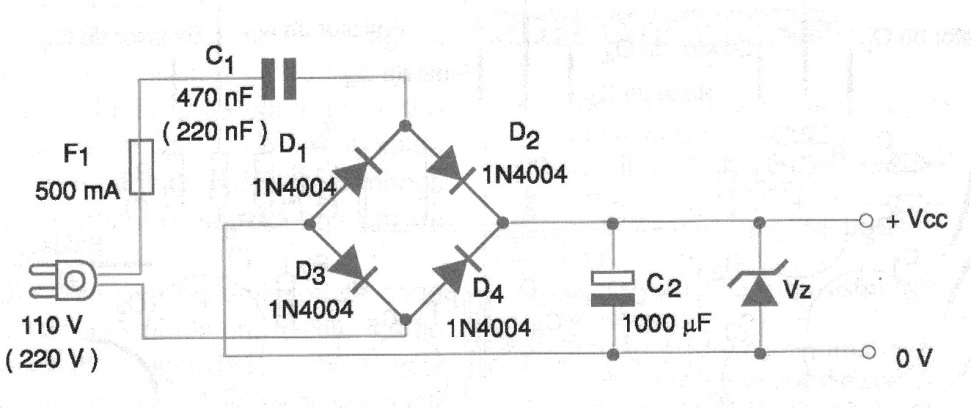
The zener diode determines the output voltage. The polyester capacitor has different values as the network is either 110 V or 220 V. The values in parentheses are for the voltage of 220 V.
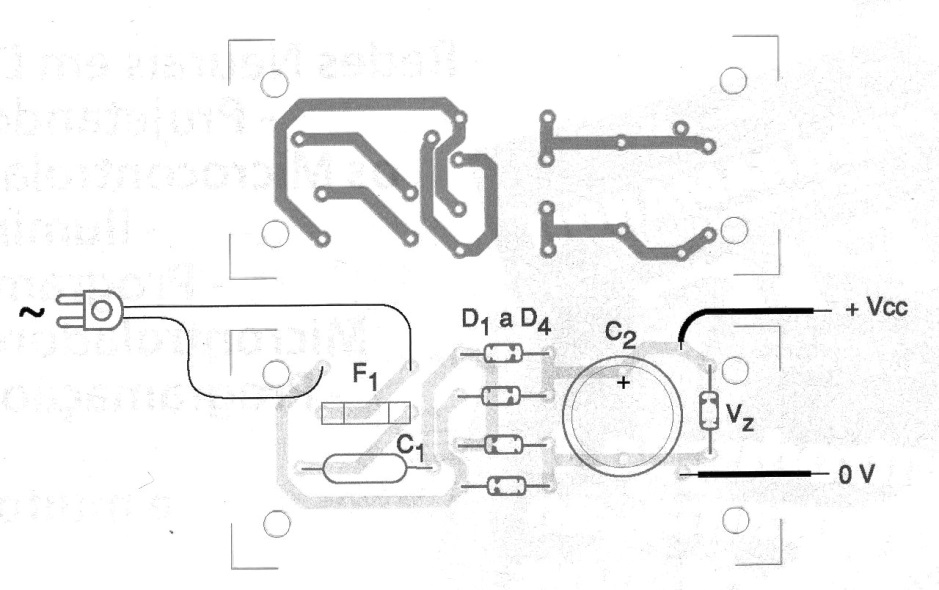
Your working voltage should be at least double the mains voltage at which the circuit will be used. In figure 2 we have a suggestion of printed circuit board for implementation of this source.
It is important to be very careful with the insulation of all parts of the device to be powered and the source itself, as it is directly connected to the power supply.
No equipment with exposed metal or electrical parts should be supplied with this type of power source.
Material list
D1 to D4-1N4004 (1N4007) - silicon diode
Z1 - 3,0 V at 12 V x 1 W - zener diode according to the desired voltage at the output.
C1 - 470 nF (220 nF) x 300 V (450 V) - Polyester capacitor for power grid
C2 - 1000 uF x 16 V - electrolytic capacitor
F1 - 500 mA Fuse
Several:
Printed circuit board, power cable, wires, solder, mounting box, etc.


