
This is a simple way to charge a car battery in an emergency. This procedure may be necessary if you cannot start your car at home on a weekend or in other unfavorable conditions.
The charger is extremely simple as it uses only two components: a bulb and a diode. The load is slow, but with a few hours of application the device can already have enough power to start.
The lamp acts as a current limiter in order to obtain 400 to 800 mA of charge current in the battery. The power of the lamp determines the speed of the load being the maximum recommended in 110 V of 150 watts and of 200 W in the network and 220 V.
Note that this charger is not economical because the lamp should be connected with approximately half the power during charging and should only be used in emergency situations.
ASSEMBLY
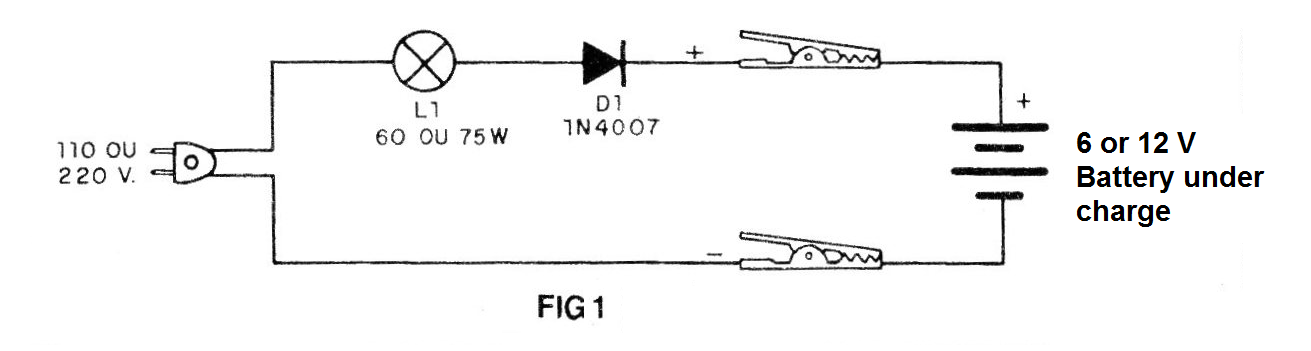
There is no secret to the assembly, as we can see from the diagram in Figure 1.
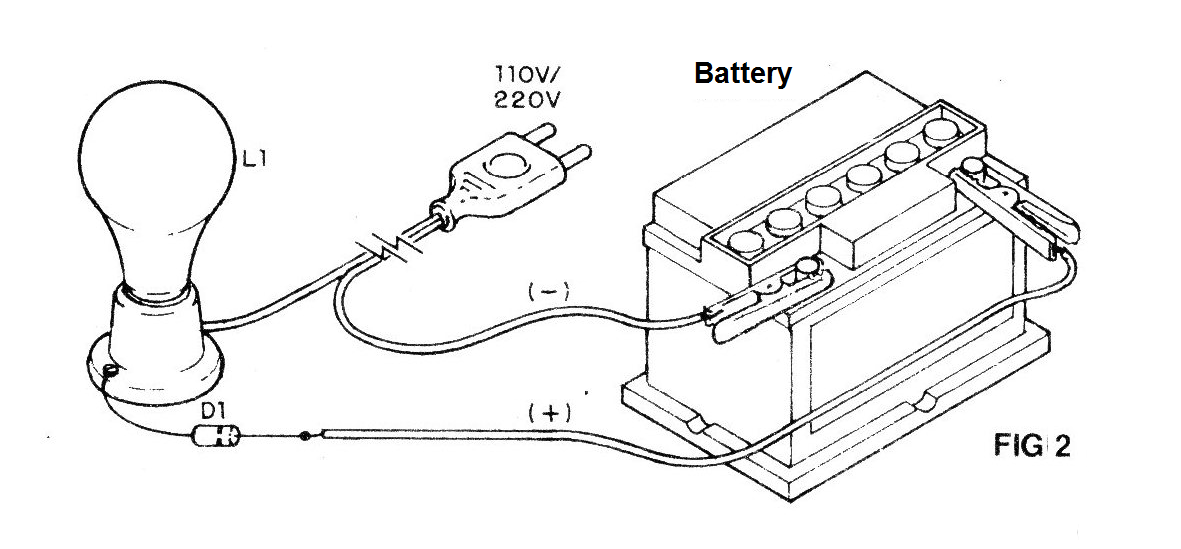
The actual arrangement of the components is shown in Figure 2.
The diode, whose polarity is to be observed by the ring position, can be 1N4004, 1N4007, BY126 or BY127 if your network is 110 V. For the 220 V network, the 1N4007 or BY127 can be used.
The lamp is mounted in a common socket, being of the incandescent type with standard power of 60W or 75W.
USE
To use, disconnect all devices from the car and connect the claws to the poles as shown in Figure 2. The positive pole of the device goes to the positive of the battery and the negative of the device to the negative of the battery.
A charge for starting should be from 3 to 5 hours.
MATERIAL LIST
D1 - Diode 1N4007 or BY127
L1 - 60 or 75 W - 110 V or 220 V incandescent bulb
Miscellaneous:
Power cord, lamp socket, claws for connection to the battery, etc.


