
How about setting up a secret intercom to talk to your brother, neighbor or colleague without anyone noticing? All you have to do is install the system with the hidden wires and you can keep a distance conversation like a real secret phone. Operating with only two batteries this unit is very simple to assemble.
An intercom is nothing more than an amplifier in which we have the possibility to speak and listen in two locations, thus maintaining dialogues. The system described is similar to those used by office clerks, or as an electronic door opener, with the only difference being that it has a smaller volume (it will be necessary to speak very close to the microphone) and that it uses few components, many of which can even be used out of use.
The connection wires between the stations do not need to be shielded (they can be ordinary wires) and their maximum distance is around 15 meters. Besides this distance the resistance of the wire causes the sound volume to decrease. The circuit is powered by two common batteries, which will have excellent durability due to the low power consumption.
Assembling the units in plastic boxes (soap dispensers for example), we will have a system of portable use, even for communications between tents of camps.
HOW IT WORKS
In figure 1 we give the schematic diagram of the intercom.
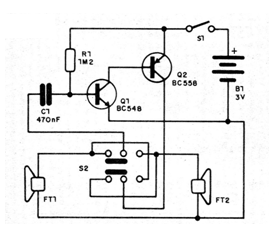
The two transistors, Q1 and Q2, act as amplifiers, increasing the intensity of the signals picked up by the microphone, which in this case is the speaker of each station itself. Thus, when we speak of the FTE1 speaker it functions as a microphone and its signal through the switch S2 is taken to the input of the circuit, being amplified and applied to FTE2, which reproduces it.
In the listening condition, the S2 switch reverses the functions. In this condition FTE2 functions as a microphone and its signal is applied to the input of the circuit, after which it is reproduced in FTE1,
Notice then that the key S2 must be triggered whenever we speak or hear. So when you finish talking, the one at the remote station (FTE2) must speak "exchange" so we can know that it's time to change the S2 to hear.
S1 is used to turn the unit on and off and the used speakers can be of any type, including used out of use radios or other devices.
ASSEMBLY
Based on a terminal strip for welding the smaller components, we give the actual appearance of the assembly in figure 2.
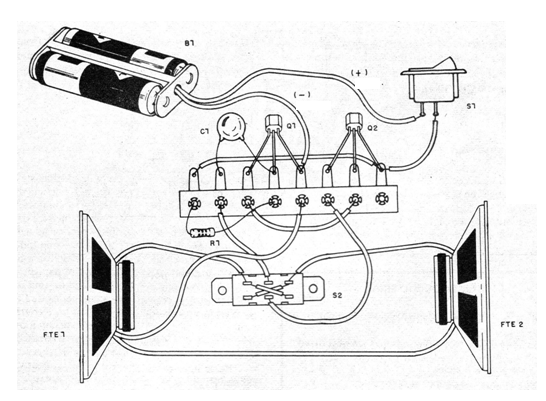
The resistor R1 can have values between 1M (brown, black, green) and 2M2 (red, red, green). You can do tests-in the sense of finding the value that gives the best volume without distortion. The C1 capacitor is also not a critical component. Values between 100 nF (104, 0.1, 100 k) and 1 uF (1u, 105) may be tested.
The connecting wires between the stations are parallel and, preferably, not very fine.
TEST AND USE
To test your intercom, simply place the batteries in the holder and press S1, which turns on the unit. Then tap lightly on a speaker and see if the sound comes out on the other, thus determining which station is in the condition of speaking and listening.
Then approach the speaker of the station "listen" from the ear and speak in the other, or tap your fingers, for playback. Reverse the position of the S2 switch and change the function of the speakers.
MATERIAL LIST
Q1 - BC548 or equivalent - general purpose NPN transistor
O2 - BC558 or equivalent - general purpose PNP transistors
B1 A- 3 V - 2 small batteries
S1 - single switch
S2 - 2-pole wrench x 2 positions
R1 - 1M2 x 1/8 W - resistor (brown, red, green)
C1 - 470 nF - ceramic or polyester capacitor
FTE1, FTE2 - 4 or 8 ohm speakers
Miscellaneous: terminal bridge, battery holder, mounting boxes, wires, soldering etc.


