
Certain types of insects that "bite" humans such as mosquitoes, muriçocas, mutuns, or whatever they are known in different regions of Brazi, for instance, do not support certain continuous sounds of certain frequencies.
Controversial studies show that frequencies can vary widely, ranging from infrasound to ultrasound.
Some researchers, for example, say that the frequencies that have the most positive effects are in the range of 2 to 7 kHz and this is precisely the range generated by the apparatus that we describe below.
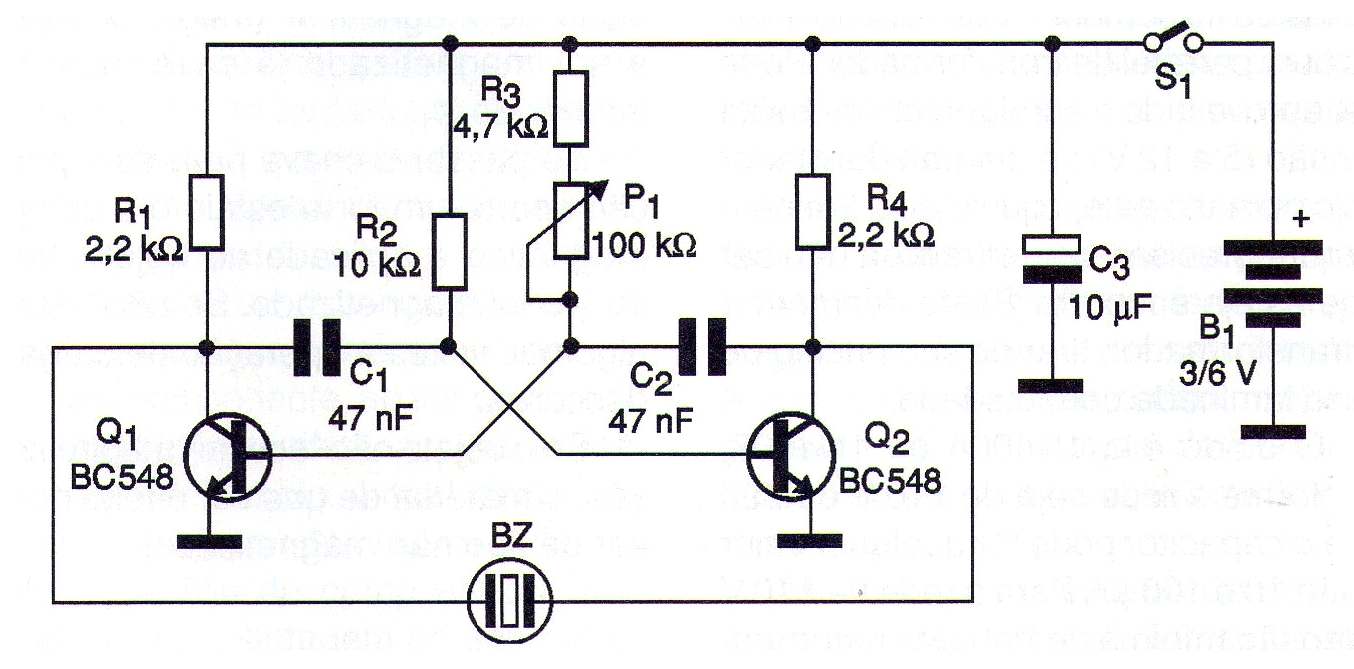
A potentiometer (P1) allows the user of the device to adjust the frequency and thus experiment with finding the ones that produce the desired effects.
The circuit is very simple and is based only on transistors, which makes it very easy for them to be assembled by beginner readers (STEMers) or by those who do not have many features in their electronics workbench.
The power can be made with two or four small cells and as the drained current is very small, its durability is enormous. In figure 1 we have the complete diagram of the apparatus.
In figure 2 we have the arrangement of the components in a terminal strip which fits easily with the other elements (batteries and buzzer) in a small plastic box.
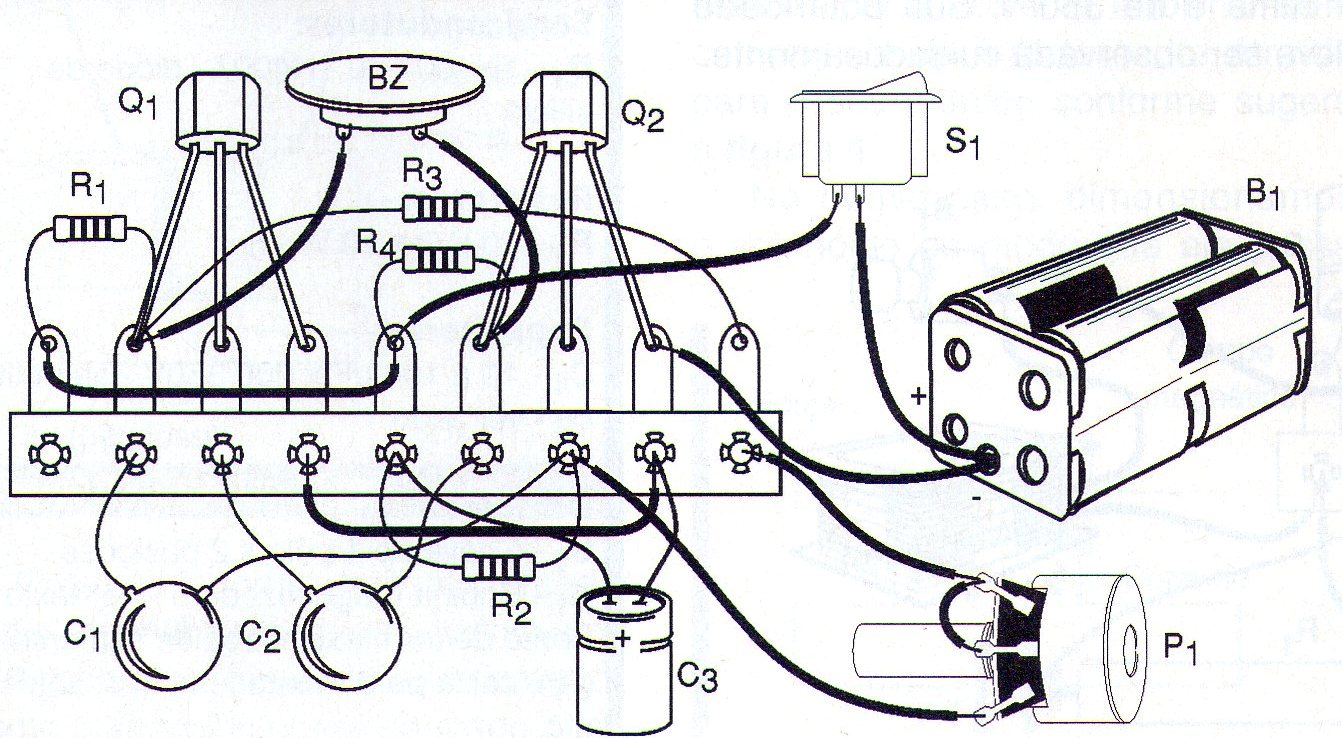
The transducer used is of a ceramic piezoelectric type, serving, for example, a crystal or ceramic headset capsule.
The transistors allow equivalents since any NPN of general use serves. Even PNP types can be used by reversing the polarity of the batteries.
The resistors are 1/8 W and for adjustment both a potentiometer and a trimpot can be used. The capacitors C1 and C2 are polyester or ceramic while C3 and a 6 V electrolyte whose value can be between 10 uF and 220 uF.
To test the device just turn on the power and set P1 so that there is the emission of a sound similar to that produced by the insect I want to amaze or a common buzzing insect. To use, just leave the appliance on.
Make attempts at various frequencies to find out what "works".
MATERIAL LIST
Semiconductors:
Q1, Q2 - BC548 or equivalent - general purpose NPN transistors
Resistors: (1/8 W, 5%)
R1, R4 - 2.2 k ohms - red, red, red
R2 - 10 k ohms - brown, black, orange
R3 - 4.7 k ohms - yellow, violet, red
P1 - 100 k ohms - trim pot or potentiometer
Capacitors:
C1, C2-47 nF (473 or 0.047) - ceramic or polyester
C3 - 10 uF at 220 uF / 6 V - electrolytic
Miscellaneous:
BZ - Ceramic transducer MP-10 or equivalent
S1 - Single switch
B1 - 2 or 4 batteries - 3 or 6 V
Terminal strip, battery holder, mounting box, knob for potentiometer, wires, solder, etc.


