
This unit instantly magnetizes small tools or parts of metal or other material that is capable of withstanding magnetism.
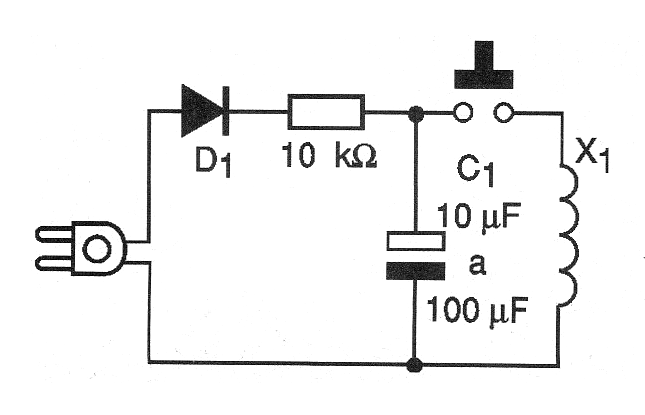
The principle of operation is simple: a capacitor is charged with high voltage and then this capacitor is discharged through a coil, which creates a strong instantaneous magnetic field able to magnetize the objects that are in its interior.
The circuit operates directly connected to the power supply of 110 V or 220 V which means that the reader must be very careful in their handling as well as in the assembly.
The discharge of the capacitor, quite strong, creating a "snap" that can even frighten. A good current rating switch should be used to prevent your contacts from burning in these discharges.
In figure 1 we have the complete diagram of the magnetizer.
In figure 2 we give the arrangement of the components that are soldered in a terminal bridge.
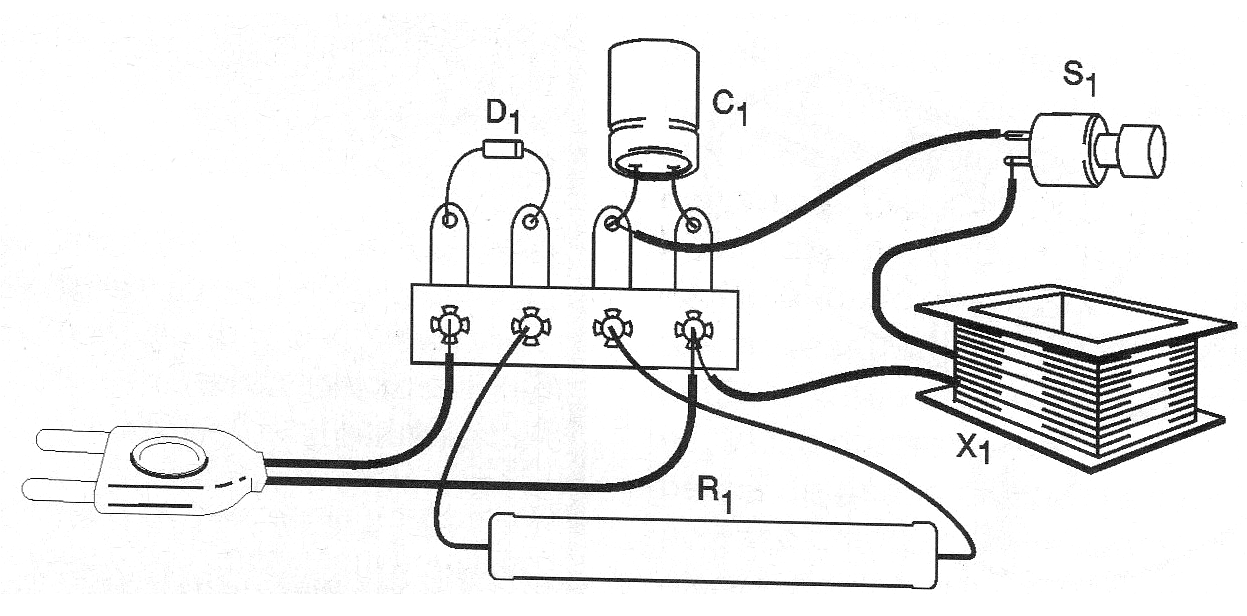
Coil X1 consists of 50 to 100 turns of common or thick enamelled wire on a transformer spool. The low voltage winding (5 to 12 V) of a transformer whose primary is burned can be used.
It does not even need to be removed, unless it is shorted. Simply disassemble the transformer, taking out its iron core laminated with care.
The diode, 1N4004 or 1N4007 depending on the grid is 110 V or 220 V and the capacitor can have any value between 10 and 100 uF. For the 110 V grid the recommended minimum working voltage is 200 V and for 220 V the minimum voltage is 350 V. Its polarity must be observed carefully.
The resistor R1 is wire with 5 to 10 W dissipation and the switch S1 must be of the reversible type of 1 pole x 2 positions. A 2-pole key can be used by taking advantage of only one section.
To use the appliance, connect it to the mains and switch the switch S1 to the charging position (car). Then wait a few seconds and go to the magnetizing (mag) position. The object to be magnetized must already be inside X1.
By passing the key to this position a strong crack occurs and the magnetic field is applied to the object. See if it has been magnetized. If not, repeat the loading and unloading operation a few times.
If the object does not "accept" magnetization, the material from which it is made may be nonmagnetizable.
MATERIAL LIST
Semiconductors:
D1 - 1N4004 or 1N4007 - silicon diode
Resistors:
R1 - 10 k ohms x 10W - wire
Capacitors:
C1 - 10 to 100 uF x 200 / 350V - electrolytic - see text
Miscellaneous:
S1 - 1-pole wrench x 2 positions
X1 - Magnetizing coil - see text
Terminal strip, power cable, mounting box, wires, solder, etc.


