
With this device you can investigate modulated light sources or even use an electronically modulated fluorescent light as an optical telegraph. By pointing to distant light sources, you may discover some sort of modulation and possibly the transport of messages. In short, it is a device that translates quick variations of brightness from a light source into sounds.
Modern theories assume that distant civilizations would be modulating powerful sources of LASET and even starlight to convey messages.
If you want you can try to point the sensor of this device to the sky and eventually discover one of these sources, trying to decipher their messages.
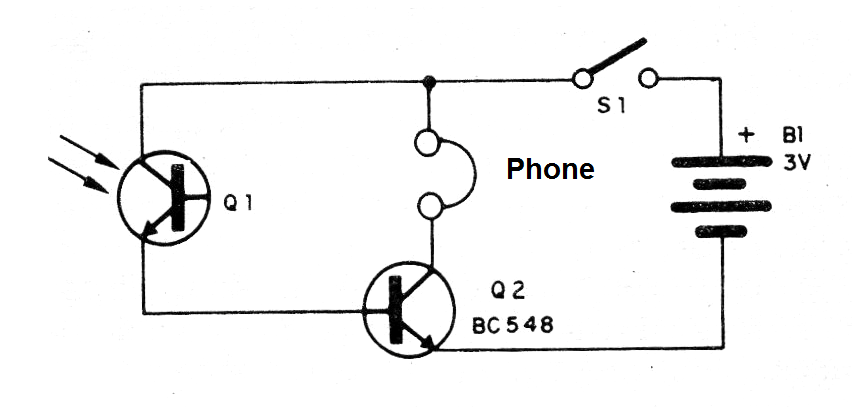
In figure 1 we have the complete diagram of the researcher, which can also be used in optics experiments in the school physics laboratory.
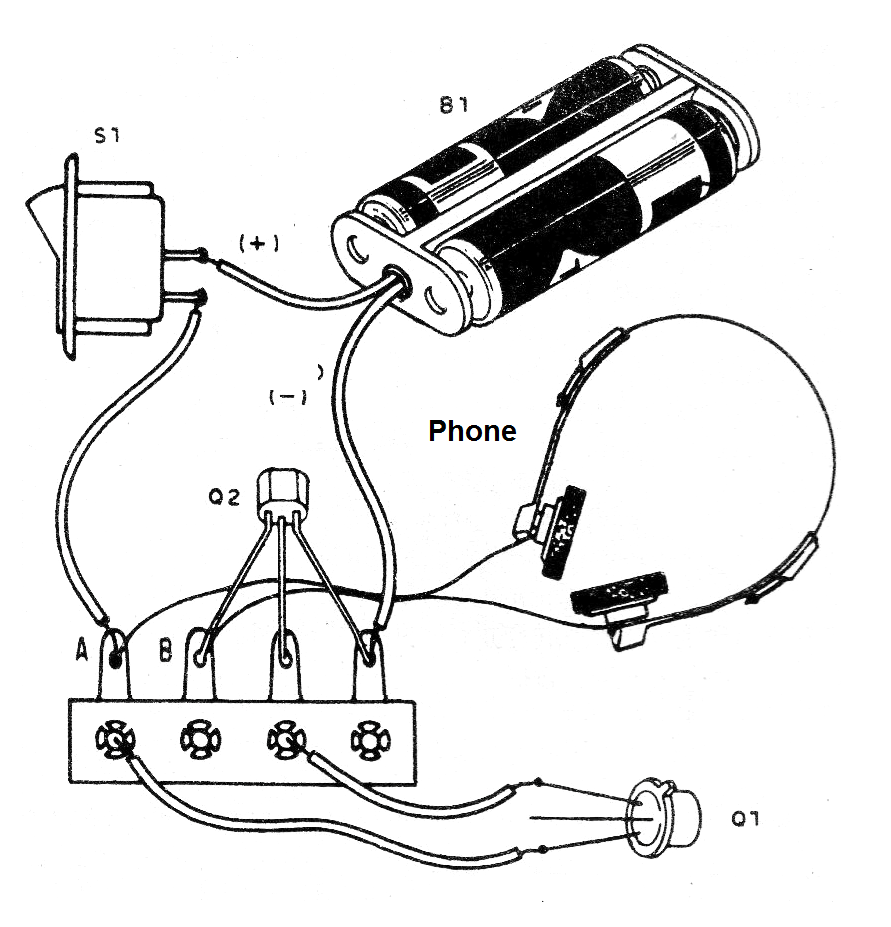
The arrangement of the components on a terminal strip is shown in figure 2. The transistor Q2 may actually be any NPN of general use and with the polarity reversal of the battery and of the phototransistor PNP types can also be used.
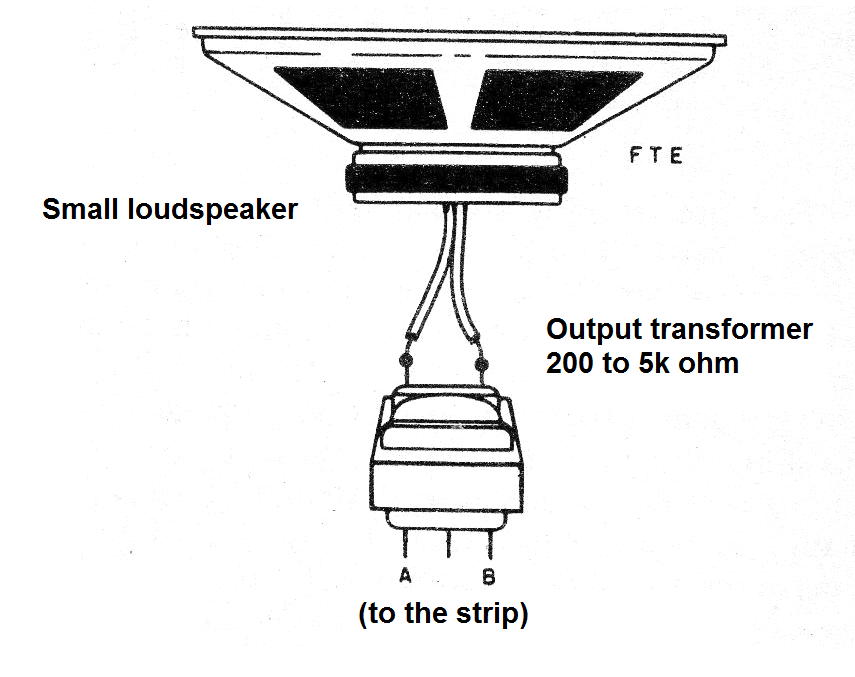
The headphone or earphonet must be either magnetic impedance ata or a small common transformer output speaker, connected as shown in figure 3.
The power supply to the device is made by two small batteries and the phototransistor can be of any type. For greater directivity for your device, mount the phototransistor a tube and place a lens in the front.
Another possibility is to mount the photo-transistor near the eyepiece of a telescope, or even a telescope for a special search of modulated sources.
List and Material
Q1 - Phototransistor of any type
Q2 - BC548 or equivalent - general purpose NPN transistor
S1 - Single switch
B1 - 3 V - two small batteries
FONE - High impedance earphone
Miscellaneous: battery holder, terminal strip, wires, solder, etc.


