
Nicad's rechargeable batteries or batteries are one of the most commonly used power sources for mechatronics and robotics projects.
In fact, we can find these batteries and batteries powering a multitude of other applications such as cordless phones, toys, automatisms, remote control transmitters, etc. However, these batteries need to be recharged.
The very simple charger we describe is for small, medium and large cells providing a load current of the order of 20 to 50 mA in the 110 V network.
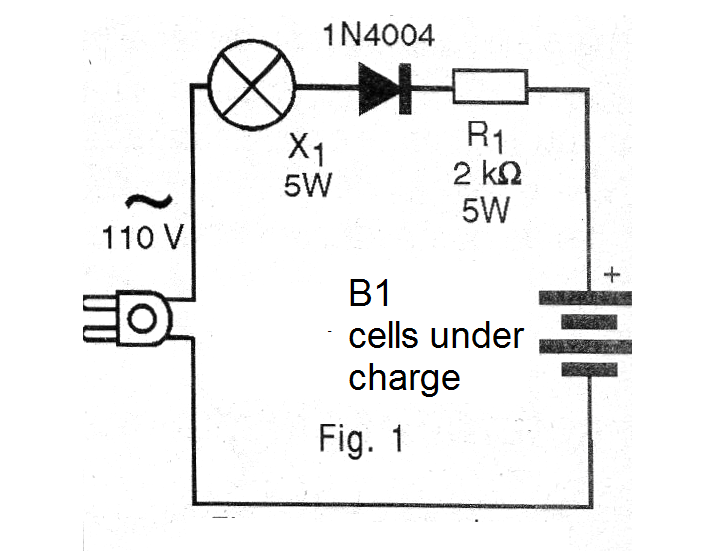
The circuit is the most economical because it does not use a transformer since the voltage reduction is made by a 5 to 15 watt incandescent lamp for the 110 V network, which also acts as a current limiting device.
The rectification is done by a diode 1N4004 and the final reduction by a resistor (R1) that can have its value changed according to the types of batteries or batteries that must be recharged.
We can charge from 1 to 4 small, medium or large batteries with this unit, for times between 5 and 16 hours, according to the manufacturer's recommendation.
The reader can use your multimeter to check the actual charge current depending on the tolerances of the components and adjust R1 to get the current you need for the specific type of batteries you use.
The polarity of the connection of the diode and the battery holder is essential for proper operation of the device.
By connecting two 4-cell batteries in series, we can charge up to 8 small, medium or large batteries.
In figure 1 we have the complete diagram of the charger.
In figure 2 we have the actual arrangement of the components for this assembly.
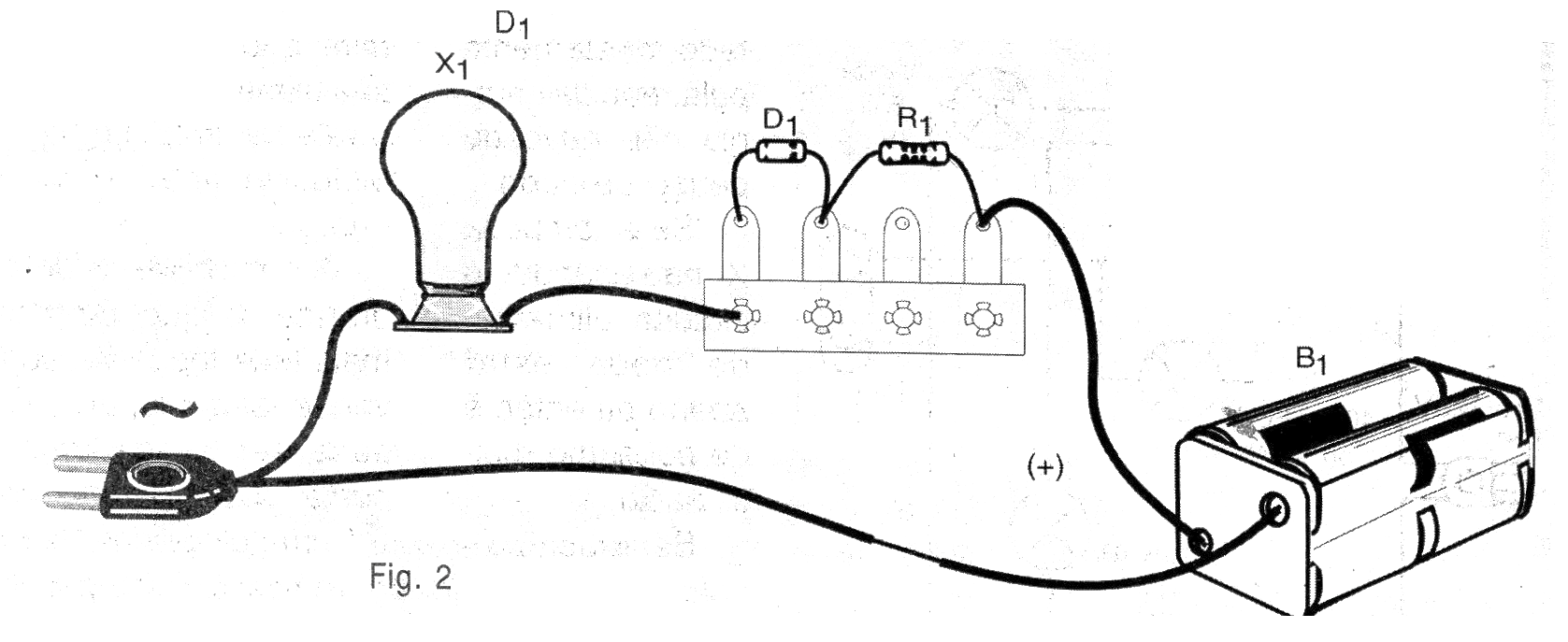
Of course, the components should not be exposed to an accidental touch that would cause dangerous shocks, since we have the direct connection in the power network.
The assembly must be enclosed in a closed plastic box.
First place the batteries you want to charge into the cradle and then plug the power cord into the cradle.
If a charge is present (batteries) the lamp should light up.
If the lamp does not light, turn off the power and set the batteries in the cradle as they may be in poor contact.
Never touch the stand or the batteries with the unit switched on, as you may experience a strong shock.
The brightness of the lamp should be slightly less than normal throughout the charge.
If any battery in the recharging process does not store energy, it is a sign that it may be damaged.
Do not use it in conjunction with the ones that are in good condition.
PARTS LIST
D1 - 1N4004 or equivalent - silicon diode
X1 - 5 watts at 15 watts x 110 V - common lamp
R1 - 2k or 2.2k ohms x 5 watts - wire resistor
B1 - Batteries to be recharged - see text
Miscellaneous - Battery holder, terminal bridge, lamp socket, power cable, mounting box, wires, solder, etc.


