
This small transmitter can operate in frequencies between 3 and 7 MHz, emitting telegraph signals for practicing Mos code or even communications at short and medium distances. The circuit can be powered with voltages from 3 to 9 V and, depending on the antenna, its range may exceed a few hundred meters. This is an experimental set-up for those who study or enjoy radio transmission.
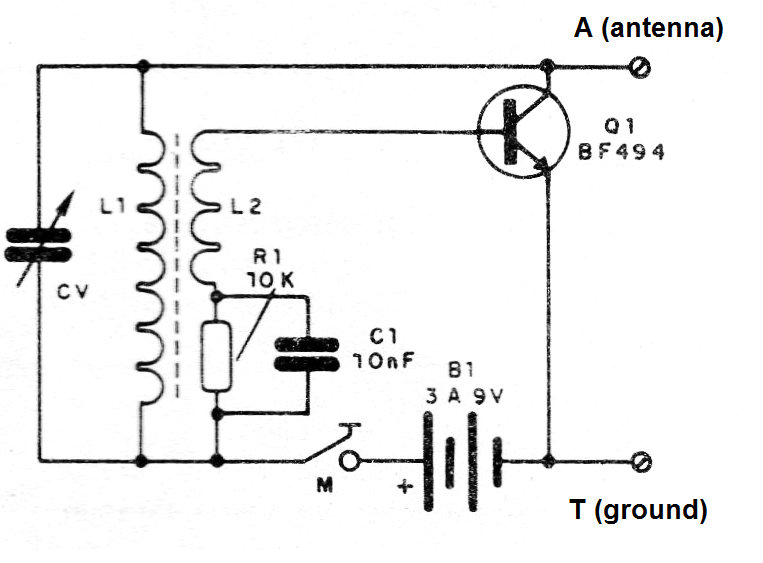
As we can see from the diagram, we have an oscillator with transistor BF494 or equivalent as 2N2218, for greater reach. The basic resistor must be obtained experimentally between 2k2 and 10k, choosing which results in better performance.
In figure 1 we have the complete diagram of the transmitter.
The assembly can be carried out experimentally in a solderless board or still in terminal strip. For the strip of terminals we have the arrangement of the components in figure 2.
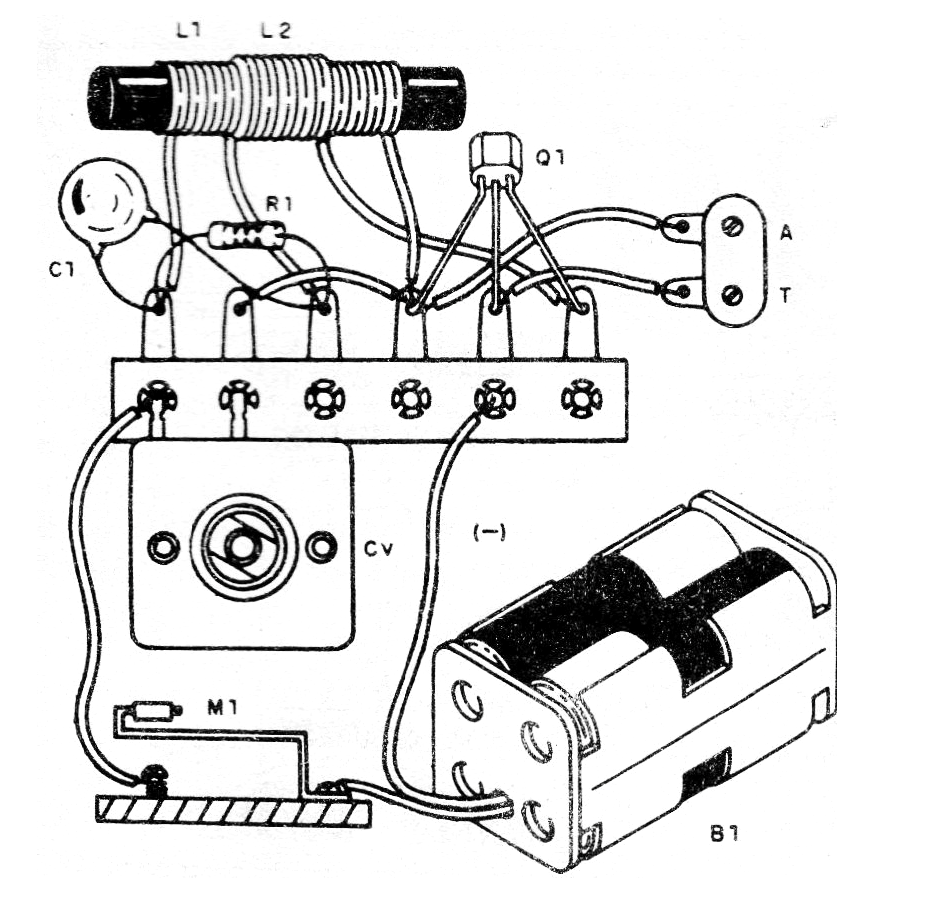
The coils shall be wound on a ferrite rod 1 cm in diameter and 10-30 cm long as follows:
L1- 30 turns of enamelled wire 28 AWG
L2 - 10 turns of the same wire on L1
The ends of the windings should be scraped weld points. If the circuit does not work on the first attempt, reverse the connections of one of the coils.
Power can be supplied with batteries or power supply. We do not recommend the use of a 9 V battery, since the consumption is high for this type of source, causing its rapid wear.
The transistor can be the BF494 or even RF and medium power equivalents like BD135, 2N2222, etc.
The manipulator can be manufactured with two metal plugs that must be touched when we push the button. The antenna can be a stretched wire whose length can vary between 1 and 20 meters. A earthing will greatly increase the yield.
To experiment with and operate the unit, connect a shortwave radio nearby, tuning in some free frequency between 3 and 7 MHz. Set CV, a transistorized radio variable, until you pick up the signal. To operate, use the Morse Code (see website).
Material list
Q1 - BF494 - RF NPN transistor
M1- Manipulator
L1, L2 - Coils - see text
R1- 10 k ohm- resistor - brown, black, orange
CV - variable radio wave capacitor
C1- 10 nF- ceramic capacitor
B1 - 3 to 9 V - source or batteries
Miscellaneous: battery holder, ferrite stick, antenna, terminal strip, wires, solder, etc.


