
We describe a simple experimental generator that can produce some volts for feeding small devices from the wind force. Simply position the generator with propeller where the wind drive occurs and then pull the wires to power the desired device. This is a project recommendedd for STEMers.
The voltage depends on the characteristics of the motor used and the current of the wind intensity. The generator is nothing more than a small DC motor, that is, a battery motor of the type that uses permanent magnets.
Just as such motors operate by converting electrical energy into mechanical energy, that is, motion, they also operate in the inverter mode, as generators. In this case, forcing its coil to cut the lines of force of the magnetic field of the magnets inside it, a voltage is generated that can be used in an external circuit.
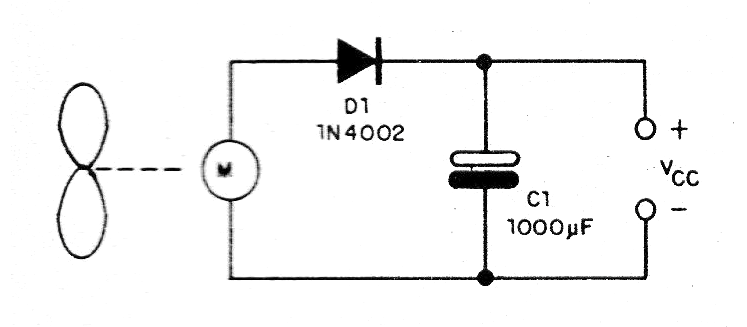
Since the voltage is pulsating and its polarity depends on the direction of rotation of the motor, we add a diode and a capacitor to the design.
The purpose of the diode is to prevent the discharge of the capacitor in case of system shutdown and the capacitor acts as a filter making the output voltage more stable.
Assembly
In figure 1 we have the complete diagram of the generator.
In Figure 2 we have the assembly aspect.
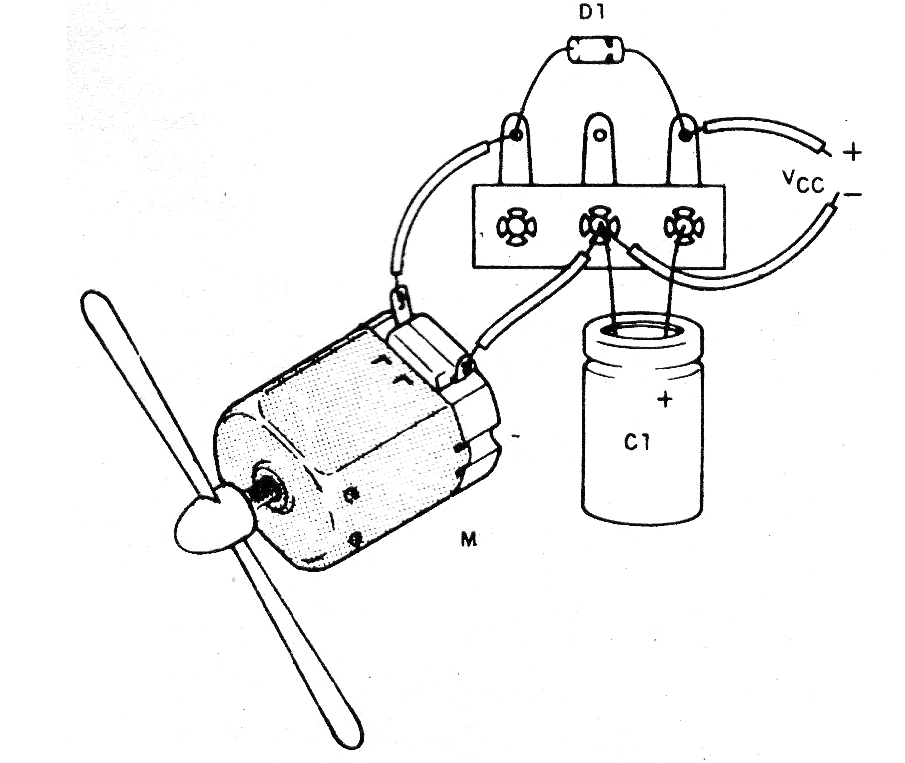
We suggest that the propeller be of the wide blade type as found in windlasses. The diode may be the 1N4002 or higher voltage equivalent. The capacitor must have a working voltage of at least 16 V.
Proof and Use
For the test, simply plug a multimeter or even an LED with a series resistor into the output and rotate the propeller. Put the generator in front of a fan to try.
Check the direction of rotation that results in correct output polarity, by reversing the motor connections, if necessary. If you get a good wind yield, you can power small lamps or sets of LEDs.
Material list
M- small DC motor from 3 to 12 V
C1- 1000 uF x 16 V - electrolytic capacitor
D1- 1N4002 - silicon diode
Miscellaneous: propeller, terminal strip, wires, solder, etc.


