
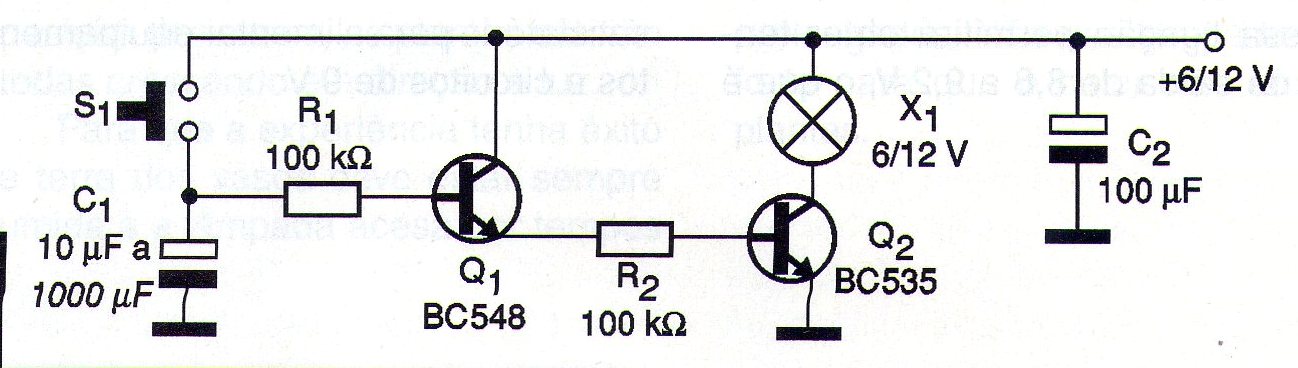
The simple timed light we present can be used in the car, in the home and in many other applications. When we tap S1, a common pressure switch, capacitor C1 charges and thus transistor Q1 is biased.
Similarly, with the conduction of Q1, Q2, saturated and the lamp X1 lights up. By releasing S1, the charge of the capacitor flows slowly through R1 and the base of Q1, thus keeping the transistor in conduction and therefore also Q2 for a certain time.
The lamp then remains on for a time which basically depends on the value of C1.
We can install this unit in the car so that even after the door is closed, the courtesy light stays on for a certain time, then automatically turns off.
The circuit can be powered by voltages from 6 to 12 volts depending on the lamp which can also have currents up to 500 mA. For currents above 100 mA, transistor Q2 needs a metal plate screwed into its body to serve as a heat radiator.
The time the lamp stays on depends on C1 which can have values between 10 and 1000 uF. Higher values mean longer times, reaching a few minutes with the maximum indicated. In figure 1 we have the complete diagram of the apparatus.
In figure 2 we have the arrangement of the components on a terminal bridge.
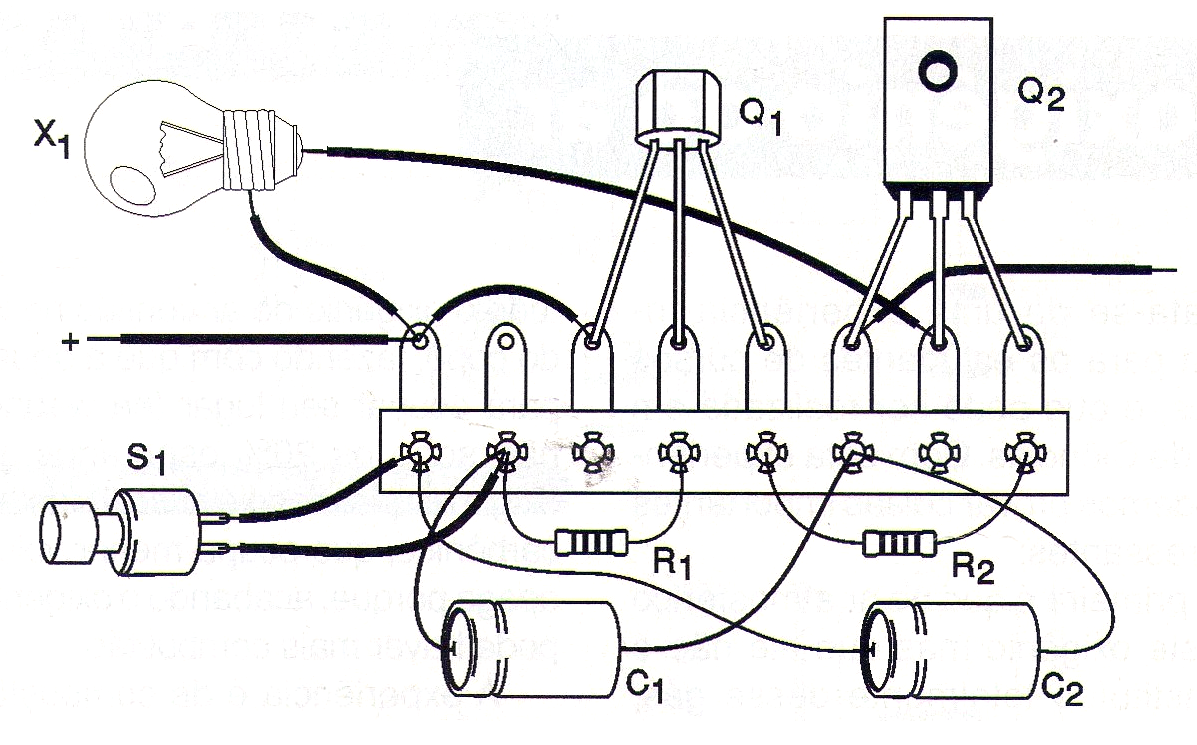
Of course, the assembly on a printed circuit board is more compact.
The transistors allow equivalents and the resistors are all 1 / 8W. Electrolytic capacitors should have voltages slightly higher than those used in the power supply.
The pressure switch is a "buzzer button" type and can be kept away from the unit for remote operation.
The current consumed drops almost to zero after some time the lamp goes off completely. The lamp wire may also be long.
To test the device, simply connect it to a power supply, observing the polarity of the wires and then pressing S1.
The lamp should light up and remain so for a time that will depend on the value C1. At the end of the timing, the lamp does not switch off suddenly but slowly, with a reduction of brightness up to zero.
Once the operation is confirmed, it is only necessary to install the appliance definitively.
MATERIAL LIST
Semiconductors:
Q1 - BC547 or BC548 - NPN general purpose transistor
Q2 - BD135 - NPN power transistor
Resistors: (1/8 W, 5%)
R1 - 100 k ohms - brown, black, yellow
R2 - 100 ohms - brown, black, brown
Capacitors:
C1 - 10 to 1000 uF - electrolytic - see text
C2 - 100 uF - electrolytic
Miscellaneous:
S1 - Pressure switch
X1 - 6 or 12 V 50 to 500 mA lamp
Terminal bridge, heat radiator for Q2, wires, mounting box, solder, etc.


