
Here is an experimental set up that is indicated as a science work, for demonstrations or even for the reader who wants to experiment with high voltage using batteries without the danger presented by connected equipment in the power grid.
A transformer coupled to a vibrator can raise the voltage of one or more cells to the point of "good shocks," though harmless. The voltage actually reaches more than 400 volts in some cases, but as the current is very low, the danger is minimal.
We observe that what is dangerous in a shock is the intensity of the current (intensity) that circulates through the person's body and which causes damage to the nervous system, paralyzing muscles, including the heart.
Tension is simply the cause of the current. A high voltage causes a high current only if the circuit can provide this current.
In the case of the power network, the shock is dangerous because the network has a very high current supply capacity, and therefore can circulate as much current as requested by the "body" subjected to the discharge. In the case of a battery-powered or current-limiting circuit (a high-value resistor), the shock is not dangerous because the current may be limited.
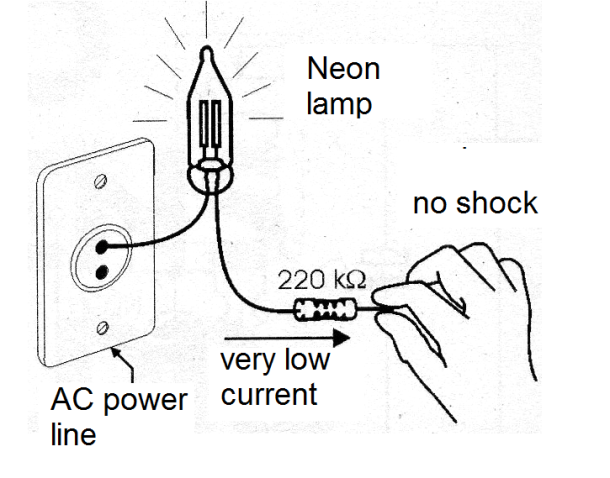
This is the case of a neon lamp connected to the power grid with a 220 k ohm or more resistor. The current through the lamp is limited by the resistor and is so small that you can walk through it without feeling anything at all. The current is too small to excite your nerves. Figure 1 shows what happens.
In our circuit, the production of high voltage is done with the help of a vibrator and a transformer. Although we have enough current to produce an unpleasant shock, it is not dangerous, but the device should be used sparingly.
HOW IT WORKS
A transformer can only change a voltage (and also a current) if it operates with alternating current or pulsating direct current, that is, that it undergoes rapid variations of intensity.
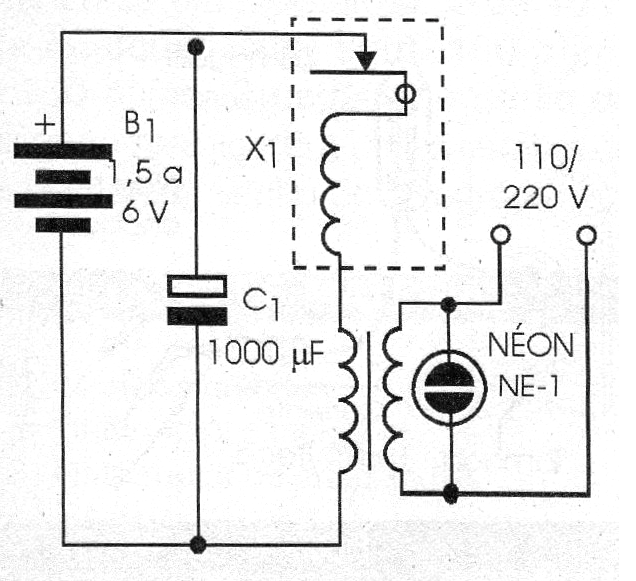
Since batteries provide pure continuous currents, we use a vibrator, an electromechanical device that quickly turns the chain on and off to make it pulsing.
A vibrator is constructed in a rudimentary way with enameled wires, nails, boards and pieces of tin, not having difficulties for its elaboration.
The nail with rolled wire forms an electro-magnet, which attracts the can in its vicinity, which switches the current into vibration.
The vibrator current passes through the low voltage winding of the transformer, thereby inducing high voltage in the other winding. This high voltage is not actually the voltage specified for the used transformer, which is 110 V or 220 V. The high voltage depends on the switching characteristics of the vibrator and can vary greatly from 80 V to more than 300 V.
ASSEMBLY
In figure 2 we have the diagram of the apparatus.
In figure 3 we have the aspect of the vibrator. Note that the electromagnet is obtained by wrapping 200 to 500 turns of fine enamelled wire on a nail or bolt that must be attached to the wooden base.
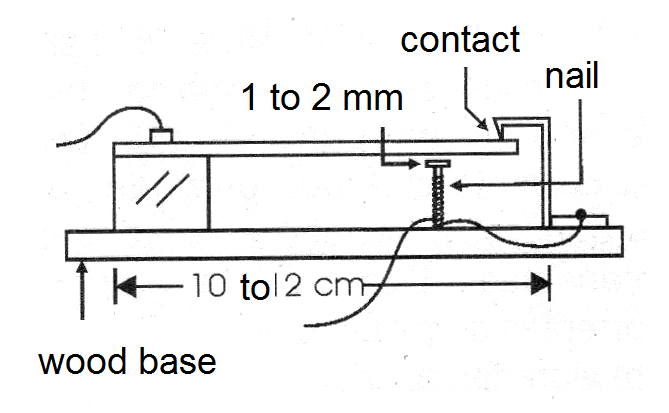
The plates that are close to the electromagnet should have all of the ink scraped off so there may be perfect electrical contact. The welding points are all indicated and for the enameled wires we must scrape them in the place where they must be welded, otherwise the weld does not adhere.
Capacitor C1, which is connected to the circuit, serves to aid in switching and its value can be between 100 uF and 1 000 uF. In figure 4 we have the final appearance of the assembly.
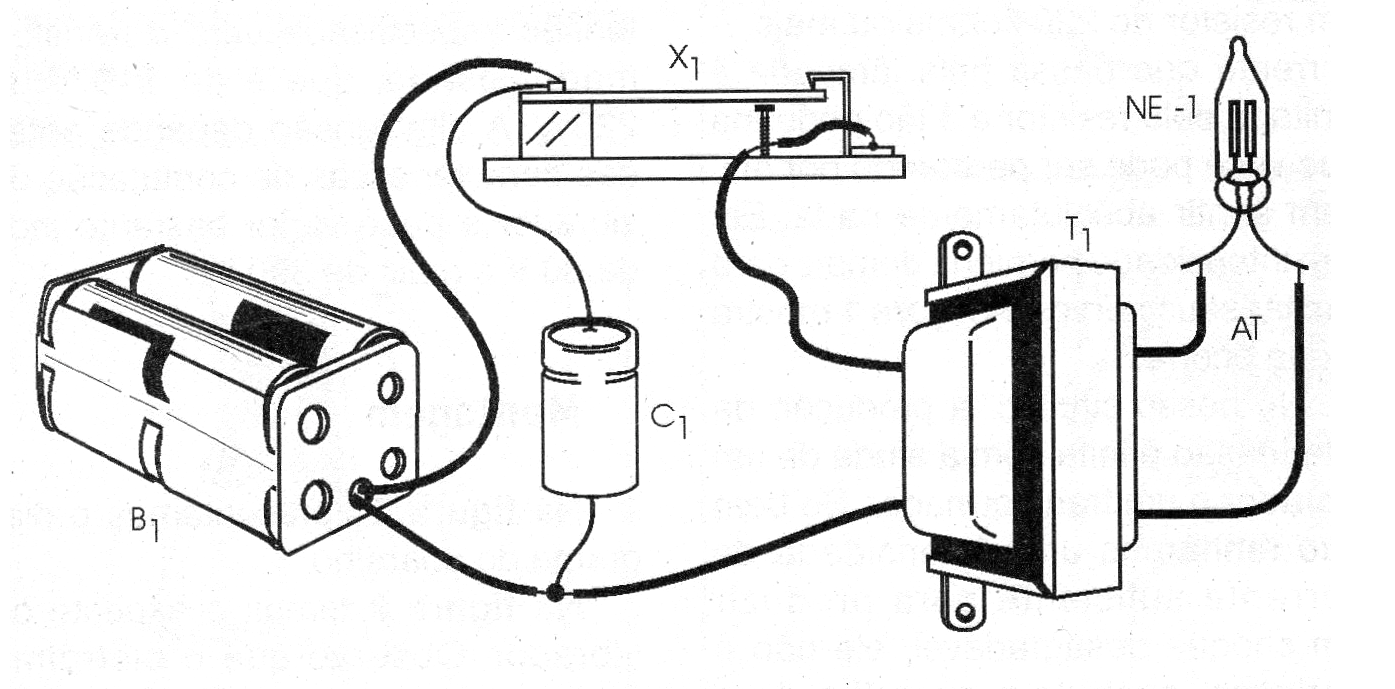
For batteries it is convenient to use a holder. The unit will run from 1 to 4 medium or large batteries. We do not recommend the use of small batteries, since the required current would cause them to run out quickly.
The transformer used may be of any type having a primary winding of 110 V or 220 V and secondary of 5 to 12 volts current in the range of 100 mA to 500 mA.
Test and Use
To check if we have really high voltage it is not interesting to hold directly on the transformer wires as the experience can be unpleasant. We recommend that a neon lamp be connected, as shown in figure 5.
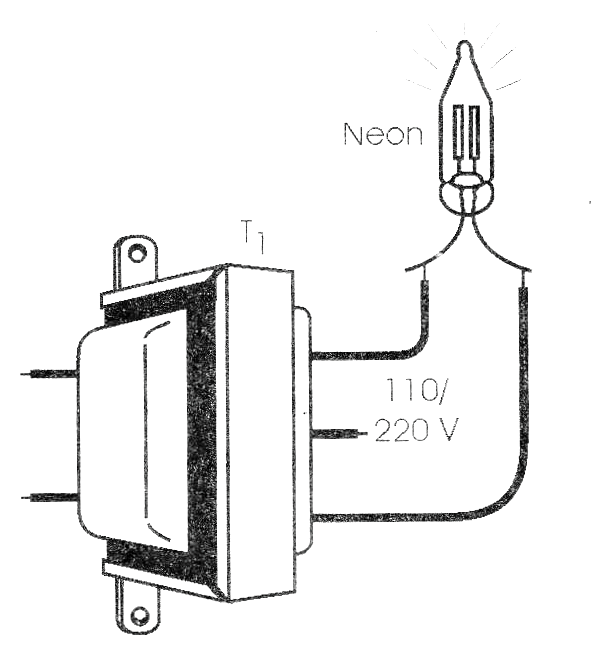
Turning on the unit, we must adjust the cans so that the vibration occurs automatically. When this happens, the appliance should already produce high voltage and the neon lamp should light up.
Once illuminated, the intensity of the light will correspond to the efficiency of the appliance.
By removing the lamp, the reader can "try" to hold the A and B wires, touching them very carefully.
To electrify an object, simply connect the wire A in this object and wire B to earth, in a water pipe or any large metal object.
It is not advisable to leave the appliance switched on for an extended period of time, since both the batteries and the electromagnet can overheat. The device should be demonstrated and used at short intervals.
MATERIAL LIST
X1 - Vibrator - view text
C1 - 100 uFto 1000 uF / 16 V - electrolytic capacitor
T1 - Transformer with primary 110 V or 220 V and secondary from 5 to 12 V with current from 100 mA to 500 mA
B1 - 1 to 4 medium or large batteries
NE-1 - common neon lamp
Miscellaneous: wires, battery holder, material for mounting the vibrator, etc.


