This experimental oscillator produces signals in the medium wave range (MW) between 550 kHz and 1600 kHz, and can be picked up in any common radios for this range. The range, of course, is small, on the order of 2 to 3 meters without antenna at most, but allows its use through walls and other obstacles. The power is made with two small batteries but it works with up to 4 batteries.
The signal is not modulated so that what is picked up on the radio is a high frequency carrier that results in the loudspeaker in a sort of "blow".
For the transmission of coded messages, S1 can be replaced by a handler. In this case, the signals will be encoded in Morse.
Placed in a small box, it becomes a pocket transmitter for short distance transmissions, or a signal generator for radio calibration.
Assembly
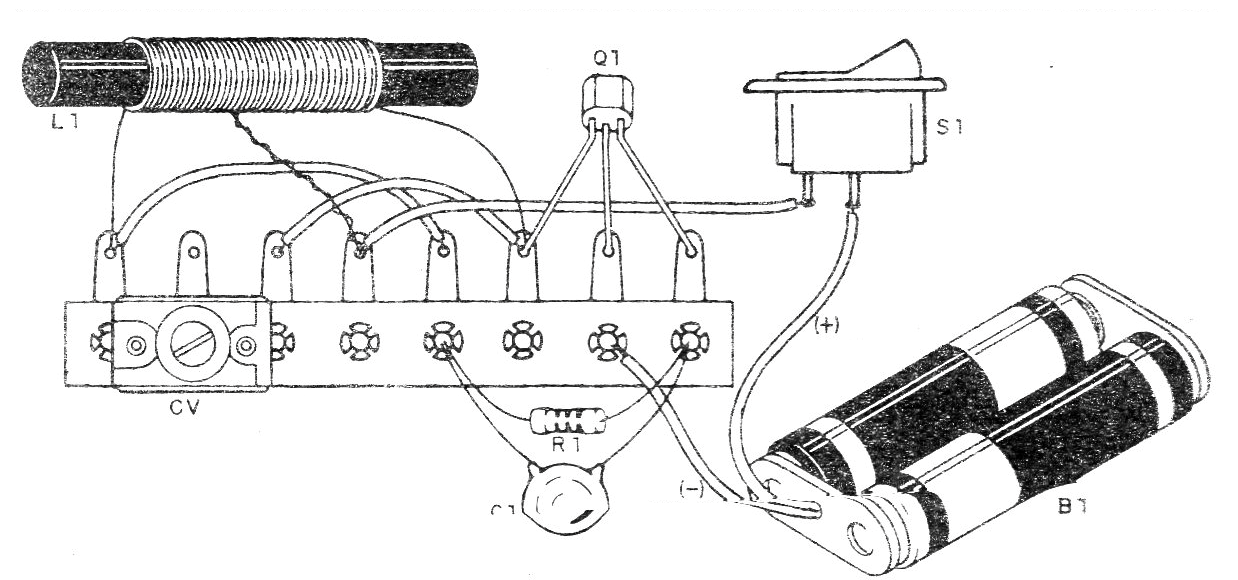
In figure 1 we have the complete diagram of the apparatus and in figure 2 we have the assembly made using a terminal strip.
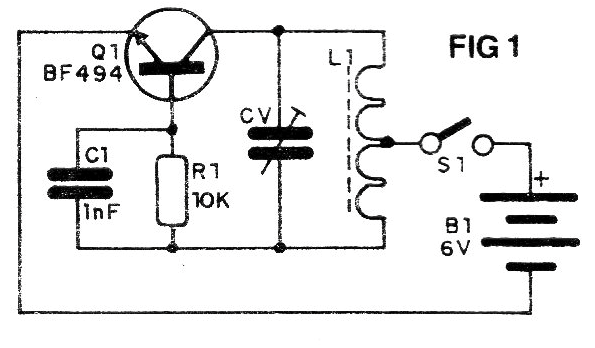
The coil L1 is wound on a ferrite rod 10 to 25 cm in length and 5 to 10 mm in diameter. This coil consists of 50 + 50 turns of 28 AWG enamelled wire.
The capacitor C1 must be ceramic and its value is not critical and may have values between 1 and 10 nF. The Cv capacitor can be a common trimmer or a variable obtained from an out-of-use transistor radiant.