
Here is a very simple experimental setup that generates high voltages from a common battery. These tensions serve for the excitement of nerves (shock machine), which will be interesting in demonstrations in classrooms, fairs and events or even as a joke.Recommended for SETEMers.
The principle of operation is simple: a battery does not provide enough voltage to produce shock, because this voltage can not overcome the resistance of the skin with the production of a current capable of exciting the nerves.
What we do then is pass this current through the primary winding of a transformer which can raise the voltage to 100 V or more, which is enough to overcome resistance of the skin, thus causing shock.
Since the transformer does not work with pure direct current, we use a file, in which we wipe a wire in order to interrupt the current quickly, thus obtaining a pulsating continuous current. This current can pass through the transformer, leading to the desired effects.
Assembly
In figure 1 we have the complete diagram of the apparatus and in figure 2 the aspect of the assembly.
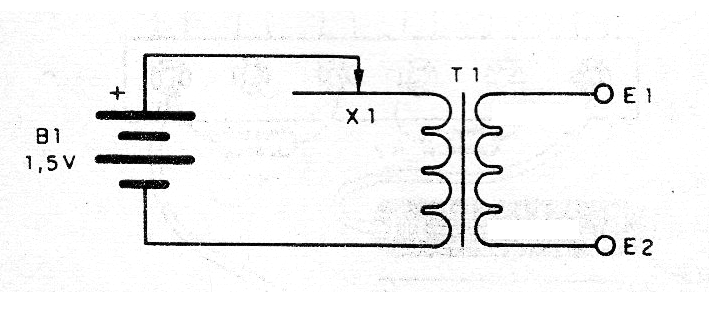
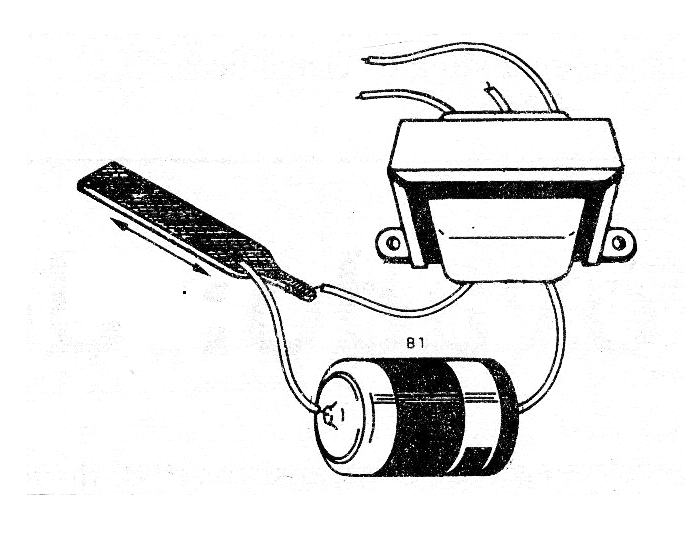
The transformer can be of the type used in old valves or even in small primary power supplies of 110 V or 220 V and secondary of 5 to 12 V with current of 250 to 300 mA. The low voltage winding will be wired to the battery.
The stack should be medium or large so we have a good current and the file can be of any type. The wire should be well scraped to make good contact at the connection points.
To test the device, touch your fingers on the high voltage terminals of the wire, holding them apart and rub the wire into the file. Remember that the shock only occurs when the wire is scraped. Keeping the cord down, the battery discharges and there is no shock.
By plugging a neon or fluorescent bulb into the transformer outlet they will blink when we scrape the wire into the file.
Material list
B1- 1,5 V - medium or large battery
T1- Transformer - see text
X1- Lima
Miscellaneous: wires, solder, etc.


