
Mosquitos and insects of the same group, or called by another name according to the region of the country, do not seem to support continuous sounds of certain frequencies. This is based on the operation of electronic repellents.
They consist of small audio oscillators that generate continuous high pitched sounds of small intensity.
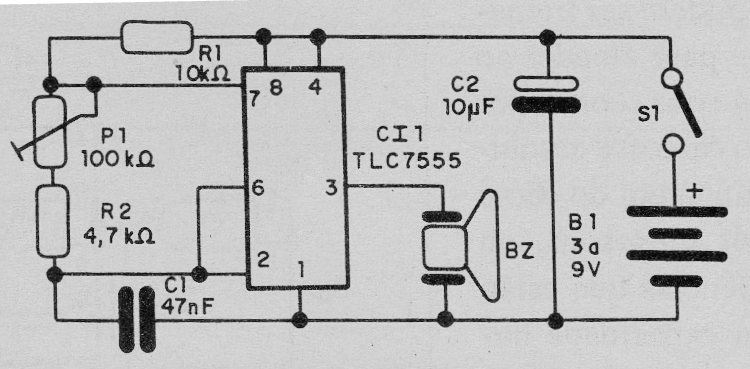
The circuit we are describing does just that. Using a low-power integrated circuit it can be powered with voltages from 3 to 9 V, ie 2 to 4 batteries or battery.
Even when used continuously, the batteries will have good durability.
Mounted on a compact unit it can be transported and used with ease. In figure 1 we have its circuit.
In figure 2 we have the arrangement of the components on a printed circuit board.
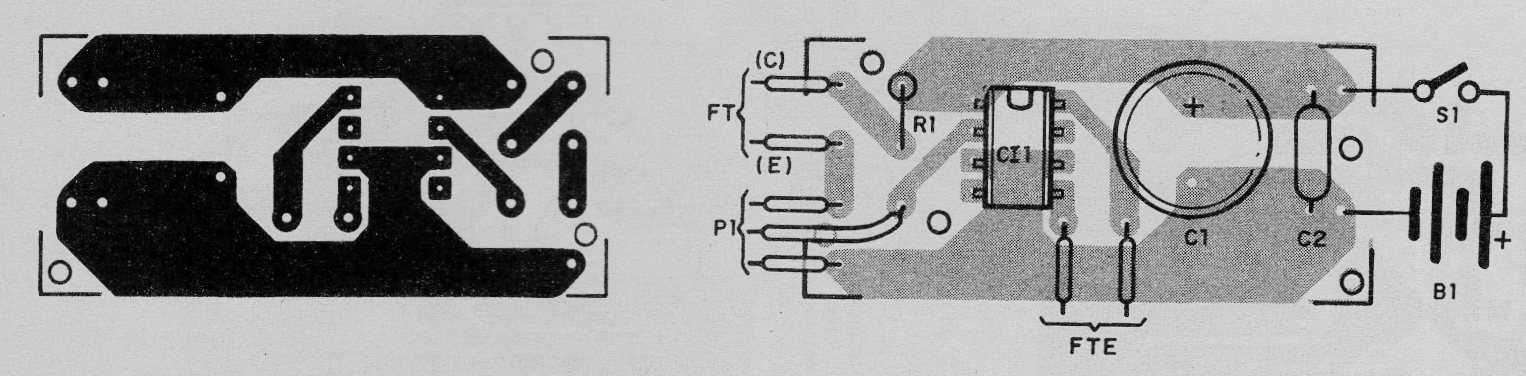
The TLC7555 integrated circuit consists of the 555 low-power CMOS version. A common 555 can be used, but the consumption will be slightly higher.
The transducer is a piezoelectric capsule or a crystal earphone. These transducers have a higher throughput at a frequency around 5 kHz. Make the adjustment to get close to the maximum point.
The other components are common. Once assembled, it is only to connect and experimentally find the frequency that gives better results with the insects that afflict it.
Material list:
CI-1 - TLC7555 or equivalent - integrated circuit
R1- 10k ohm x 1/8 W- resistor - brown, black, orange
R2- 4.7 k ohm x 1/8 W- resistor - yellow, violet, red
P1-100k - trimpot
C1- 47 nF- ceramic or polyester capacitance
C2 - 10 uF - electrolytic for 12 V or more
S1- On/Off switch
BZ - Piezoelectric transducer
B1- 3 to 9 V - batteries or battery
Miscellaneous:
Printed circuit board, battery holder or battery connector, mounting box, wires, solder, etc.


