
This circuit generates a high voltage alternating able to provoke the sensation of shock, this from common piles.
The intensity of the shock can be adjusted both as a function of its frequency and the voltage itself using two potentiometers.
Even though it is powered by batteries and therefore harmless, the sensation of the shock produced is quite unpleasant at the maximum intensity set.
We can use it, among other things, as a generator of stimuli in biology laboratories.
Basically what we have is an inverter that, through a transformer, raises the voltage of medium or large batteries to a value that exceeds 100 V, even reaching close to 400 V.
The low output current of the circuit prevents the device from being dangerous, although its use must be done with great care, moderation and especially by experienced people, like any device with similar aims.
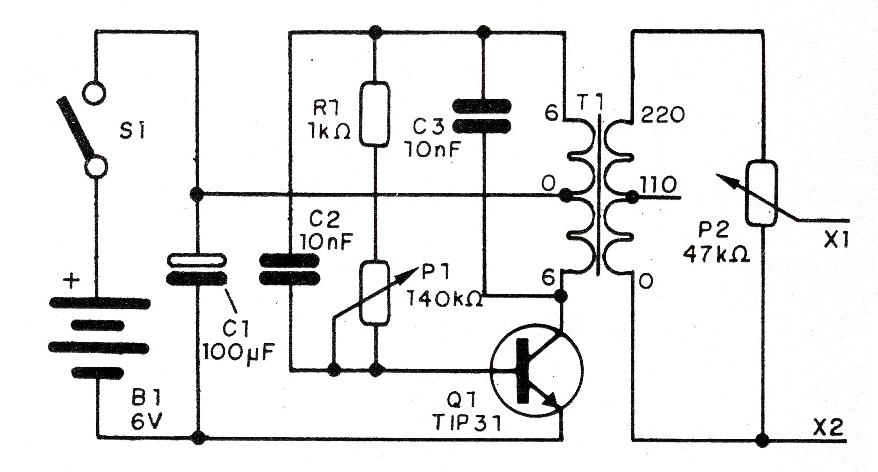
In figure 1 we have the complete diagram of the apparatus.
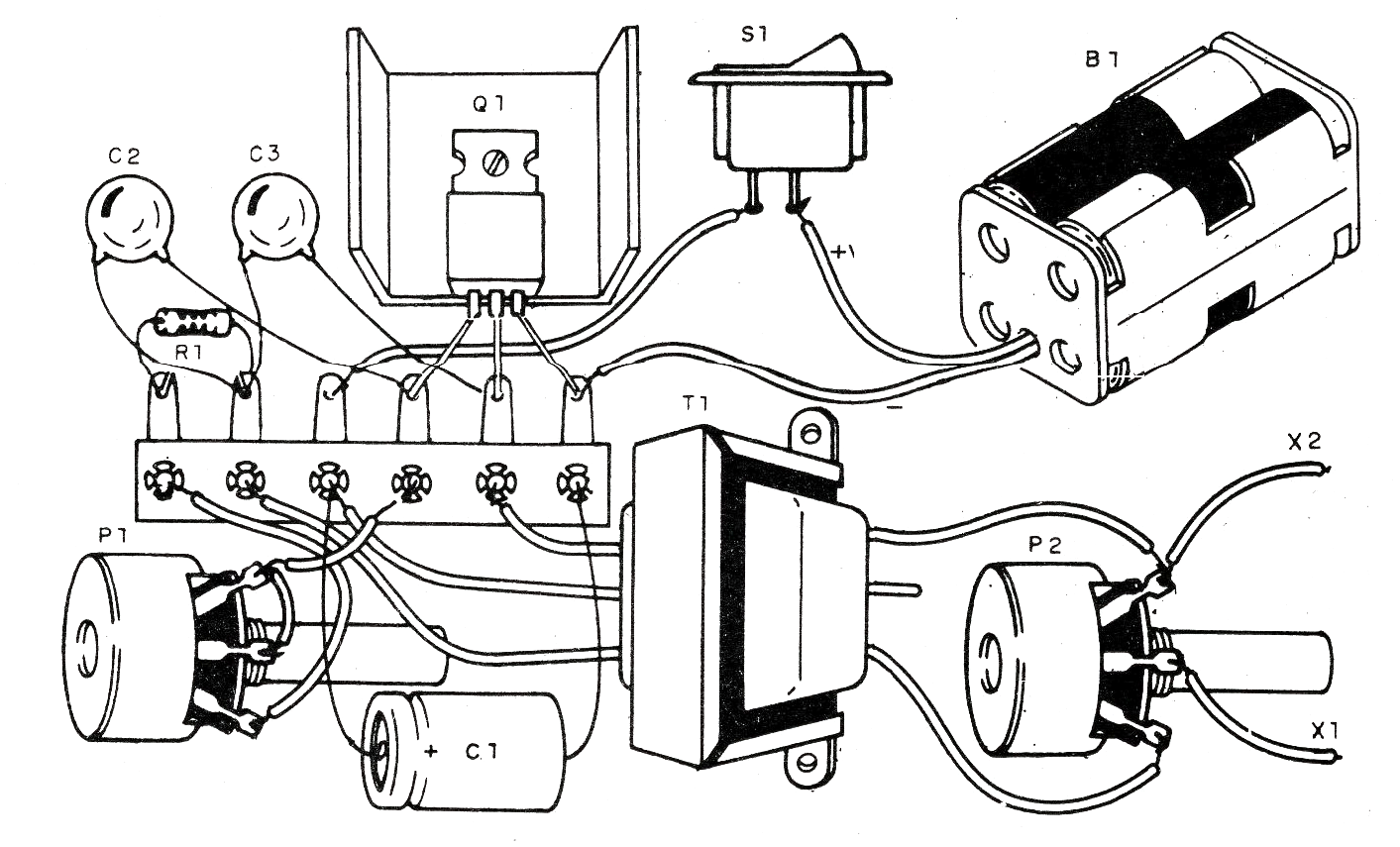
In figure 2 the assembly is made based on a terminal strip.
The transformer is common with primary supply of 110-220 V (determining the output voltage) and secondary of 6 + 6 V with currents of 200 to 500 mA.
The resistor is 1/8 W and the capacitors are of any type. The transistor must be provided with a small heat radiator. The electrodes X1 and X2 are spent batteries with scraped paint or metal tubes.
These electrodes must be safe by the person receiving the stimuli. To use the unit, set P2 to the minimum resistance position and turn S1 on. Then adjust P1 and P2 to shock at the desired intensity.
Material list
Q1 - TIP31 - NPN power transistor
T1 - Transformer - see text
X1, X2 - Electrodes - see text
S1- Single switch
B1 - 6 V- 4 medium or large batteries
P1 - 100 k ohm - potentiometer
P2 - 47 k ohm - potentiometer
R1 - 1k ohm x 1/8 W- resistor - brown, black, red
C1- 100 uF - electrolytic capacitor - 12 V or more
C2, C3-10 nF - ceramic capacitors or polyester
Miscellaneous:
Terminal block, battery holder, mounting box, heat radiator for Q1, wires, solder, buttons for potentiometers, etc.


