
If we use the old general purpose transistors BC548 and BC558 to solve a myriad of general electronics problems, they could not be missing from the audio solutions. In addition, these transistors can be found with extreme ease anywhere.
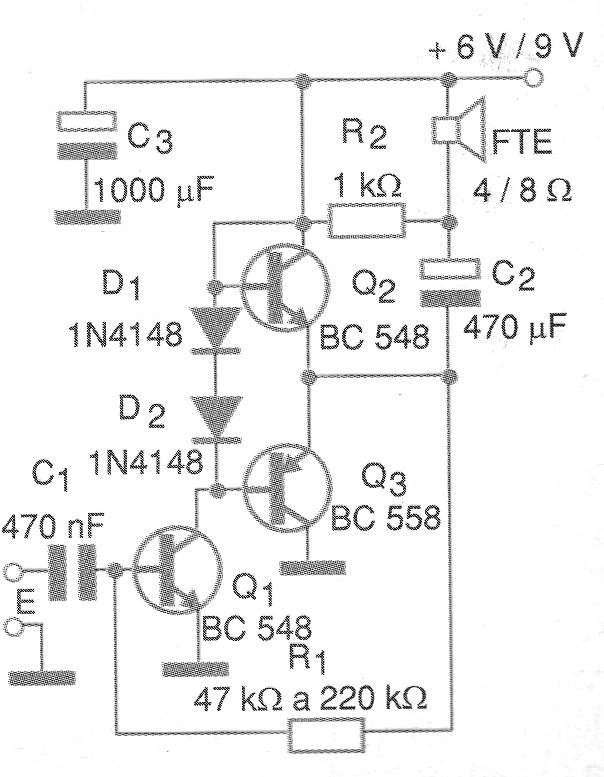
Thus, if the reader needs a small audio amplifier for a warning system an intercom, to trigger a transducer in an alarm, where the power is in the range of 20 to 200 mW, figure 1 has an interesting solution.
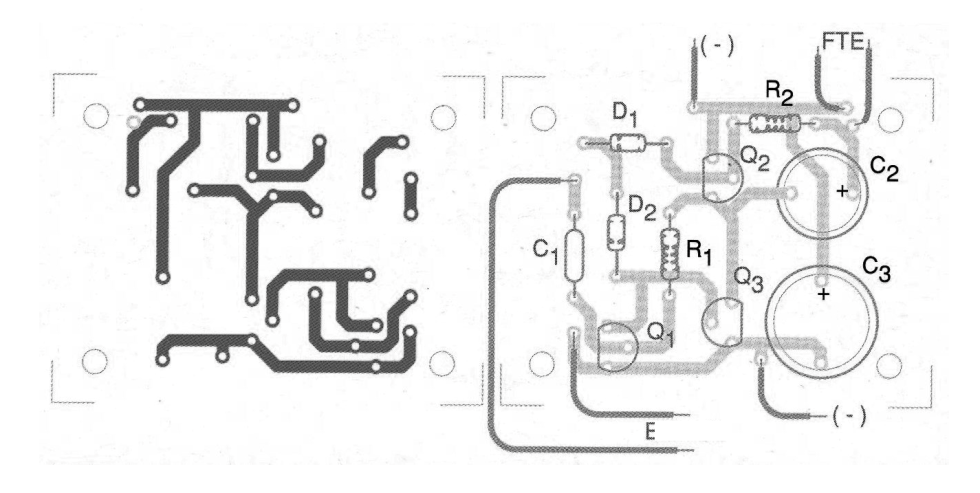
In figure 2 we have a suggestion of printed circuit board for the assembly of this amplifier.
The negative feedback resistor both determines the gain of the circuit as the resting current and the distortion, and its value must be obtained experimentally in the indicated range of values, depending on the voltage used. Because the power is small, it will not be necessary to use a heatsink on the output transistors.
Two of these amplifiers consist of an excellent PC amplifier solution or a CD player. The speakers should be of good quality to ensure good sound fidelity.
If the power supply is used, it must have excellent filtration so that snoring does not occur. The input impedance is of the order of 10 k ohms and the sensitivity of the order of 100 mV.
MATERIAL LIST
Semiconductors:
Q1, Q2 - BC548 or equivalent - general purpose NPN transistors
Q3 - BC558 or equivalent - general purpose PNP transistors
D1, D2-1N4148 - silicon diodes for general use.
Resistors: (1/8 W, 5%)
R1 - 47 k at 220 k ohm - resistor (yellow, violet, orange to red, red, yellow)
R2 - 1k ohm - brown, black, red
P1 - 10 k ohm - volume control, potentiometer (optional)
Capacitors:
C1 - 470 nF - ceramic or polyester
C2 - 470 uF x 12 V - electrolytic
C3 - 1000 uF x 12 V - electrolytic capacitor
Several:
FTE - 4 or 8 ohm - 5 to 10 cm speaker
Printed circuit board, 6 to 9 V supply, wires, solder, etc.


