
This experimental transmitter can be used in demonstrations or as school work, presenting a range that reaches more than 100 meters depending on the sensitivity of the receiver and the antenna used.
We describe the assembly of a simple Hartley RF oscillator which, connected to an antenna, transmits its signals to a nearby medium-wave radio.
The coil can be modified for short-wave transmission up to about 15 MHz.
The power supply must come from a source or large batteries, because the consumption of the circuit is somewhat high, by the power of the signal that general
L1 consists of 80 turns of wire 28 or close in a ferrite rod 1 cm in diameter and 12 to 20 cm in length.
L2 consists of 12 to 15 turns of the same wire next to L1, as shown in the figure in which we give the appearance of the assembly.
In figure 1 we have the complete diagram of the transmitter.
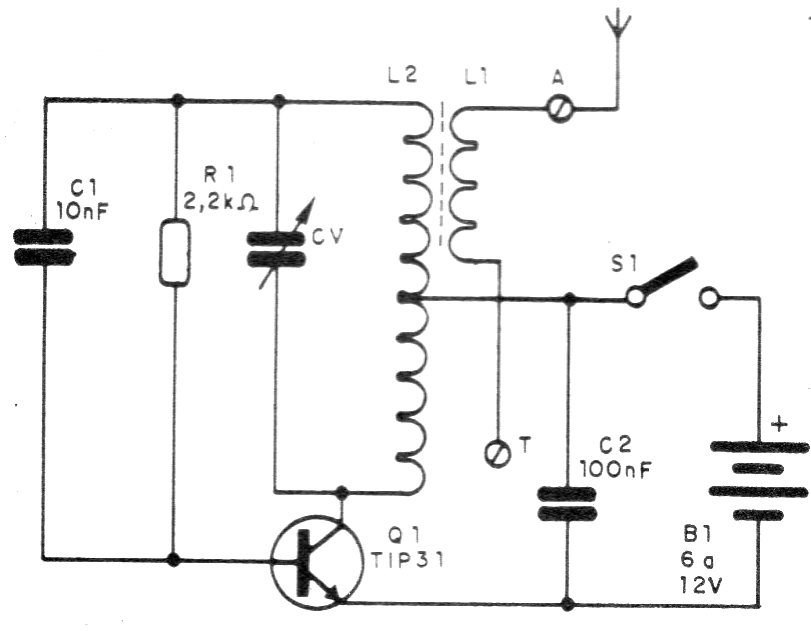
Assembly can be done on a small terminal strip, as shown in figure 2.
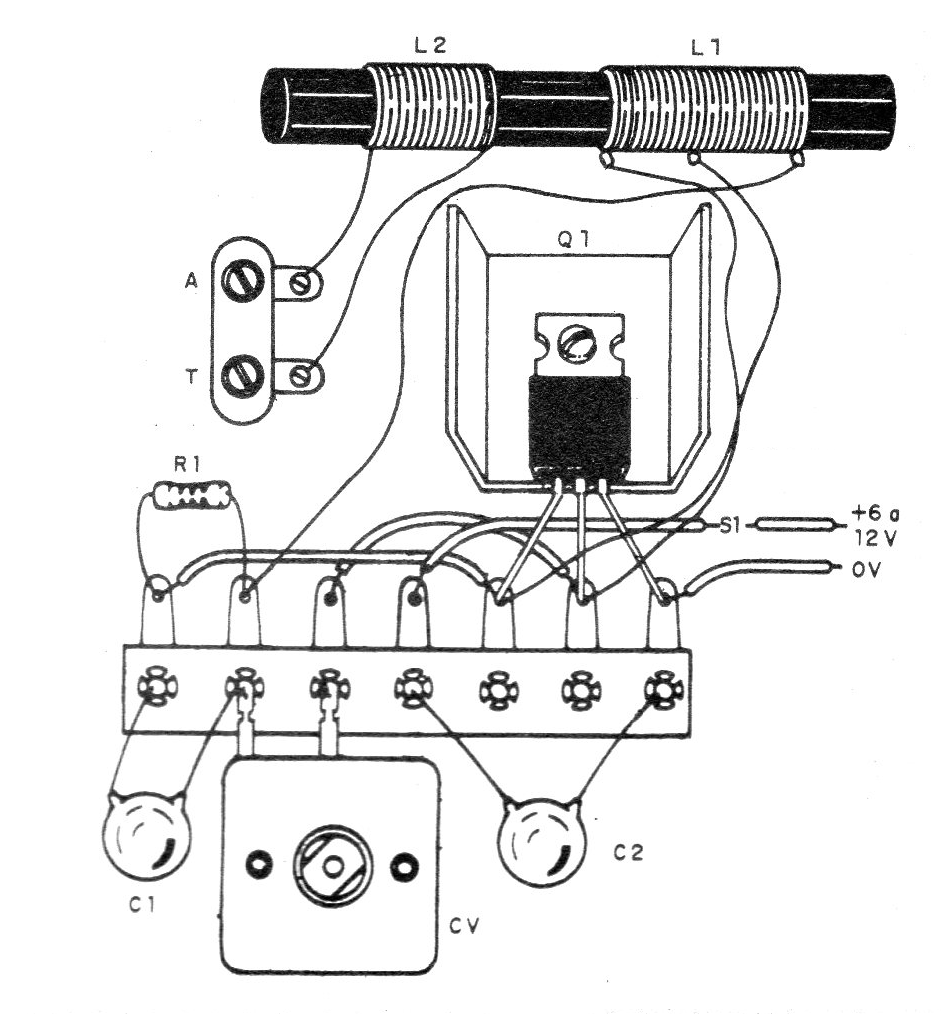
The CV capacitor can be obtained from any medium wave radio.
The antenna consists of a piece of wire stretched from 2 to 12 meters long.
The capacitors must be ceramic and the resistor is 1/8 W.
The morse key (S1) can be improvised with metal plates.
Material list
Q1 - TIP31 - NPN power transistor
L1, L2 - Coils - see text
S1 – Morse Key - see text
B1 - 6 to 12 V - source or battery
R1 - 2k2 - resistor - red, red, red
C1- 10 nF - ceramic capacitor
C2- 100 nF - ceramic capacitor
CV - variable capacitor - see text
Several:
Radiator for transistor, antenna, wires, solder, etc.


