
The circuit shown in figure 1 generates a low-frequency rectangular signal, but whose harmonics extend over a wide spectrum enabling its reception by nearby medium and short-wave receivers.
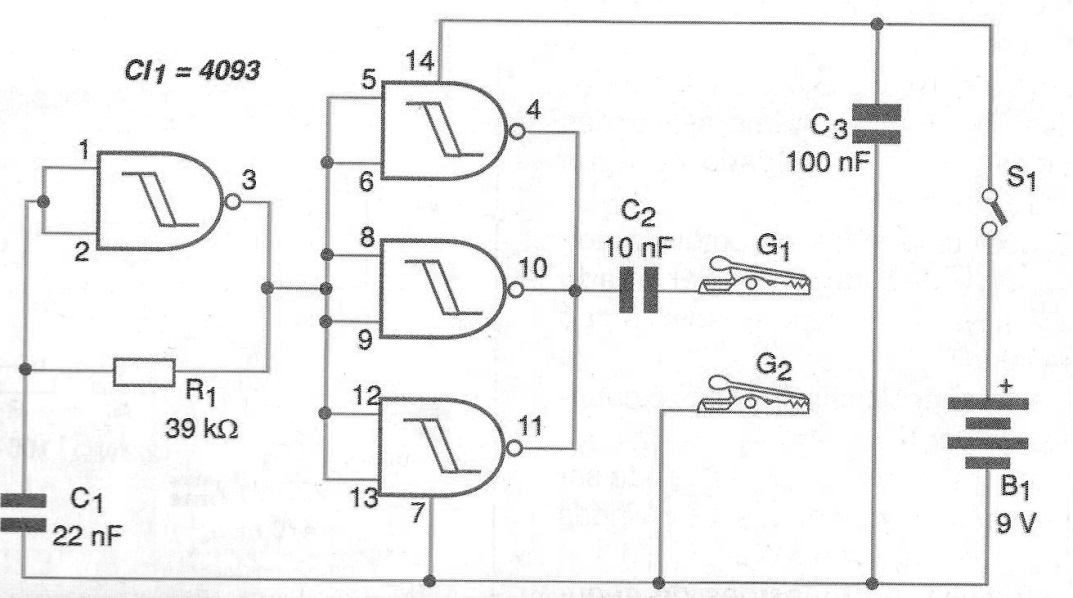
This means that by injecting the signal of this circuit into a cable, we can accompany it through its duct (provided that it is not metallic, since it acts as shielding) using as receiver a medium or short wave radios common. Simply place the receiver at a frequency free of the band where a stronger harmonic of the circuit can be tuned.
The circuit generates signals of sufficient intensity to allow detection of the cable even if it is embedded or buried at depths of up to 20 cm or more. The circuit power can be made with a 9 V battery and as its consumption is very low it will have a great durability in this application.
In figure 2 we have a printed circuit board for the assembly of this cable locator.
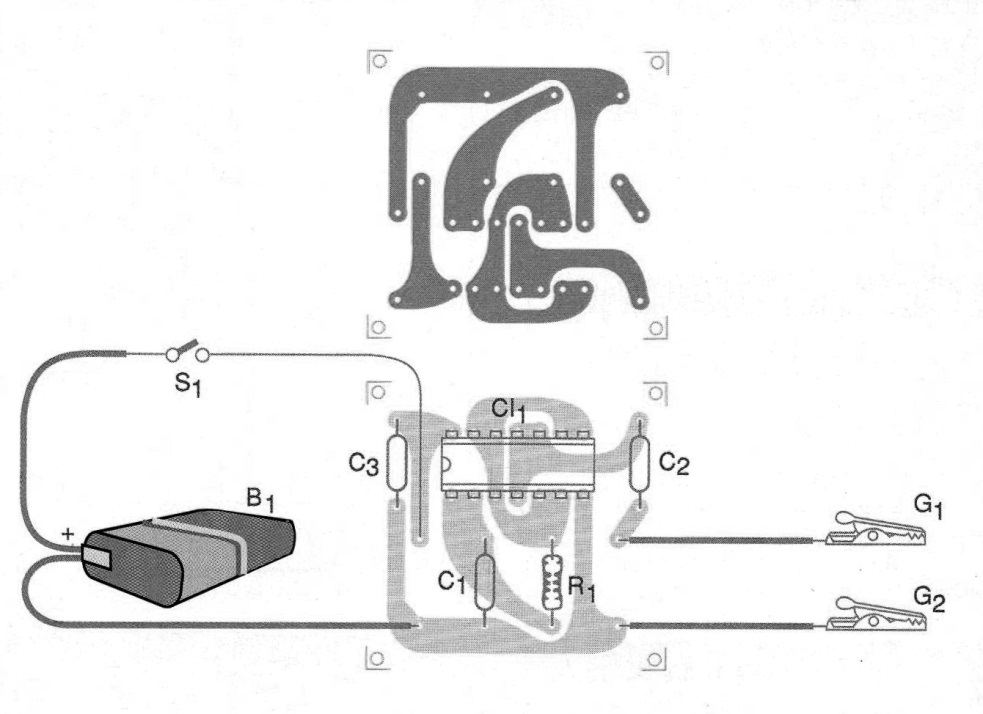
To use it, greater efficiency is achieved when one of the claws is attached to one end of the rope (the other end must be disconnected) and the other claw to a metal or earth object.
MATERIAL LIST
CI-1 - 4093 - integrated circuit
R1 - 39 k ohm x 1/8 W - resistor - orange, white, orange
C1 - 22 nF - ceramic capacitor
C2 - 10 nF - ceramic capacitor
C3 - 100 nF - ceramic capacitor
S1 – On/Off switch
B1 - 9 V - battery
G1, G2 - Common alligator claws
Several:
Printed circuit board, mounting box, battery connector, wires, solder, etc.


