
This simple circuit makes a light bulb light up when someone leans on the sensor. This sensor can be a metal plate, an object or simply the tip of a bare wire. The circuit works connected to the power grid but is totally safe with no danger of shocks. The reader can use this circuit in science fairs, demonstrations or even to trigger an alarm by touch, protecting some valuable object.
Since the current flowing through the body of the operator is very weak, you can drive a powerful light bulb plugged into the power supply without danger.
The SCR used supports loads of up to 400 watts in the 110 V network, but we do not recommend that the reader use bulbs of more than 60 watts for added safety.
The device has a sensitivity control that allows adjusting the operating point to the type of sensor used, thus avoiding erratic triggering.
Important note: although the trip is totally safe due to the very weak current flowing through the sensor, this does not mean that the device must be mounted without special care.
This is assembly attached to the power grid and the dangers always exist. If you do not practice in this type of assembly ask the help of someone more experienced.
HOW IT WORKS
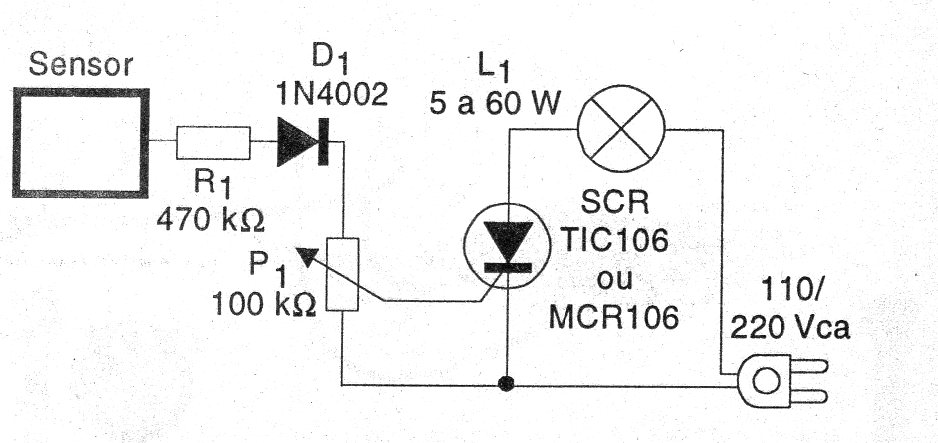
The basic element of the circuit is a SCR (Silicon Controlled Diode) consisting of a semiconductor that connects when a weak current is applied to its gate.
A chain of millionths of ampere is capable of firing it and with this the driven current can light a bulb or sound a loud bell.
In the case of TIC106 we can control intense currents with a current so weak that it can circulate through our body without being perceived, or cause any kind of shock.
This is what we do in this case: connecting a sensor to the gate, we can shoot the SCR by the simple touch of the fingers, because the current that circulates through our body is enough for that.
The resistor is intended to block any excess current, thus making the operation of the device completely safe.
ASSEMBLY
In figure 1 we have the complete diagram of the Touch Key.
Its assembly on a terminal bridge is shown in figure 2.
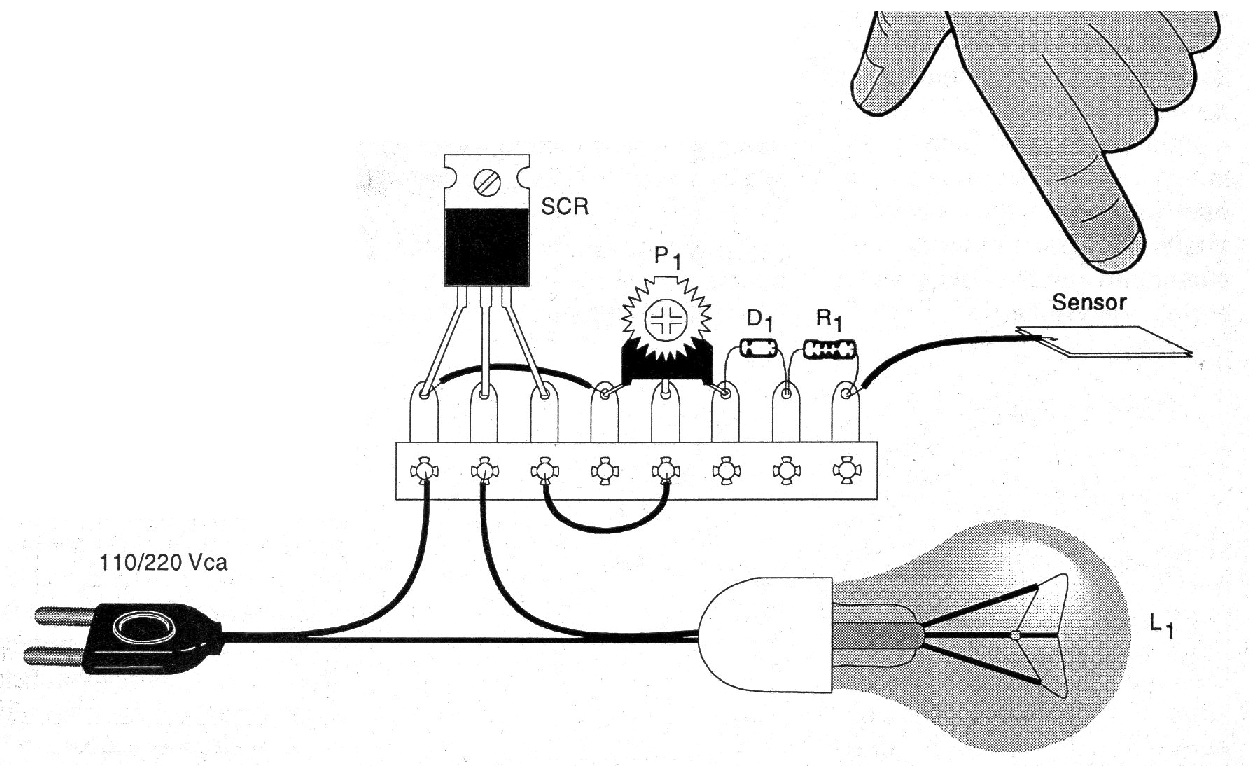
If your power network is 110 V you will need an SCR with a B suffix or 200 V or more. If it is 220 V the suffix of the SCR will be the D for 400 V or more.
If the lamp or controlled load is 40 watts or larger, it is convenient to provide the SCR with a heat exchanger, a metal plate screwed into the component.
The diode D1 may be of any general use type and the resistor R1 may actually have values between 470 k ohms and 1 M ohms.
A common potentiometer can also be used instead of the trimpot if the appliance is enclosed in a plastic box.
TEST AND USE
To prove it, simply connect the unit to the power grid and touch the sensor, adjusting the adjustment trimpot at the same time.
The wire to the sensor should not be more than 2 meters in length. Adjust P1 until the lamp lights up with the touch.
The sensor may be a 4 x 4 cm metal plate attached to a plastic or wood base.
If the lamp does not light up, reverse the position of the outlet, ie turn it clockwise. This is necessary to obtain the correct phase of the network to polarize the diode D1 in the sense of conducting the current in the direction of tripping.
We note that large metal objects can not be connected to the sensor, such as doors, cars or motorcycles, because their size causes a leakage current sufficient to trigger the circuit before anyone even touches it.
We also note that objects acting as sensors must be isolated from the ground.
If there is a tendency to experience a slight shock when touching the sensor, increase the value of R1.
WHAT TO EXPLAIN
The human body is the conductor of electricity and we are in contact with the earth. Thus, when we touch the sensor circulates a current between our body and the sensor which is enough to trigger the sensitive circuit.
Explain then how the circuit works and that it is used in many types of alarms and even household appliances.
ADDITIONAL WORKS
By replacing the bulb with a buzzer or buzzer the circuit can be used as an alarm protecting objects. If your front door is wood and the metal lock you can use the lock as a sensor. Whenever someone taps the doorbell the doorbell will ring.
MATERIAL LIST
SCR - TIC106-B (110 V) or TIC106-D (220 V) - silicon controlled diode
P1 - 100 k ohms - trimpot
R1 - 470 k ohms - resistor - yellow, violet, yellow
D1 - 1N4002 or equivalent - silicon diode
L1 - 5 to 60 watts - common lamp according to the power grid
Several:
Terminal strip, power cable, socket for the lamp, sensor, wires, solder, etc.


