
This circuit can be connected to the output amplifiers, portable radios, MP3 and other sound systems, at which time the LED will flash to the music. We can connect up to two LEDs in series, but this is not recommended due to low supply voltage.
The operating point is determined by the volume of the stereo, and no adjustment is required. You can change R1 to a higher value resistor if there is too much sensitivity.
The LED can be of any color and in its assembly must be observed its polarity. Wires A and B are connected to the handset output or to the speaker of the stereo. In Figure 1, we have the complete diagram of the device.
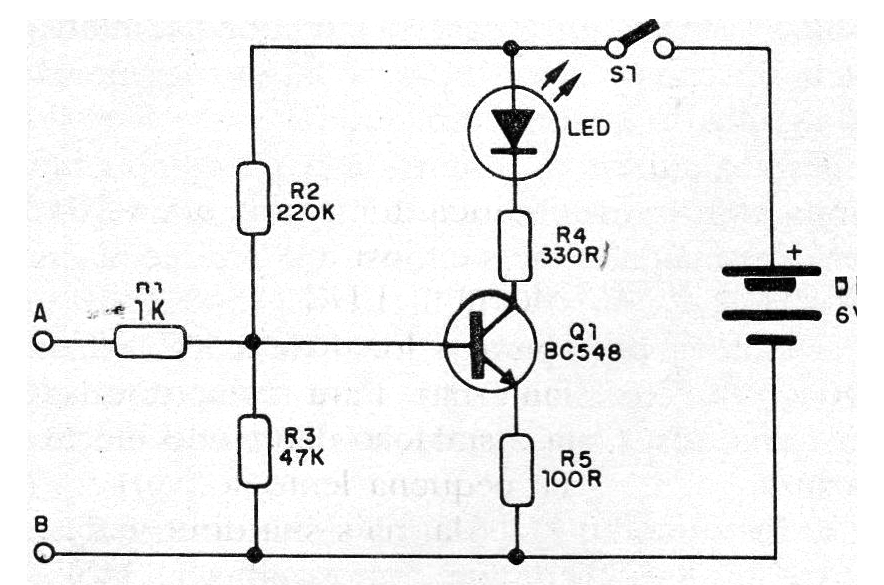
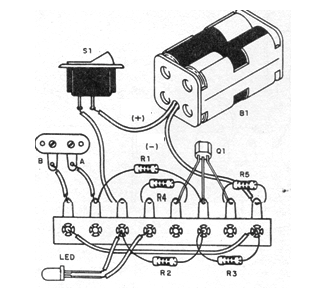
In Figure 2, we have the way of assembling the components in a terminal strip. Observe the polarity of the batteries and the position of the transistor.
Material list
Q1 - BC548 or equivalent - general purpose NPN transistor
LED - common LED of any color
R1 - 1k ohms x 1/8 W - resistor - brown, black, red
R2 - 220 k ohms x 1/8 W- resistor - red, red, yellow
R3 - 47 k ohms x 1/8 W - resistor - yellow, violet, orange
R4 - 330 ohms x 1/8 W- resistor - orange, orange, brown
R5 - 100 ohms x 1/8 W - resistor - brown, black, brown
S1 - Single switch
B1- 6 V - 4 small batteries
Miscellaneous: terminal bridge, battery holder, wires, welding, etc.


