
Twin-T oscillators consist of a simple solution to generate sinusoidal signals of low frequencies, up to typically 10 kHz. These circuits can also be used to generate damped oscillations by simply replacing R / 2 with a trimpot of the same value. In the case of damped oscillations, the stimulus for their production can be applied to the base of the transistor through a capacitor or a diode.
In figure 1 we have the basic configuration of a double-T oscillator.
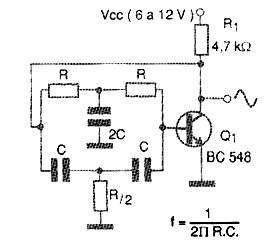
Typical values of R are between 100 k and 150 k ohms and for capacitors (C) values between 4.7 nF and 470 nF can be used. Note the need for the double T components to maintain the value ratios indicated in the diagram.
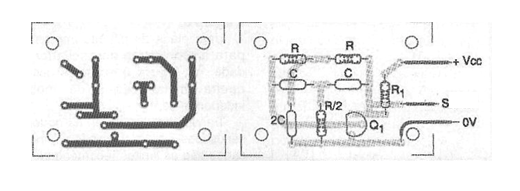
The formula that allows to calculate the frequency in function of the components of the double T is also given next to the diagram, in order to facilitate the developer. A printed circuit board for mounting the oscillator is shown in figure 2, if it is used alone.
Material list
Q1 - BC548 or equivalent - NPN general purpose transistor
R1 - 4.7 k ohm or 5.6 k ohm x 1/8 W - resistor
R - 100 k ohm - resistors - see text
C - 4.7 nF to 470 nF - capacitors - see text
Several:
Printed circuit board, wires, solder, power supply, etc.


