
This alarm sounds when water or moisture in a plant pot or vessel disappears, thus indicating the need for irrigation. The electrodes are two wires in contact with the earth or water or can be buried in the ground in a garden.
The circuit has a sensitivity adjustment and is very sensitive to detect very small variations in the degree of soil moisture. The power of the circuit is made by 4 small batteries and in standby condition, that is, quietly the consumption is very low.
The sound volume generated is reasonable depending on the supply voltage. In figure 1 we have the complete diagram of the apparatus.
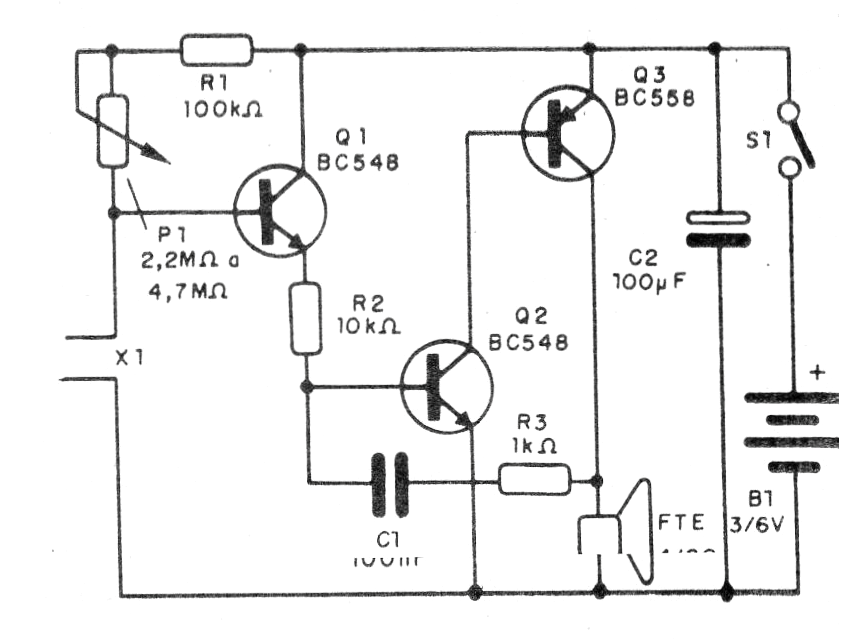
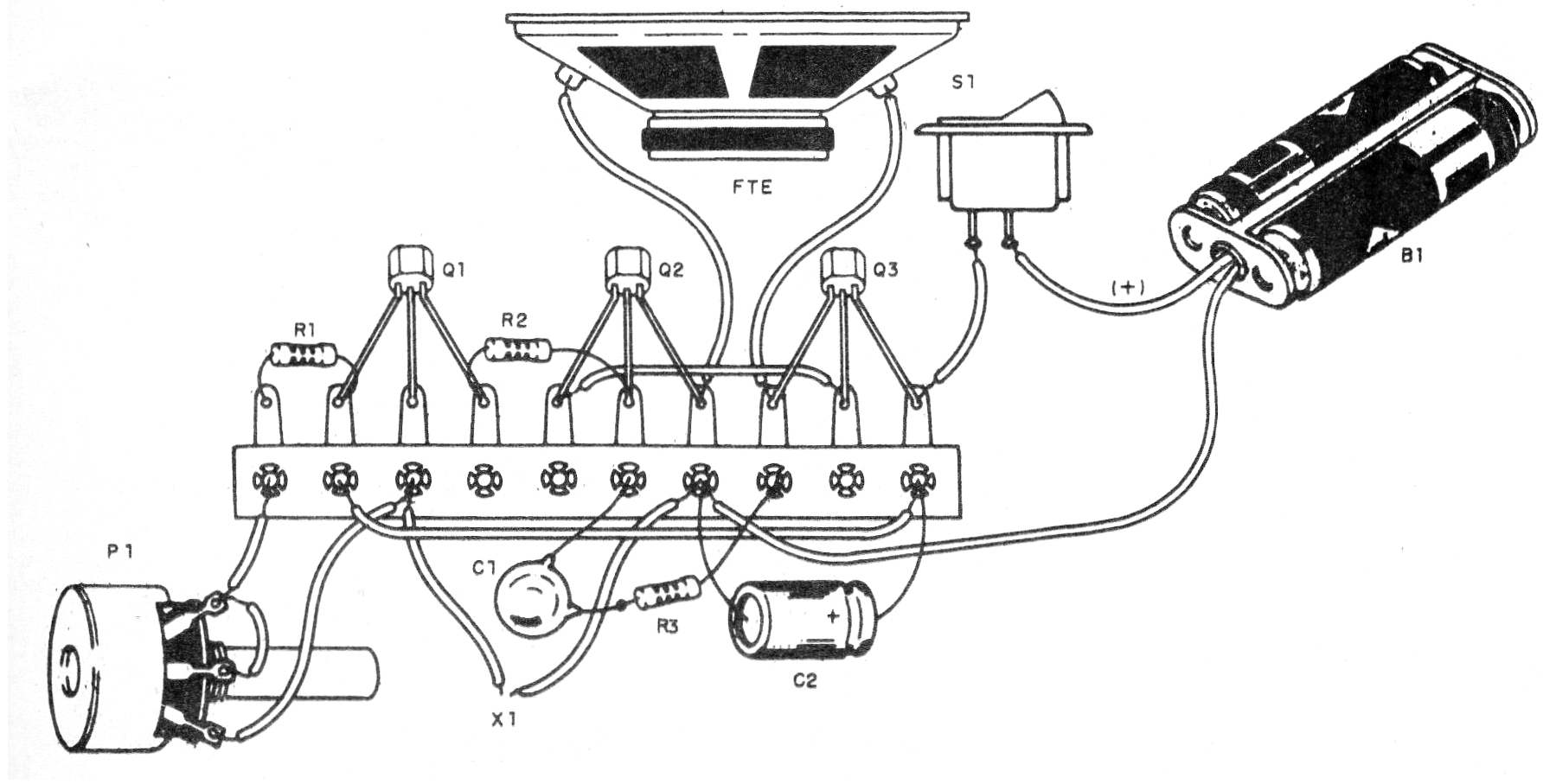
The sensor is formed by two pieces of hard wire with peeled tips of at least 10 cm to have direct contact with the earth. The speaker can be of any type and the other components are common. For very dry soils, increase the size of the electrode.
Material list
Q1 and Q2 - BC548 or equivalent - general purpose NPN transistors
Q3 - BC558 or equivalent - general purpose PNP transistors
R1- 100 k ohms x 1/8 W- resistor - brown, black, yellow
R2 - 10 k ohms x 1/8 W - resistor - brown, black, orange
R3 - 1k ohms x 1/8 W- resistor - brown, black, red
P1- 2.2 M or 4.7 M trimpot or potentiometer
C1 - 100 nF - ceramic or polyester capacitor
C2- 100 uF x 6 V or more - electrolytic capacitor
FTE - 4 or 8 ohms - speaker
X1- Sensor - see text
S1 – On-Off switch
B1-3 or 6V - 2 or 4 small batteries
Miscellaneous: terminal strip, battery holder, mounting box, wires, solder, etc.


