
The circuit shown produces the sound of the English police sirens with excellent volume on the performance speaker. The circuit is simple to assemble and supports alternatives to the power stage.
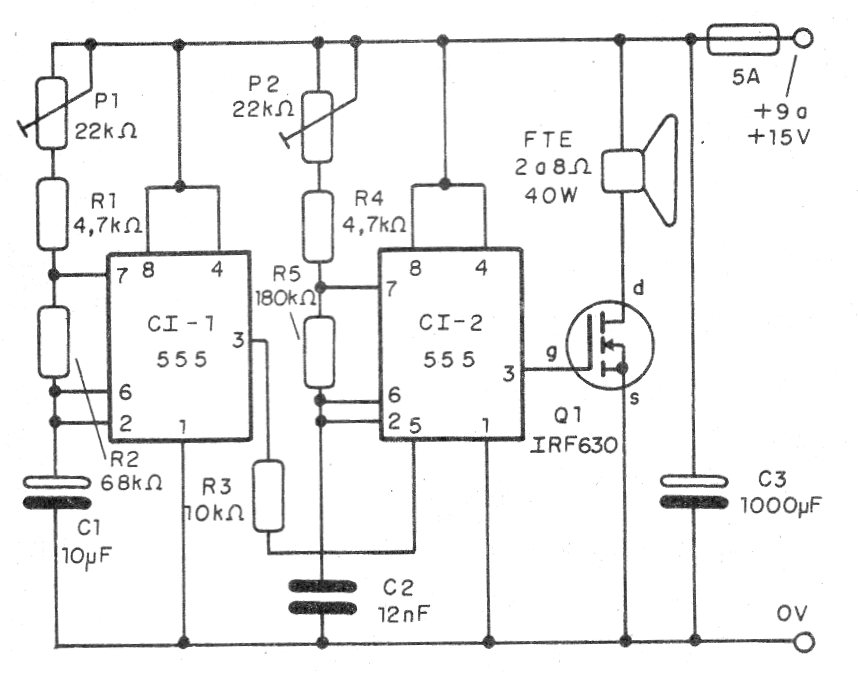
What we have are two oscillators with the 555, one being responsible for the modulation and the other responsible for the final tone.
The circuit signal is amplified by a power MOSFET, but a power NPN transistor such as the BD135 or TIP31 can be used with a 1 k resistor in series with the base.
In any case, the transistor must be provided with an appropriate heat sink.
The adjustments, which allow to reach the desired sound, compensating the tolerances of the components, are made in the two trimpots.
The power supply can be made with voltages from 9 to 12 V for FETs and 6 to 12 V for bipolar transistors.
In figure 1 we have the complete diagram of the siren.
In figure 2 we have the printed circuit board recommended for the assembly.
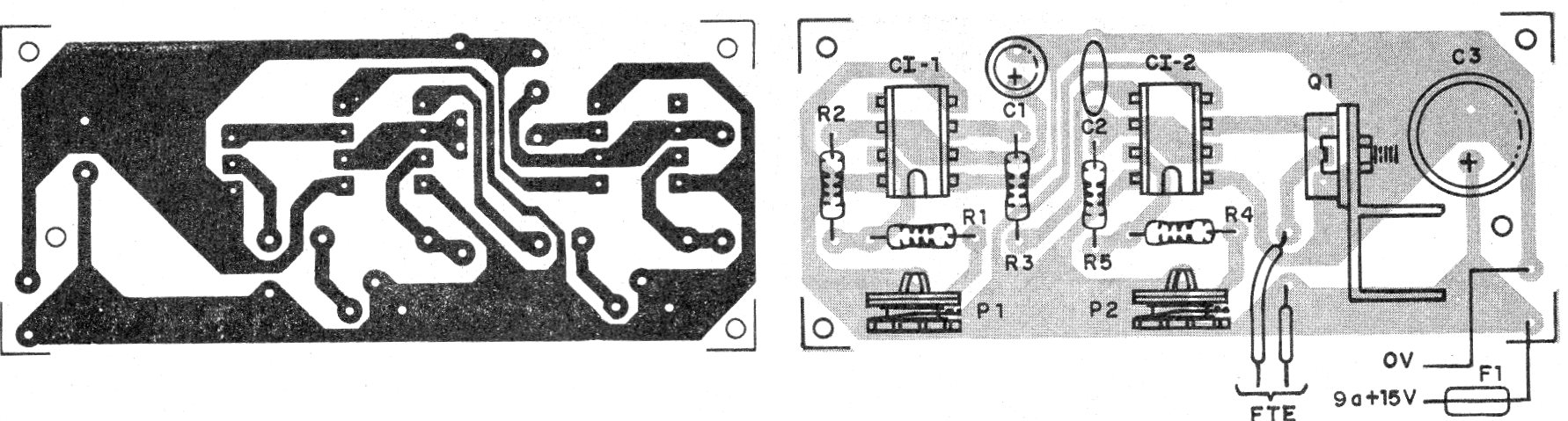
The resistors are 1/8 W and the electrolytic capacitors must have working voltages of 16 V or more.
For greater performance a speaker of at least 10 cm of type with heavy magnet is recommended.
To test and use, simply plug the circuit into the power supply.
If source is used, it must have at least 2 A current capacity.
Material list
CI-1, CI-2 - 555 - integrated circuits
Q1 - IRF640 or any equivalent - see text
P1, P2 - 220 k ohms - trimpots
R1, R4 - 4k7 ohms - resistors - yellow, violet, red
R2 - 22k ohms - resistor - red, red, orange
R3 - 10 k ohms - resistor - brown, black, orange
R5 - 180 k ohms - resistor - brown, gray, yellow
C1 - 10 uF - electrolytic
C2-12 nF - polyester or ceramic
C3 - 1000 uF - electrolytic
FTE - 4 or 8 ohms - speaker - see text
F1- 2 A- fuse
Several:
Printed circuit board, mounting box, heat radiator for transistor, wires, solder, etc.


