
This ultra-simple circuit serves to demonstrate the principle of operation of a transformer, generating enough high voltage to light a small neon lamp from ordinary batteries.
The circuit shown uses a homemade vibrator to produce an intermittent direct current that, applied to a transformer, generates voltages capable of lighting a small neon lamp.
In fact, the circuit will also light up fluorescent lamps up to 15 W, even those that no longer function when connected to the power grid.
The capacitor assists in operation intermittently, making the circuit operate as a pulsator, its value being experimentally obtained in the range of 10 to 47 uF.
In figure 1 we have the assembly aspect.
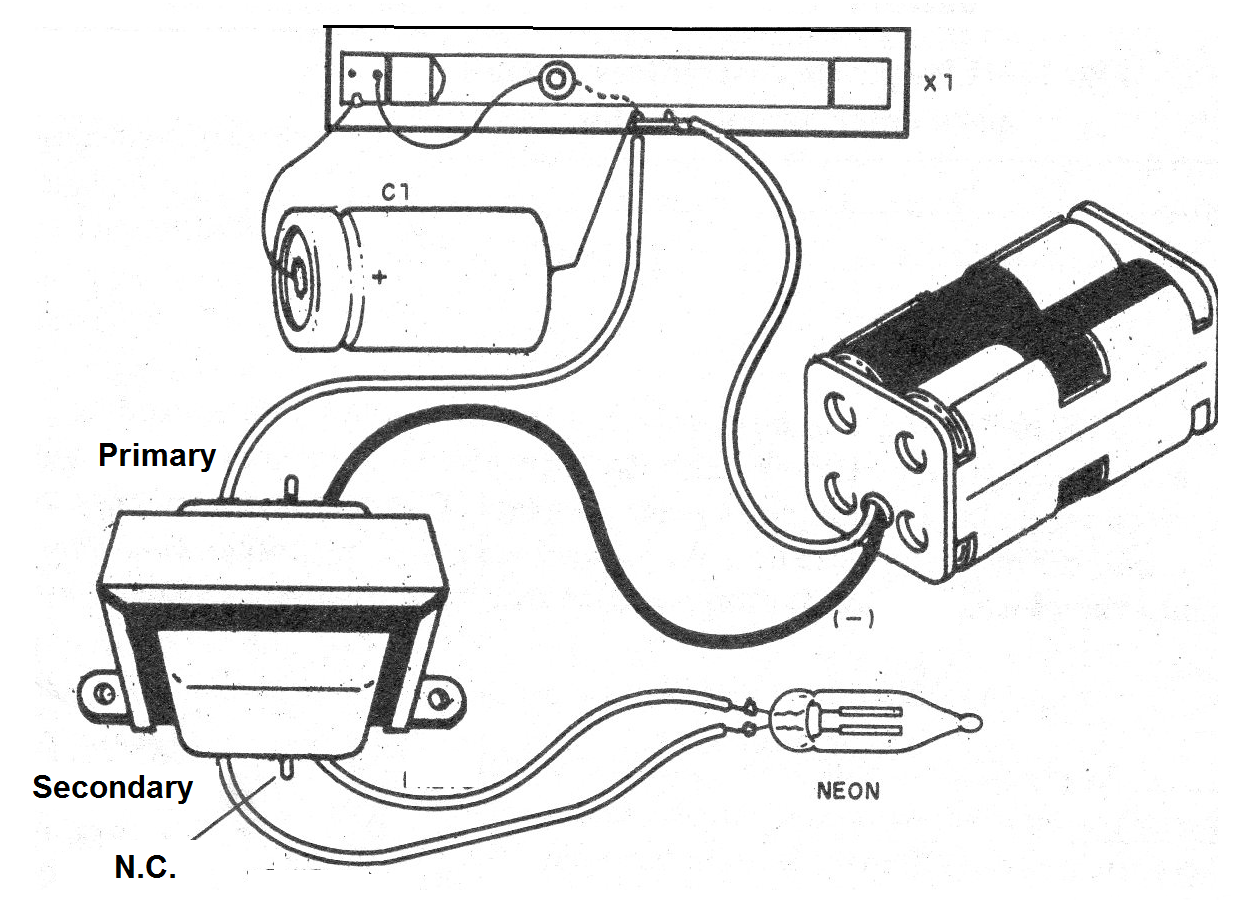
The vibrator assembly is detailed in figure 2.
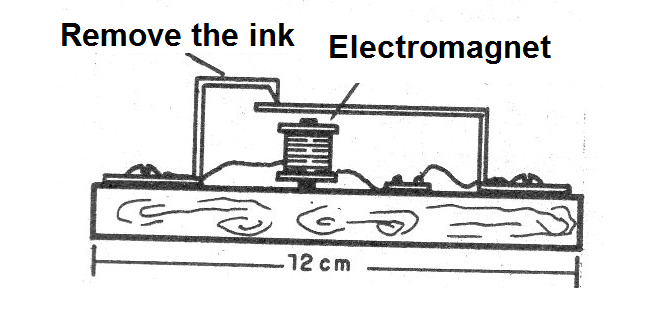
We use very carefully cut can with appropriate scissors and the bobbin is formed by 200 to 500 turns of wire 32 on a nail or thick screw.
The base is a 5 x 15 cm tablet.
The transformer can be of any type with secondary from 5 to 12 V with 100 to 300 mA of current and primary of both 110 V and 220 V.
The circuit also serves as a nerve driver, giving a good shock to those who hold the output wires.
A potentiometer of 47 k can be connected to the output to control the intensity of the shocks.
The circuit may serve as the basis for an interesting job for science fair.
Material list
T1 - Transformer - see text
V1 - Vibrator - view text
C1 - 10 47 uF x 12 V - electrolytic capacitor
B1 - 4 small or medium size batteries
Several:
Wires, soldering, battery holder, etc.


