
The circuit presented makes 5 to 100 watt bulbs flicker with the rhythm of the music of a stereo. The input wires are connected directly to the speaker of the stereo. Note that this circuit does not steal any power from the amplifier because the power that lights the lamp comes from the mains. Newton C. Braga
Read more:
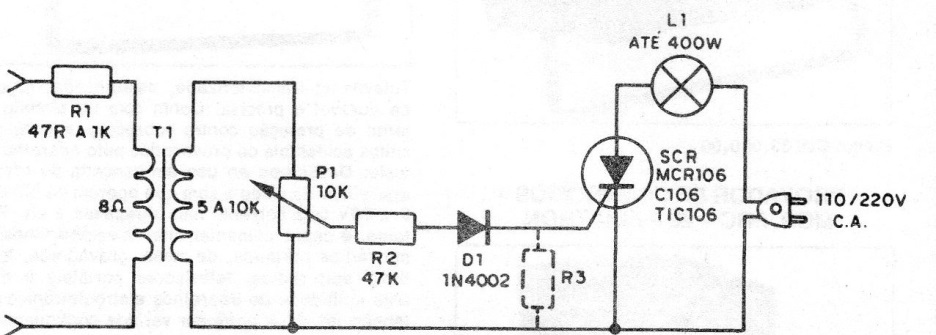
The amplifier comes in with only a few thousandths of a watt to control the SCR. In figure 1 we give the complete diagram of the apparatus.
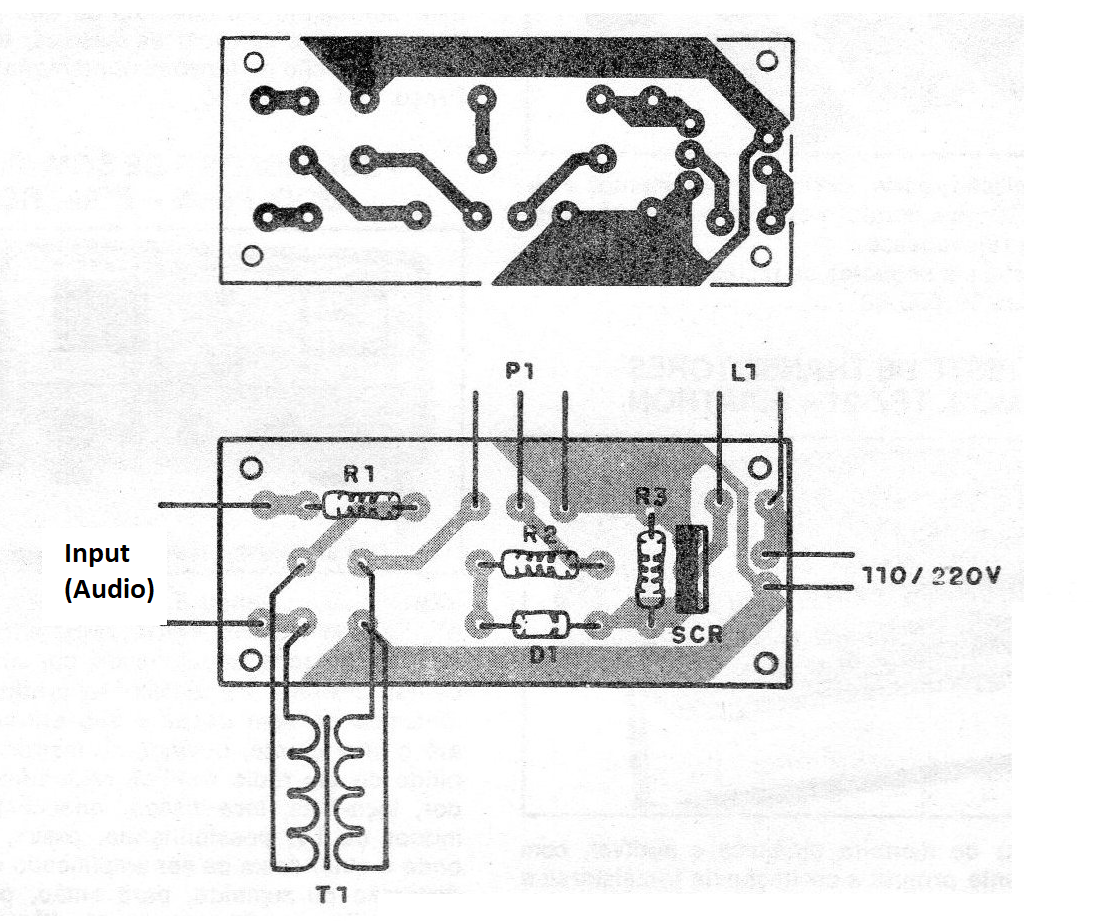
In figure 2 we have the printed circuit board.
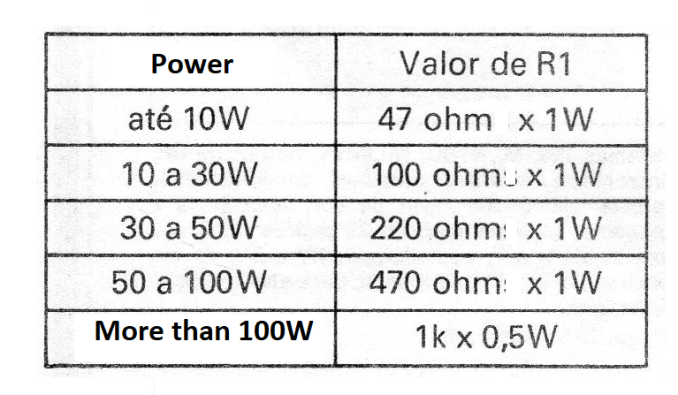
The resistor R1 has values that depend on the power of the amplifier, according to the following table:
The resistor R3 will be required and will have values between 4k7 and 1ok, when the TlC106 is used instead of the MCR106. This SCR should be mounted on a small heat radiator.
The transformer T1 may be of any type having a high impedance winding and a low winding. We indicate a transformer with 110 V primary, which will be connected to potentiometer P1, and secondary from 5 to 12 V with 100 to 250 mA, which is the easiest type to obtain. To turn the rhythm light on, just turn on the stereo and adjust to the desired volume. Then, proceed on P1 until the lamp flashes at the desired pace.
The connection of a capacitor in parallel with the transformer winding going to P1, with values between 4n7 and 47n, allows to change the response of the circuit, which will respond more to the bass sounds. Note: The circuit works only with incandescent bulbs.
MATERIAL LIST
SCR - MCR106 or TIC106 to 200 V if the network is 110 V or 400 V if the network is 220 V
D1 - 1N4002 or equivalent - silicon diode
T1 - transformer (see text)
R1, R3 - see text
R2 - 47k x 1/8 W - resistor (yellow, violet, orange)
P1 - 10 to 47 k - potentiometer (with or without key)
L1 - common lamp from 5 to 100 W- can be connected several times to the side, provided that the sum of the powers does not exceed 400 W in 110 V or 800 W in 220 V
Miscellaneous: printed circuit board, wires, solder, power cable etc.


