
This is an electrochemical experiment that can be applied to elementary and middle school classes (STEM). With it we demonstrate that the conductivity of a solution depends on its concentration and that pure water is an insulator.
This simple assembly, which requires care in the handling, since it is connected to the power grid, allows to demonstrate that pure water is insulating and when we add a salt, acid or base it becomes conductive.
We have an indicator light that stays off when the electrodes are immersed in pure water, but which lights up when the water becomes conductive by the addition of a salt, acid or base.
We should use a low power incandescent bulb, between 15 and 40 W for best results.
Tap water can be used, but since it contains impurities and purifying substances, it is not fully insulated, which means that the lamp will already light up with reduced brightness.
However when we throw into the water substances such as cooking salt, dilute acid or caustic soda, the lamp increases in brightness, showing the change in conductivity.
To get the lamp completely off at the beginning of the experiment, distilled water should be used.
In the laboratory, additions of various substances can be programmed to demonstrate which changes and which do not change the conductivity of the water.
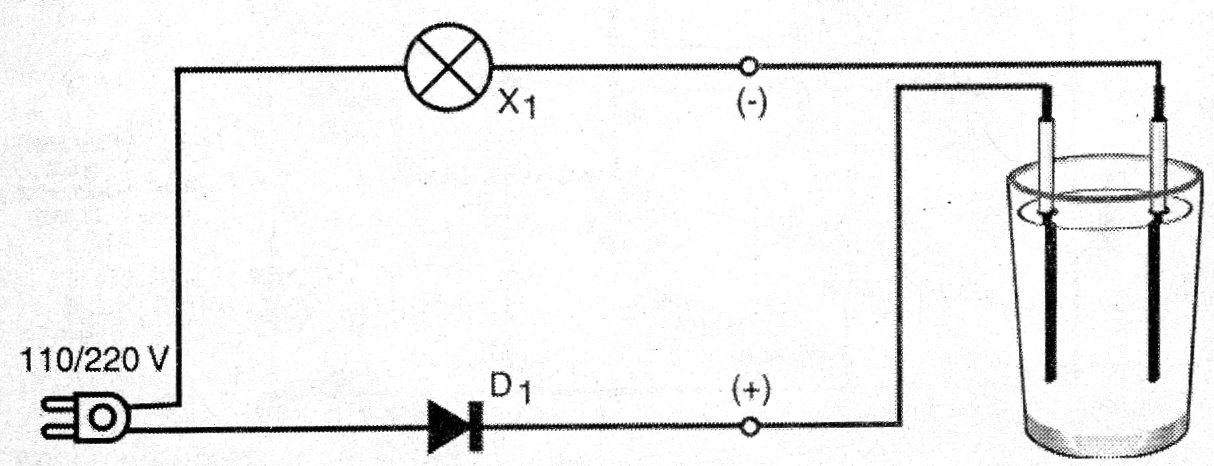
In our project we added a diode that allows pulsed direct current to be used and thus use the same apparatus in an electrolysis or electroplating experiment.
See more about these topics in our website articles.
In figure 1 we have the complete diagram of the apparatus.
The final assembly is shown in figure 2.
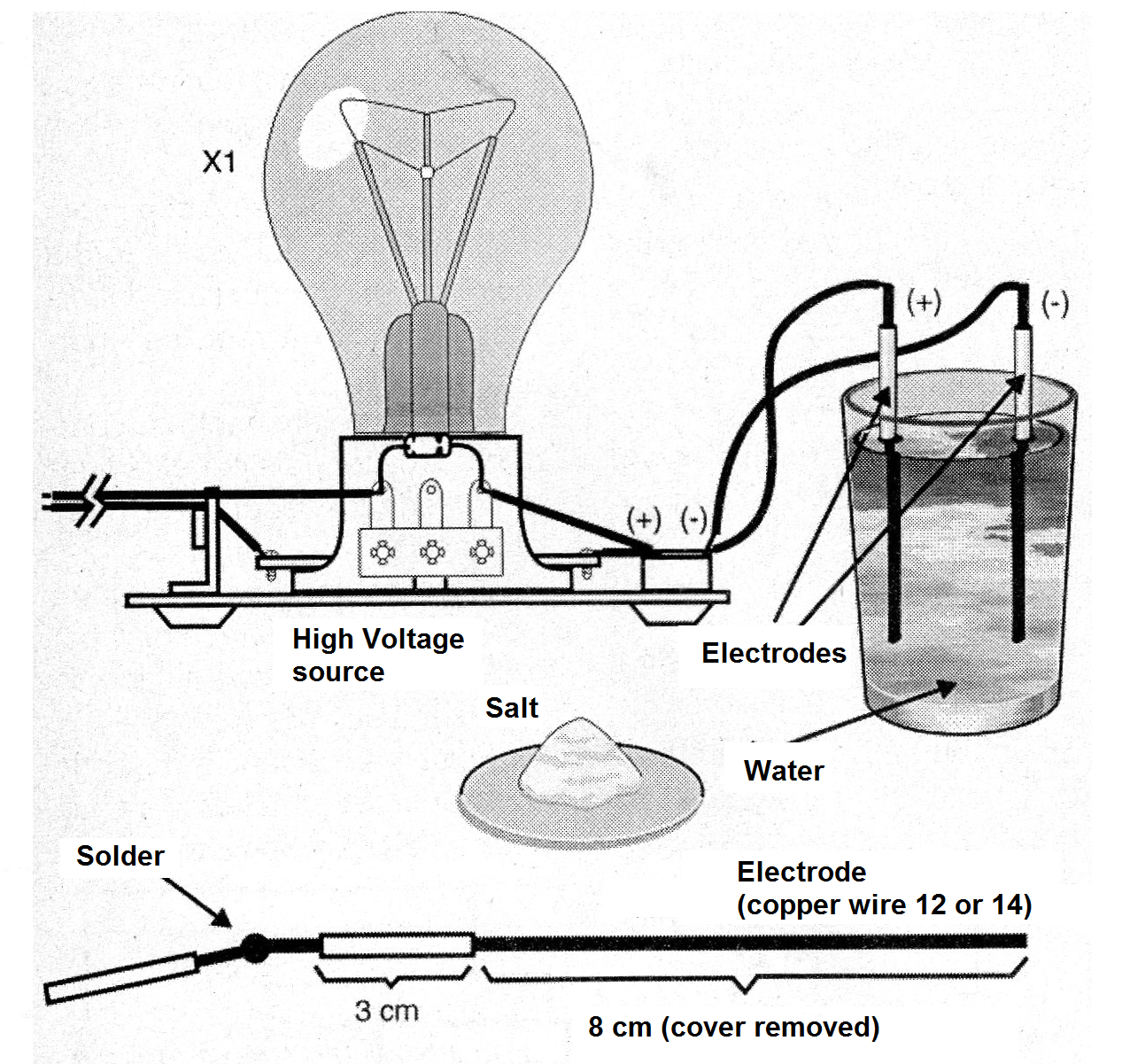
Care must be taken not to touch any wire or exposed part of the circuit, as hazardous shock may occur.
Material list
X1 - 15 to 40 W lamp - depending on the network
D1 - 1N4004 (110 V) or 1N4007 (220 V) - silicon diode
Several:
Power cable, electrodes, socket for lamp, wires, solder, etc.


