
The circuit shown in figure 1 causes an LED to light or a relay to close its contacts when sound is picked up by the microphone.
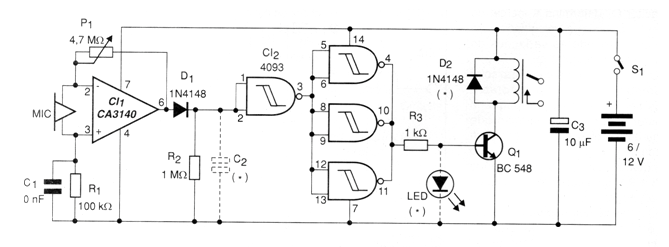
Using a relay, we can use the circuit as "vox" ie a key that connects a recorder or other equipment to the ambient sound.
The sensitivity of the circuit is controlled by the feedback potentiometer.
The microphone used is of the low impedance dynamic type (100 to 600 ohms) and the relay must have coil voltage according to the supply voltage.
The capacitor C3 is used to avoid relaying of the relays, filtering small oscillations of sound that should not act on the circuit. Its value can be between 10 nF and 1 uF.
The microphone must be installed near the circuit. If it is installed more than 1 meter, shielded wire must be used for its connection.
In figure 2 we have a suggestion of printed circuit board for its assembly.
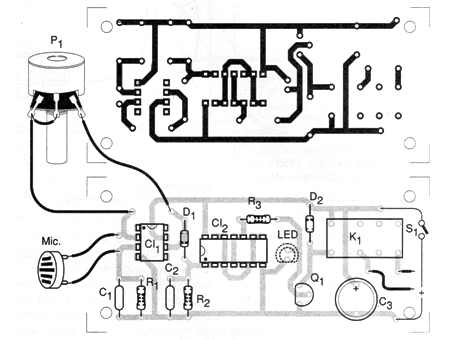
Because the standby condition is very low, batteries or batteries may be used in the power supply.
If an external source is used, its filtering should be excellent so that snoring from the power grid does not cause the circuit to trip randomly.
Material list
CI-1 - CA3140 - Operational Amplifier - Integrated Circuit
CI-2 - 4093 - CMOS integrated circuit
Q1 - BC548 or equivalent - general purpose NPN transistor
D1 - 1N4148 - general purpose diode
LED1 - Common red LED
R1 - 100 k ohms x 1/8 W - resistor - brown, black, yellow
R2 - 1 M ohms x 1/8 W - resistor - brown, black, green
R3 - 1k ohms x 1/8 W - resistor - brown, black, red
P1 - 4.7 M ohms - potentiometer
C1 - 10 nF - ceramic or polyester capacitor
C2 - see text - 10 nF at 1 uF
C3 - 100 uF x 12 V - electrolytic capacitor
S1 - Single switch
MIC - dynamic mic from 100 to 600 ohms
B1 - 6 to 12 V - batteries or battery
Several:
Printed circuit board, battery holder or battery connector, mounting box, wires, solder, etc.


