
In the absence of a phototransistor or a photo-diode in an emergency application or even to solve a small problem of optoelectronics, an ordinary LED can be used as a sensitive photo sensor. The circuit of Figure 1 shows how to do this.
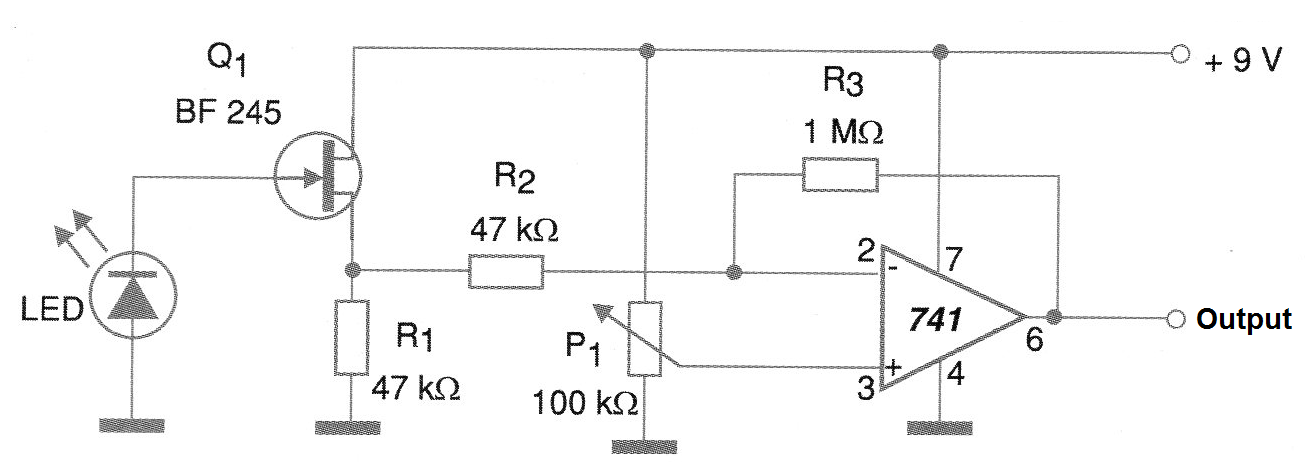
P1 adjusts the triggering or conduction point of the transistor. The sensor is a common LED and the frequency response for the light color depends on the type of LED used.
The gain of the circuit is given by R3 which can be increased up to 4.7 M ohms so as to obtain the maximum without instability problems.
The power supply does not need to be symmetrical and equivalent junction field effect transistors can be used as well as operational amplifiers. The frequency response of this circuit is of the order of a few tens of kilohertz.
In Figure 2, we have a suggestion of a printed circuit board for implementation of this sensor with an LED. Optical features should be used to focus the light on the LED for greater directivity and sensitivity.
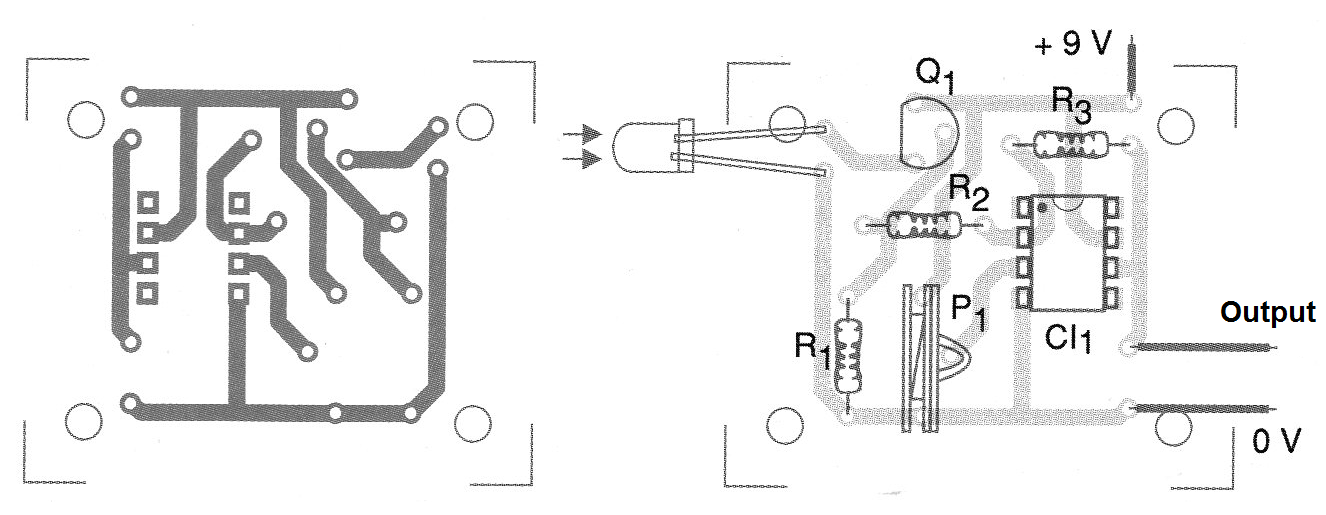
The output can be connected to power steps with transistors to drive relays or other power loads. This output will be of the order of 1 to 2 V in the low level and 7 to 8 V in the high level, according to the LED lighting.
MATERIAL LIST
CI-1 - 741 or equivalent - operational amplifier
Q1 - BF245 - junction field effect transistor (JFET)
LED - common LED of any color - see text
R1, R2 - 47 k ohm x 1/8 W - resistors
R3 - 1 M ohm x 1/8 W - resistor
P1 - 1000 k ohm - trimpot
Miscellaneous:
Printed circuit board, wires, welding, etc.


