
We describe a simple experiment that shows how electrical energy can be converted into sound (acoustic energy). The experimental circuit uses only 3 components.
What this circuit does is to convert the 60 Hz signal from the power grid into a beep of the same frequency.
We can even use this signal in acoustics experiments in the physics lab when we need a known constant frequency sound.
We note that the circuit is connected to the power grid and therefore must be enclosed in a box so that dangerous contacts will not occur.
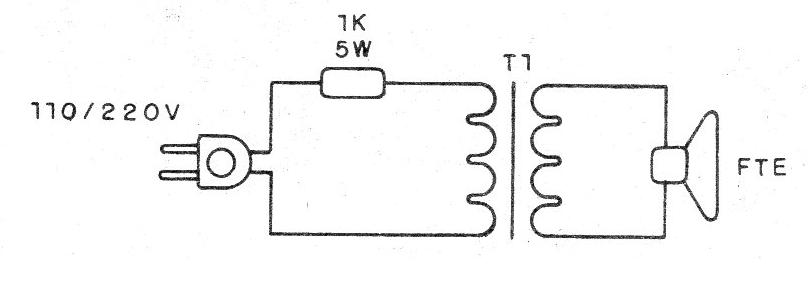
In figure 1 we have the complete diagram of the apparatus.
The assembly based on a small terminal strip is shown in figure 2.
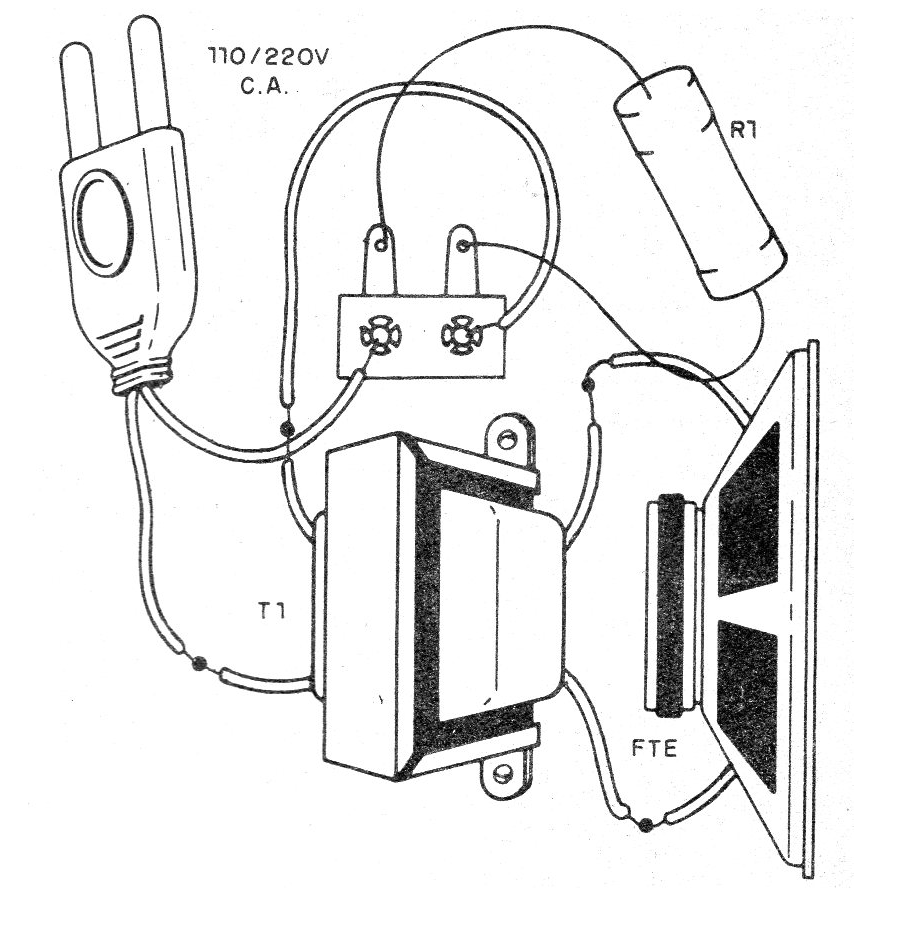
The transformer has primary winding of 110 V or 220 V according to the local and secondary network of 5 to 6 V with current of 200 to 300 mA.
The speaker can be 4 or 8 ohms with 10 cm or more and the resistor must be wire with 5 W dissipation or more.
By connecting the unit to the mains power the loudspeaker should emit a continuous sound of 60 Hz.
Material list
T1 - Transformer - see text
R1 - 1k ohms (110 V) or 2k2 ohms (220 V) - 5 W wire resistor
FTE - 4 or 8 ohms - speaker
Several:
Power cable, wires, mounting box, solder, etc.


