
Here's a circuit that lets you connect a DC motor from a single touch to a sensor. The device can be used as an alarm or in automation devices, resulting in 'interesting robotics projects. The system operates with 3 to 12 V direct current motors with current up to 1 A.
The system that we propose triggers with a simple touch and stays activated even after we remove the fingers of the sensor.
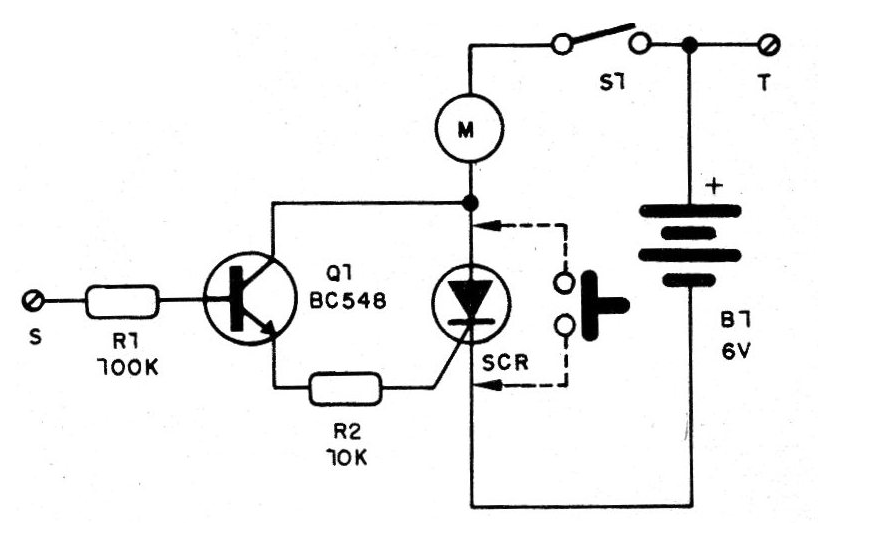
In order to switch off the motor, it is necessary to cut off the power, which can be done through the general switch (Sl) or through a pressure switch connected in parallel with the SCR.
The system, in addition to being simple, as it uses only 4 components, has excellent sensitivity and can serve as a ring alarm.
The basic version can operate with voltages from 6 to 12 V and currents up to 1 A, but small modifications allow the expansion of this operating range.
HOW IT WORKS
The T terminal must be grounded in this circuit, thereby providing a return to the trigerring current.
When we touch the sensor element (S), a current circulates between T and this element, in such a way as to polarize in the direct direction the base / emitter junction of Q1, which leads.
The resulting current in the emitter of Q1 is more intense than the base current, because it is added to the collector current in a ratio that depends on the gain of the transistor.
So we have a good current for SCR firing.
The SCR used is extremely sensitive, which means a tremendous ease for firing from the current of Q1.
Once triggered, the SCR feeds the motor, which thus remains indefinitely, until the power is cut off.
We observed that the SCRs have a voltage of the order of 2 V when conducting the current.
This drop should be compensated for in the feed.
So if the motor is 3 V we must make the power with 5 or 6 V and if the motor is 6V it will be necessary to power the circuit with 8 or 9V.
And, and if the motor is 12 V we should power the circuit with 14 V or 15 V.
ASSEMBLY
We begin by giving the complete diagram of the apparatus in figure 1.
The assembly on a terminal strip is shown in figure 2.
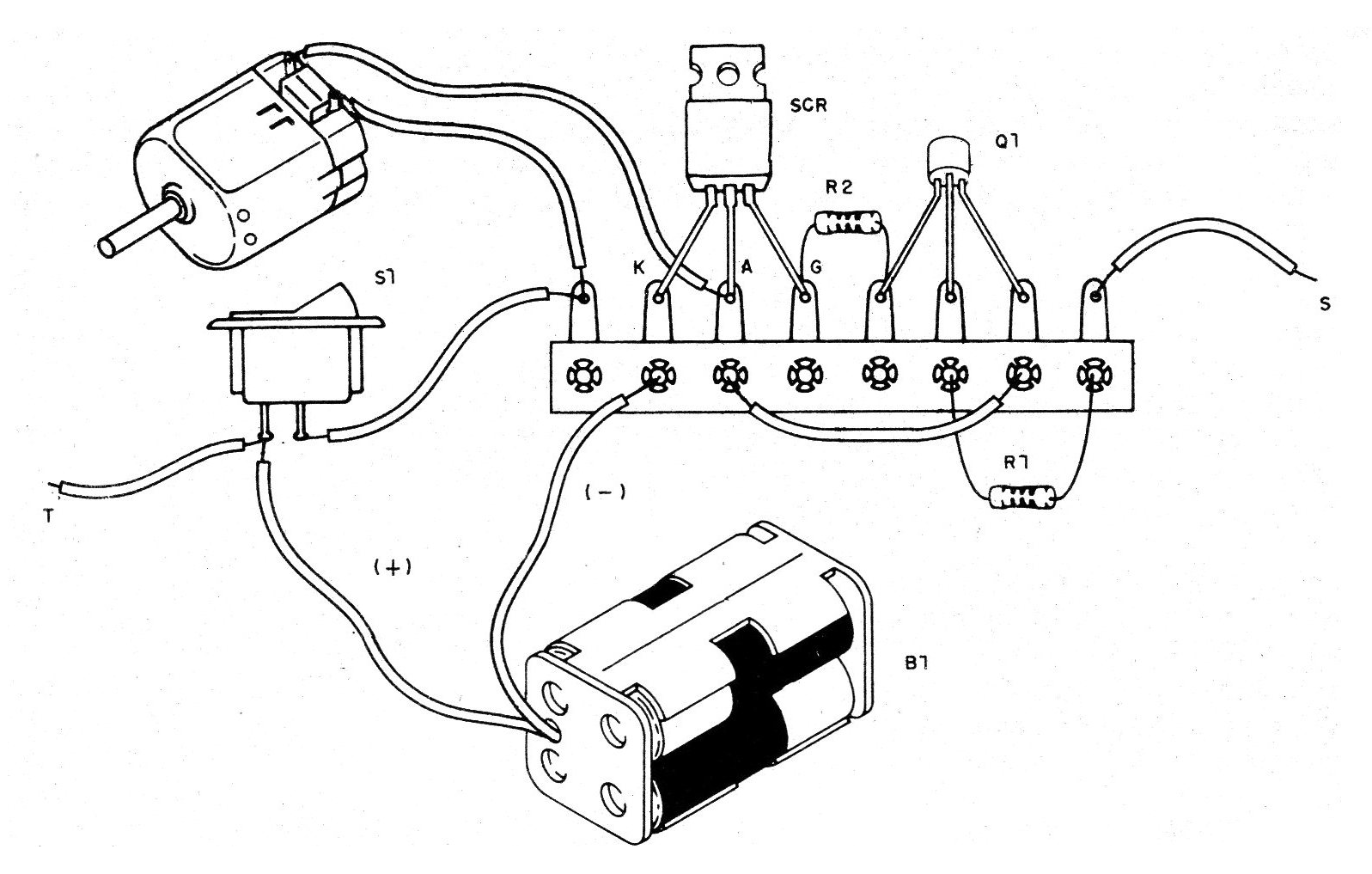
If the motor current exceeds 500 mA, the SCR must be equipped with a small heat radiator.
The resistors can be 1/8, 1/4 or even, ½ W, importing only the value, which is also not critical.
Thus, R1 may have values between 47 and 220k, while R2 may have values between 2k2 and 22k.
It is important to observe the ground connection, which can be made on any metal object in contact with the ground, such as a faucet or door or window miter.
The polarity of the motor must be observed if the direction of rotation of the motor is important.
TEST AND USE
Feed the circuit with small batteries if the motor requires currents up to 200 mA.
As a sensor use metal plate, no more than 20 x 20 cm between and for power, use medium or large batteries, and for more than 500 mA use battery or power supply.
LIST OF MATERIAL
C1 - BC548 or equivalent - general purpose NPN transistors
SCR - MCR106 or TIC106 for 50 V or more - SCR
M1 - motor up to 1A from 3 to 12 V
S1 – On-Off switch
B1 - motor battery 6 to 15 V - see text
R1 - 100k - resistor (brown, black, red)
R2 - 10 k - resistor (brown, black, orange)
Miscellaneous: terminal strip, mounting box, sensors, wires, solder, battery holder etc.


