
While there are bicolour LEDs with flashing lights already included, in a practical application they may not be accessible. The circuit shown in Figure 1 provides a quick and simple solution for making two LEDs (of different colors or not) flash alternately at a frequency that can be adjusted over a wide range of values.
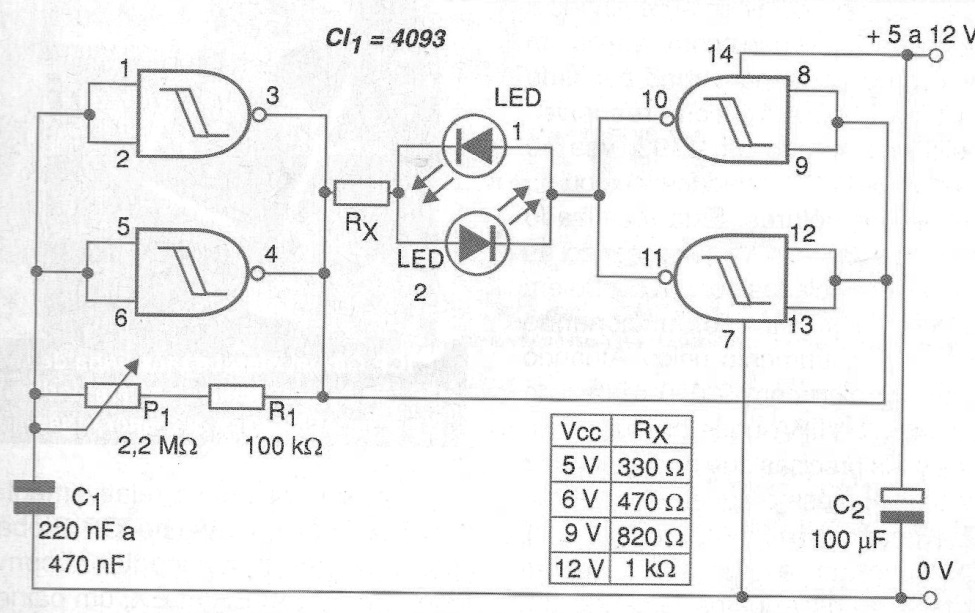
The frequency depends on C1 and also on the trimpot P1 setting. The current limiting resistor Rx in the LEDs depends on the supply voltage and its value is given by the table next to the diagram. In figure 2 we give a suggestion of printed circuit board for implementation of this circuit.
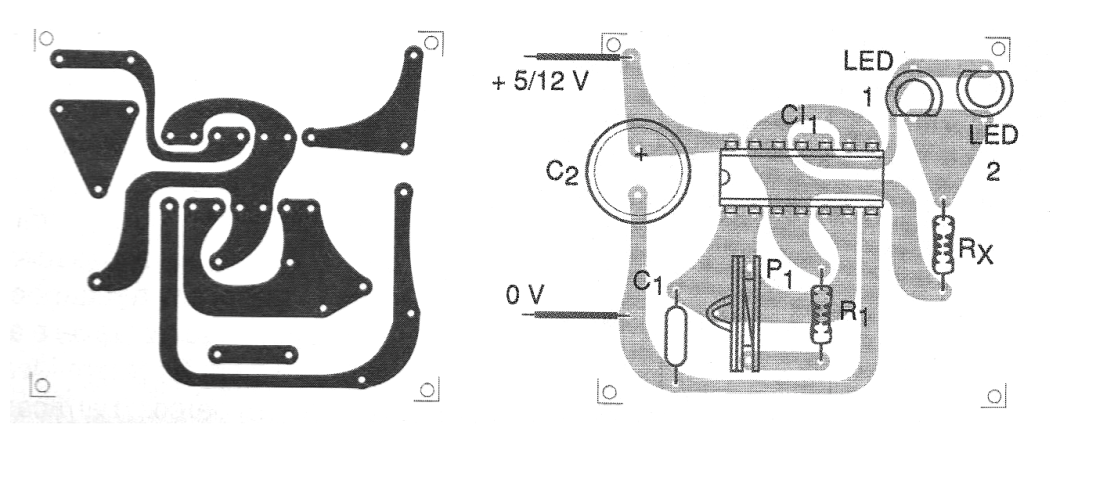
We observed that the fixation of the resistor between pins 4 and 6 makes it possible to obtain fixed frequency with greater economy for the assembly. The source decoupling capacitor C2 is optional.
MATERIAL LIST
CI-1 - 4093 - CMOS integrated circuit
LED1, LED2 - Common LEDs of any color
R1 - 100 k ohm x 1/8 W - resistor - brown, black, yellow
Rx - see text - 1/8 W resistor according to supply voltage
P1 - 2.2 M ohm - trimpot
C1 - 220 nF to 470 nF - ceramic or polyester capacitor
C2 - 100 uF - electrolytic capacitor
Several:
Printed circuit board, wires, solder, etc.


