
ART1150S ART142
Light is nothing more than electromagnetic radiation; that is, it is formed by waves whose frequencies differ from the common signals of radio, TV, radar, and others that we are accustomed to using in electronics, only by their frequency. Figure 1 shows the placement of the visible band, that is, the frequencies that our eyes can see, in the electromagnetic spectrum.
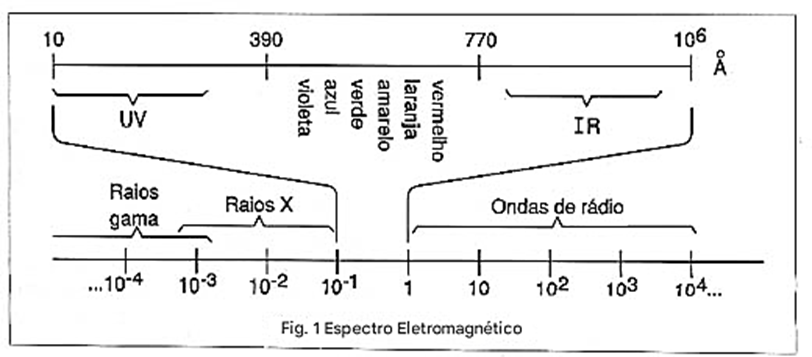
As the reader can see, in this range, the various wavelengths or frequencies also determine the type of sensation that our eye will have in relation to the color of the light. Thus, the lower frequencies and therefore the longer wavelengths correspond to red and orange light, while the shorter wavelengths and higher frequencies correspond to blue and violet radiation.
The simplest way to obtain light and therefore the emission of electromagnetic radiation is by heating. By heating a body, its atoms vibrate at all possible frequencies, emitting light of all colors that mix. The sun operates in this way and so does a common incandescent light bulb. In the sun, the high temperature agitates the atoms of the substances that form it in such a way that they begin to emit radiation, the same occurring with the filament of an incandescent light bulb when an electric current passes through it, as shown in Figure 2.
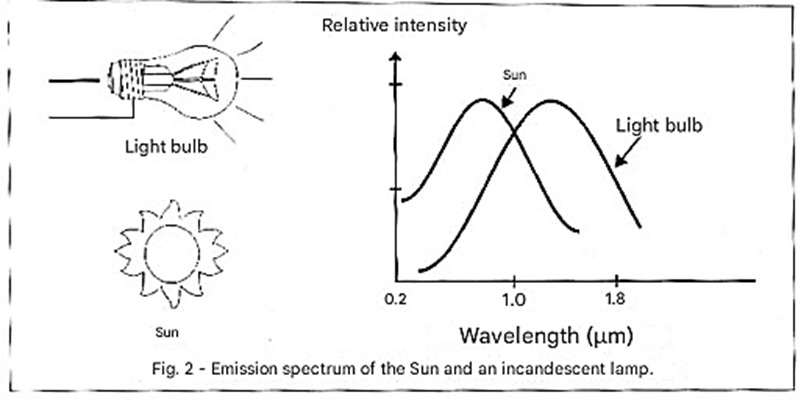
The radiation emitted by these bodies is disordered. This means that each atom, when agitated, emits a small portion of radiation at a different wavelength or frequency. It is interesting to note that the energy emitted under these conditions also has a minimum quantity, like the atom, which is the smallest portion of matter. This means that excited atoms always emit these minimum portions, which are called "quanta" of energy. The plural of "quantum," which is a Latin word, is "quanta," and the theory that explains how they behave is quantum theory.
Thus, when atoms are agitated by heat, each emits a "quantum" of energy of a different frequency. The result is that we do not have a single type of radiation, but rather a mixture that covers the entire visible spectrum and even part of what we cannot see, such as infrared and ultraviolet radiation, as shown in Figure 3.
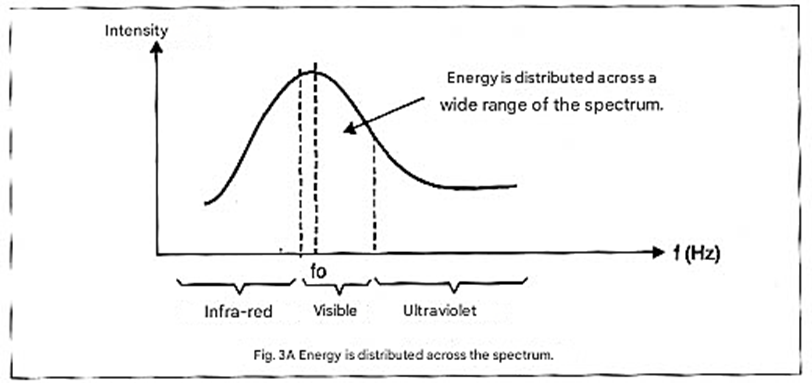
If the distribution of the emitted energy, that is, the number of quanta, is more or less uniform in the sector of the spectrum that we can see, the mixture will give us the sensation of white light. Now, the distribution of this emitted energy varies according to the temperature of the body. A hotter body tends to emit more particles of higher frequencies. For this reason, a very hot body glows with bluish light. A colder body, for example, a glowing iron, glows with reddish light, as shown in Figure 4.
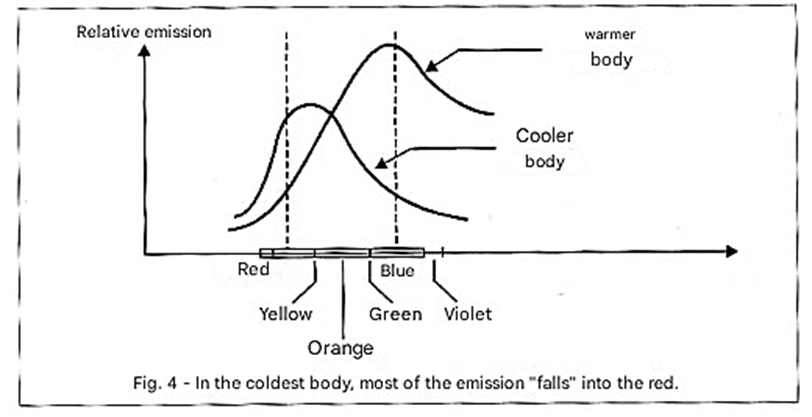
A physicist named Boltzmann established a formula for the distribution of this radiation emission as a function of temperature for a black body. The interesting thing about white light emission, or light containing all wavelengths like that of the sun, is that it allows us to see the colors of nature. Thus, what happens is that if we illuminate an object and it reflects only blue light, absorbing the others, it will appear blue to us, as shown in Figure 5.
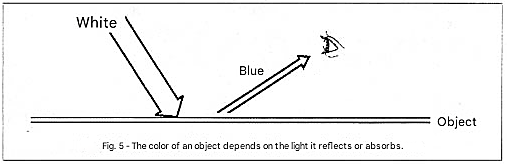
The objects we see in nature, when illuminated by sunlight or a common lamp, appear in their colors because they reflect the frequencies that determine those colors. If we illuminate a green object with a light source that emits radiation corresponding only to red light, the object will appear completely black. Therefore, we can speak of two types of light emissions:
That of sources like the Sun and a common lamp, which in reality possess all possible frequencies and therefore cover a wide range of spectrum, and sources that can emit light of a single frequency. In electronics, we can associate these single-frequency sources with a well-tuned transmitter, while the light that covers the entire spectrum would be a noise emitter.
We say that light sources that emit radiation of a single frequency or color are monochromatic. LEDs are monochromatic sources because they produce their light through a different process than what we saw for the Sun and a common lamp. Let us analyze how LEDs work:
ENERGY LEVELS AND MONOCHROMATIC LIGHT
Any material, including semiconductors, emits light when heated due to the agitation of its atoms. However, certain materials can emit light without being heated; that is, they can emit light even when cold, through a process called luminescence. The luminescence of certain materials has been known since 1889, but only recently has it been more widely used in electronics for the creation of various devices.
One type of luminescence is that which occurs when a beam of electrons strikes a layer of phosphor on a television screen. Luminescence is explained as follows: Electrons orbiting an atom do so in well-defined orbits that establish fixed energy levels, as shown in Figure 6.
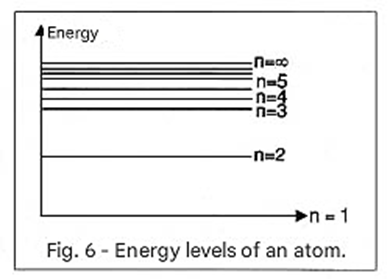
An atom can absorb energy for a brief moment, and when this occurs, an electron "jumps" from its orbit to another of a higher energy level. In other words, the energy is potentially stored in the electron's position in its orbit. When the electron, a fraction of a second after absorbing the energy, returns to its normal orbit, the absorbed energy is released, as shown in Figure 7.
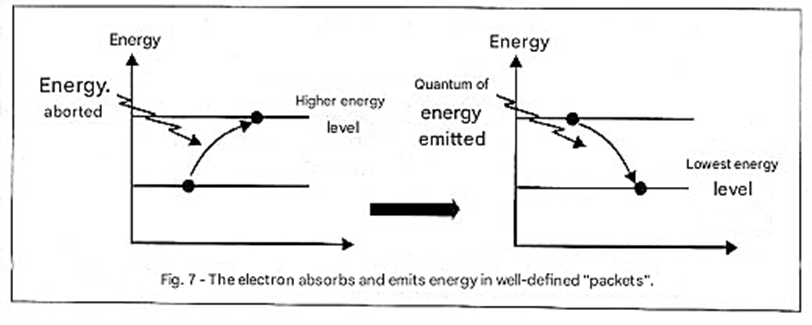
The returned energy is a quantum of electromagnetic radiation whose frequency depends on the electron's "jump," that is, the energy it has to return. The energy levels an electron can assume in an atom depend on the nature of that atom, that is, the material it represents. Thus, for each type of atom, electrons can only make defined jumps, meaning they can only return energy in the form of electromagnetic radiation of a very well-defined frequency.
If the energy band the electron returns is between 3800 and 7500 Angstroms, the energy manifests as visible light, and the material in which this occurs begins to emit light. There are several ways to excite a material so that it absorbs and then emits energy in the form of electromagnetic radiation. The circulation of a forward current through a semiconductor junction, for example, a common diode, as shown in Figure 8, is one of them.
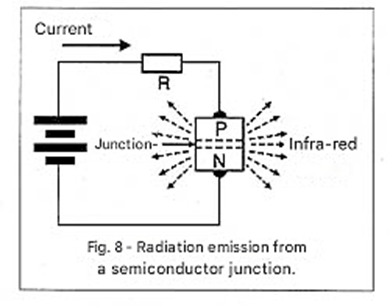
However, in a common diode, the emitted energy is concentrated in the infrared range (which we cannot see) and its intensity is very small. This radiation has its frequency precisely determined by the nature of the semiconductor material used in the diodes, which is silicon. To obtain radiation at frequencies higher than infrared, other semiconductor materials with different energy levels can be used, and these levels can even be changed by adding impurities. Thus, with gallium arsenide semiconductor (GaAs), we achieve a higher yield in the process, but still within the infrared range.
By adding phosphorus or indium to gallium arsenide, we can obtain higher frequencies, and the semiconductor then emits light in the red, yellow, orange, green, and blue range, reaching even violet and ultraviolet, as shown in the graph in Figure 9.
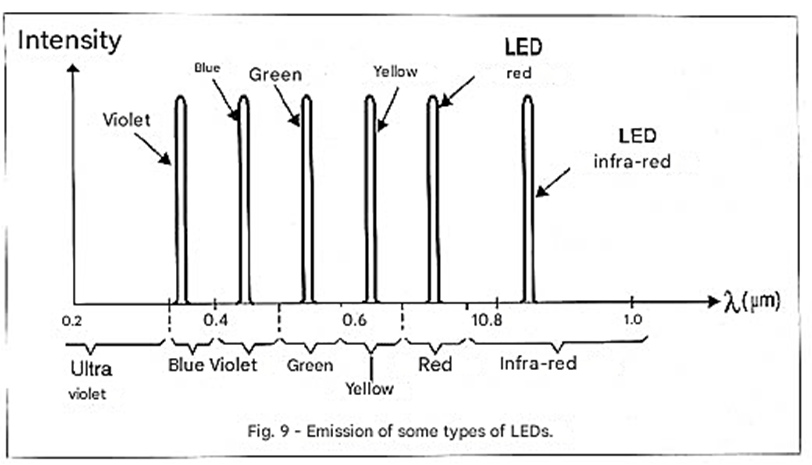
As you can see from this graph, the emission curves of devices obtained in this way, which are LEDs (Light-Emitting Diodes), are quite narrow, meaning they are monochromatic light sources. To obtain frequencies higher than that of green light, a new substance has been used. This is Silicon Carbide (SiC), which has had luminescent properties known since the beginning of the century.
However, obtaining pure semiconductor crystals of this substance was a difficulty overcome only recently. Silicon Carbide in semiconductor form can, when electrically excited, emit light not only in the frequency range corresponding to blue but also up to violet.
In this way, blue and violet LEDs, which are already on the market, can be manufactured with this new substance. Another substance that also exhibits light emission in the violet range is Silicon Nitride (SiN), which is also already used in the manufacture of LEDs. Figure 10 shows the structure of this type of LED, in which three types of materials can be observed.
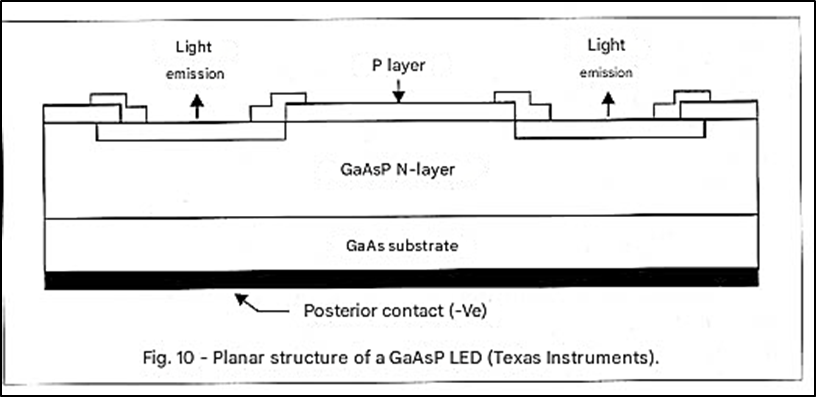
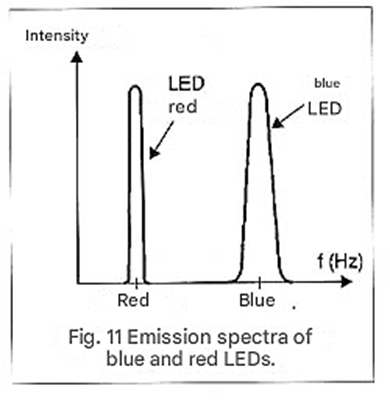
Along with the epitaxial pn junction, we have a SiC substrate that is excited during conduction, causing light emission. Figure 11 shows the emission curve of a blue LED, noting that it is much wider than that of common gallium arsenide LEDs, due to the characteristics of the semiconductor material itself.
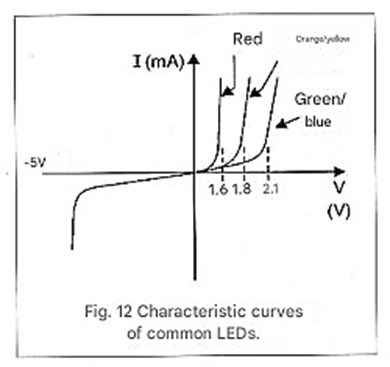
Blue and violet LEDs have a characteristic curve similar to that of any common diode and LED, only with the "knee," that is, the point where conduction begins, at a slightly higher voltage: 2.5 V. This characteristic curve is shown in Figure 12, and it shows us that the use of this type of LED is no different from common LEDs, requiring only the placement of a current-limiting resistor in series.
SEMICONDUCTOR LASERS
What differentiates a laser from an LED is that in a laser the emitted light is concentrated and coherent, due to the production process itself in the semiconductor material. In an LED, light is produced by an uncontrolled excitation of atoms which, upon receiving and returning energy, emit light at any instant and in any direction. In a laser, the atoms receive excitation in such a way that there is a phenomenon called "population inversion," that is, that at a given instant there are more excited atoms than unexcited ones.
Thus, when an atom returns its energy in the form of a quantum of light, this quantum serves to excite other energized atoms, forcing them to return their energy in a kind of chain reaction, shown in Figure 13.
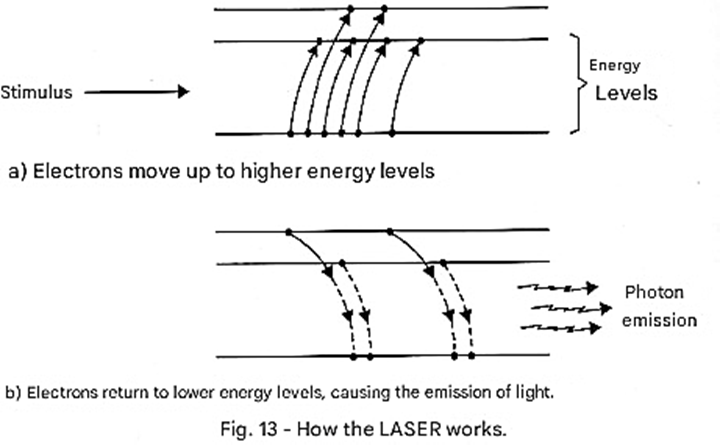
The result is that the return of the absorbed energy occurs in an excited and coordinated manner, resulting in the emission of concentrated and coherent light. A mirroring effect in the semiconductor material allows this return to be more controlled, and the emission occurs in the form of a beam in a single direction. However, just as with LEDs, the frequency and therefore the color of the emitted light depends on the nature of the material, and today semiconductor lasers of various wavelengths are available.


