
Many sound equipment has an LED that blinks to the rhythm of the song. You can incorporate an LED or a set of up to 4 LEDs to your sound with this simple assembly. The circuit uses few components and is powered by batteries.
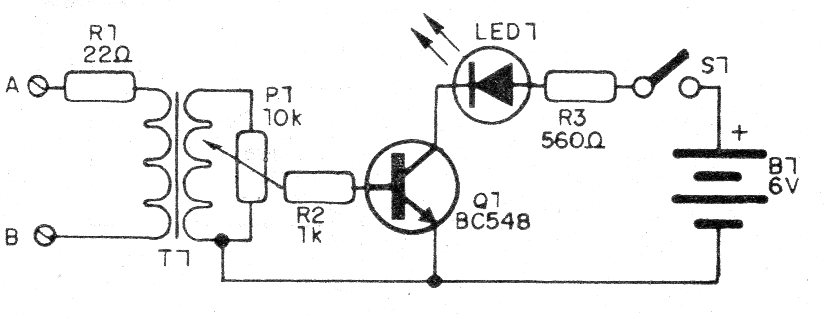
The displayed circuit causes a set of LEDs to blink to the sound of a sound system.
This circuit is connected to the output of the amplifier and can operate from 1 to 3 LEDs of any color connected in series.
In the original, the power consists of 4 common batteries (up to 2 LEDs), must be 9 V for 3 LEDs or even a small power supply isolated from the power grid.
The potentiometer adjusts the point at which the LEDs start to blink according to the volume of the music.
In figure 1 we have the complete diagram of the rhythmic LED.
In figure 2 we show the elementary assembly using the improvised technique of the matrix of the terminal strip, however it is possible to realize with advantages the assembly in printed circuit board.
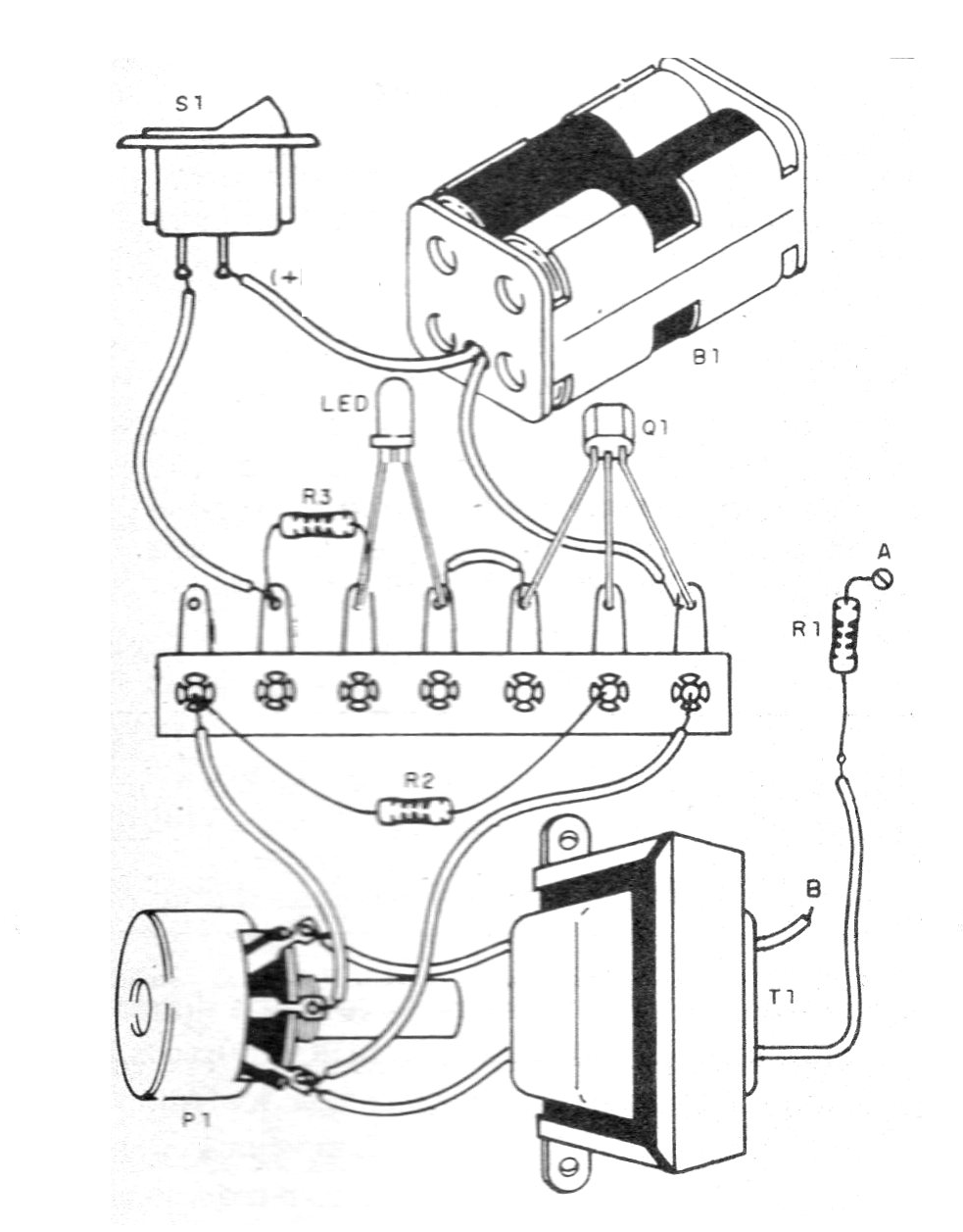
All components are common and capacitor C1 determines the speed of the circuit response to the sound variations and can be changed.
The transformer may be a small primary power transformer with 110 V and 12 V secondary with 200 or 300 mA.
A small output transformer taken from an old transistor radio can also be used.
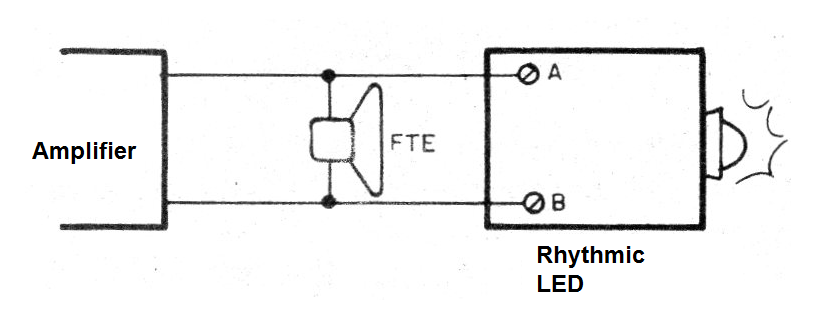
To use the unit, it must be connected in parallel with the loudspeaker, as shown in figure 3.
Set P1 so that at the volume used, the LED blinks normally.
Material list
Q1 - BC548 - NPN general purpose transistor
T1 - Transformer - see text
B1 - 6 or 9 V - batteries, battery or power supply
S1 – On-Off switch
P1 - 10k or 22k - potentiometer
R1 - 22 ohms - resistor - red, red, black
R2 - 1k ohms x 1/8 W - resistor - brown, black, red
R3 - 560 ohms x 1/8 W - resistor - green, blue, brown
Several:
Terminal strip, battery holder, wires, solder, etc.


