
A traditional oscillator configuration used when a rectangular signal is desired is one that uses two transistors connected as an astable multivibrator. The configuration shown in Figure 1 can generate signals ranging from Hertz fraction to a few tens of megahertz, without problems, using ordinary transistors.
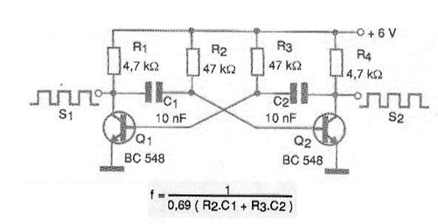
Next to the diagram we have the formula that allows to calculate the components for the desired frequency. By doing R2 = R3 and C1 = C2 the active cycle will be 50%. We can use different capacitors to get other active cycles.
Capacitors can typically have values between 10 nF and 100 uF. The resistors R1 and R4 can be changed as well as R2 and R3 as a function of the supply voltage. The circuit operates satisfactorily between 3 and 12 V.
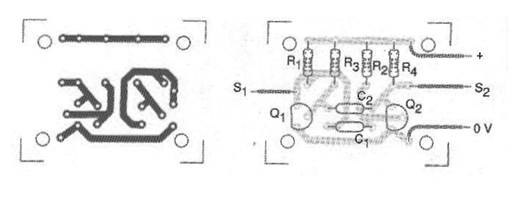
In figure 2 we have a suggestion of printed circuit board for the assembly of this oscillator.
For the indicated values the frequency will be around 3.5 kHz, with 6 V supply.
Material list
Q1, Q2 - BC548 or equivalent - general purpose NPN transistors
R1, R4 - 4.7 k ohm x 1/8 W - resistors
R2, R3 - 47 k ohm x 1/8 W - resistors
C1, C2-10 nF - ceramic capacitors or polyester
Several:
Printed circuit board, wires, solder, etc.


