
Perhaps this is one of the integrated circuit oscillator solutions with more projects already published by us. In fact, because of its versatility, capable of generating signals from 0.001 Hz to almost 10 MHz with ease and only two external components, it is the ideal solution when a rectangular signal is needed.
In this case, we only use one of the four NAND ports of the 4093 and the other three ports can be used for other purposes. The basic circuit, with the formula that allows to calculate its frequency is given in figure 16.
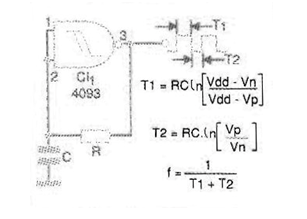
T1 is the period in which the output remains at the high level, while T2 is the time it remains at the low level.
Vdd is the supply voltage, Vt the positive excursion voltage and Vn the negative excursion voltage. These last two voltages depend on the power, according to the table given below:
| Voltage (Vcc) | |
| Vt | |
| Vn | |
| 5 V | |
| 3,3 | |
| 1,8 | |
| 10 V | |
| 6,2 | |
| 4,1 | |
| 15 V | |
| 9,0 | |
| 6,3 |
These are typical values at room temperature and may vary appreciably in practice. Thus, they serve only for an approximate calculation of frequency.
The 4093 can range up to 7 or 8 MHz with 10 V power. Typical R values are in the range of 1 k ohm to 1 M ohm and for C between 100 pF and 100 uF.
In figure 2 we have a suggestion for a printed circuit board to take advantage of only the first port as oscillator. The other ports can be used in other functions or even connected in parallel as inverters for digital amplification of the signal generated.
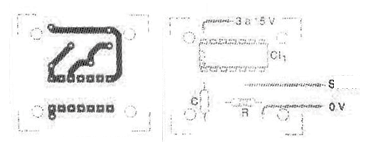
The current drained or supplied by each output with 10 V supply is 2.25 mA.
Material list
CI-1 - 4093 - CMOS integrated circuit
R - resistor - see text
C - capacitor - see text
Several:
Printed circuit board, wires, solder, etc.


