
Would you like to know what the position of a door or a remote mechanism is? The monitor we describe uses a potentiometer as a sensor, which can be attached to moving objects to indicate their position.
By coupling the sensor potentiometer to a lever, for example, we can remotely know where it lies.
If the lever is attached to a float in a tank, for example, we can remotely monitor its level.
The circuit is of low current, which means low consumption and also that the wires to the sensor can be long.
The indicator is of the analog type (galvanometer) of 200 uA to 1 mA of full scale, being able to be taken advantage of equipment out of use, since they are no longer easy to obtain.
As an option we can use the lowest current range of a multimeter to read.
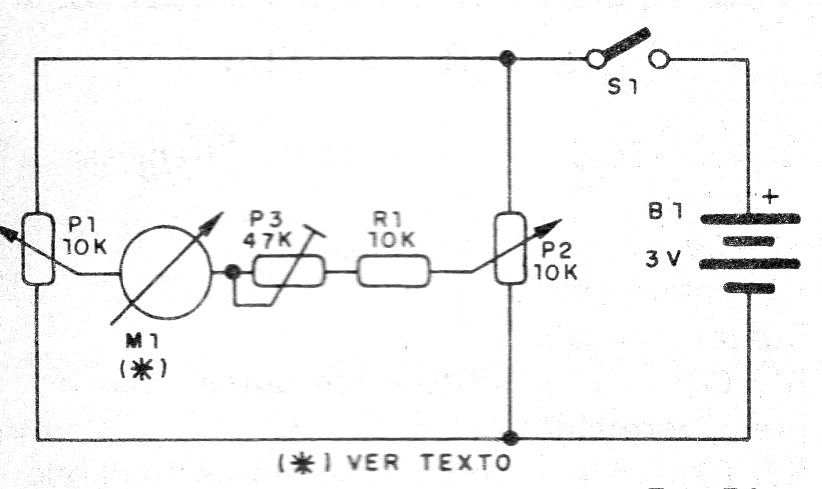
In figure 1 we have the complete diagram of the indicator.
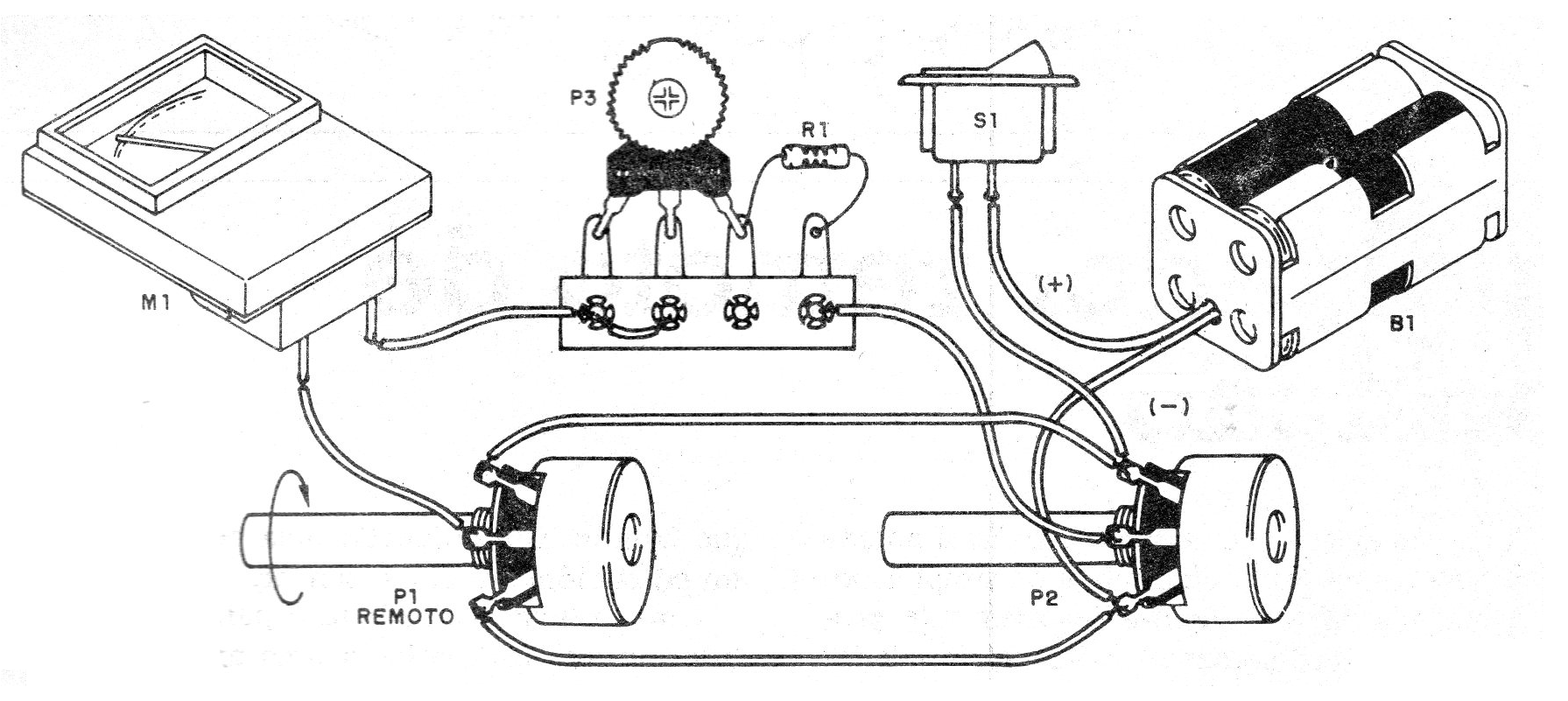
The assembly based on a terminal strip is shown in figure 2.
The ideal instrument is that it has zero at the center of the scale, to indicate the centering of the sensor.
The resistors are 1/8 W with any tolerance and the linear potentiometers.
P1 is the potentiometer sensor that is connected remotely through 3 wires that can be up to 20 meters in length.
P2 adjusts the full scale of the instrument and P3 is used to center the scale.
For less sensitive instruments it may be necessary to reduce P1 to 10k and R1 to 2k2 ohms.
Material list
M1 - galvanometer - see text
B1 - 3 V - 2 AA or AAA batteries
S1 – On-Off switch
P1, P2 - 10 k ohms - linear potentiometers
P2 - 47k ohms - trimpot
R1 - 10 k ohms - resistor - brown, black, orange
Several:
Battery holder, terminal bridge, mounting box, wires, solder, etc.


