
In figure 1 we have an electronic toy organ that can both serve to amuse the children as the basis for a science work in schools.
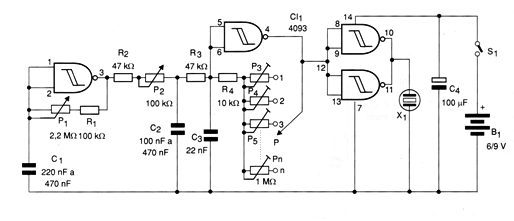
The main feature of this circuit is the vibrato effect that makes the produced note vary quickly, with a rather interesting sound that may even help to get some simple songs.
In this circuit, a first port of the 4093 (CI-1a) produces the low-frequency modulation or vibrato effect, adjusted by potentiometer P1. This is the "effect speed" potentiometer.
The depth of the modulation, or sound variation, is set in the potentiometer P2 of "depth" while the adjustments of the individual notes are made in the set of trimpots that goes from P3 to Pn.
The number "n" of potentiometers can not be very large as it is difficult to make your adjustment. we recommend that the organ has only one octave.
The suggested keyboard system is by probe. One tip touches metal or copper areas of a plate that correspond to musical notes.
The transducer used is of the piezoelectric type for greater economy. However, a small amplifier that excites a loudspeaker can be added, in which case higher volume is obtained.
In figure 2 we have a suggestion of printed circuit board for the assembly of the organ.
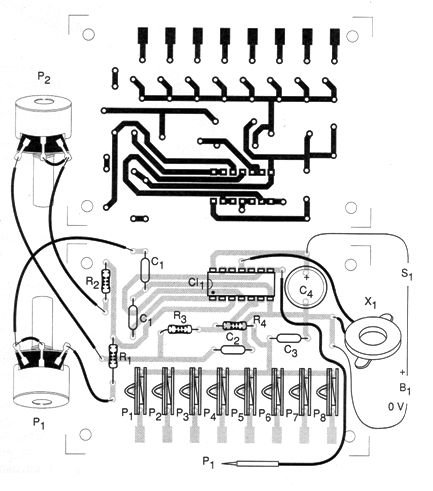
The set fits in a small wooden or plastic box with the keyboard and controls on its top.
Power can be supplied with batteries or power supply. The source must have good filtering so that snoring does not occur during playback.
To use just adjust the effect and touch the keys with the probe. Two circuits similar to this can be used to obtain a polyphonic organ, that is, in which two keys can be played at the same time.
Material list
CI-1 - 4093 - CMOS integrated circuit
P1 - 2.2 M ohms - potentiometer
P2 - 100 k ohms - potentiometer
P3 to Pn - 1 M ohms trimpots - see text
R1 - 100 k ohms x 1/8 W - resistor - brown, black, yellow
R2, R3 - 47 k ohms x 1/8 W - resistors - yellow, violet, orange
R4 - 10 k ohms x 1/8 W - resistor - brown, black, orange
C1 - 220 nF z 470 nF - ceramic or polyester capacitor
C2 - 100 nF to 470 nF - ceramic or polyester capacitor
C3 - 220 nF - ceramic or polyester capacitor
C4 - 100 uF x 12 V - electrolytic capacitor
S1 - Single switch
X1 - Piezoelectric transducer
B1 - 6 V - 4 small batteries or power supply
P - Probe
Several:
Battery holder, keyboard, mounting box, buttons for potentiometers, printed circuit board, wires, solder, etc.


