
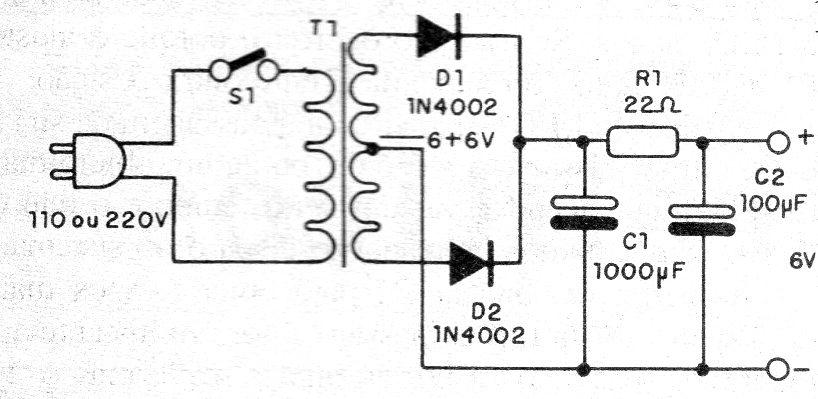
This simple unregulated low voltage source can be used to power your experimental designs that need 6 to 8 V with currents up to 100 mA. The circuit can even take advantage of scrap components.
We describe the assembly of an experimental simple source for projects that can be fed by voltages from 6 to 8 V.
The circuit is from a single unregulated source, serving the less critical designs that allow a range of voltages without the need for regulation.
In figure 1 we have the complete diagram of the source.
Because it is a very simple design, it can be made based on a small bridge of terminals, but nothing prevents the reader from making a printed circuit board.
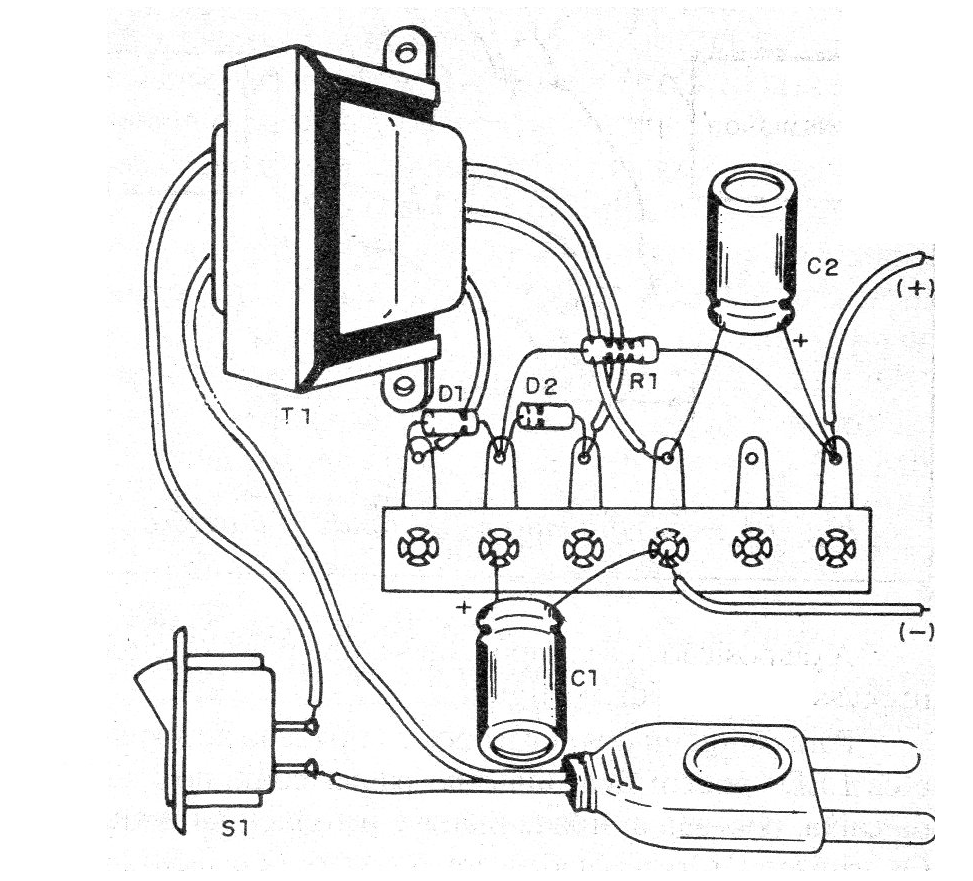
The transformer can have currents of 200 to 600 mA and secondary voltage of 4.5 + 4.5 V or 6 + 6 V.
Observe the polarity of the diodes and electrolytic capacitors.
The capacitors have a working voltage of 12 V or more.
Material list
D1, D2 - 1N4002 or 1N4004 - rectifier diodes
T1 - Transformer with primary according to the local network - see text
S1 - Single switch
F1 - 500 mA - fuse
R1 - 22 ohms x 2 W - resistor - red, red, black
C1, C2-1000 uF - electrolytic capacitors - 12 V or more
Several:
Power cable, terminal bridge, wires, solder, mounting box, red and black claws for the outlet, etc.


