
The 9V batteries (mainly alkaline) are costing the eyes of the face! And some devices that use this type of battery are really Hungry Monsters, which exhaust them in a short time.
If the player has a toy, some radios, or other equipment that uses 9V batteries, and can not stand it, do not play it out. With this eliminator you may not have the same mobility for your use, but it will certainly make a good economy.
By feeding it through the local area network, you will certainly stop buying expensive 9V batteries, leaving them at their maximum for emergency occasions when mobile use becomes necessary.
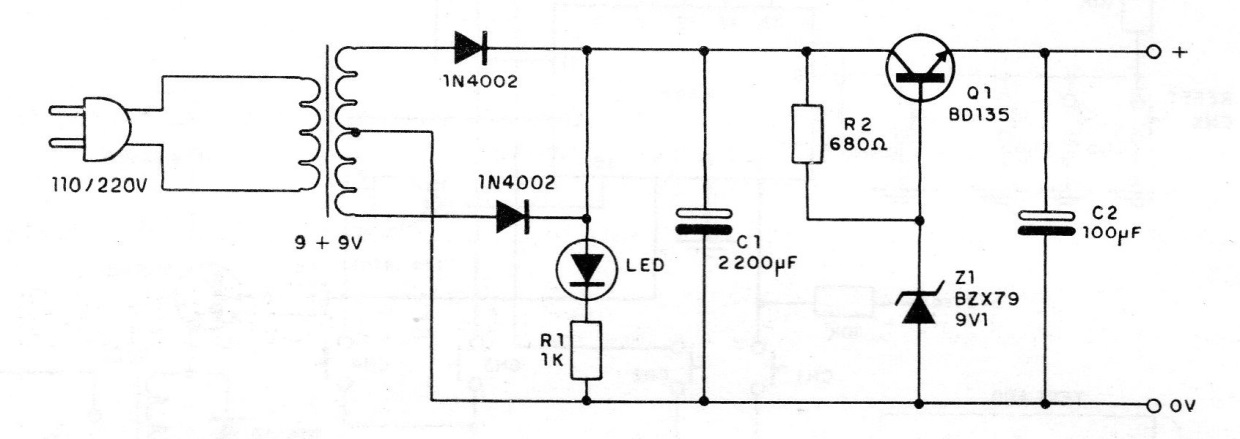
The circuit is simple: a regulated source that supplies a voltage close to 9 V, with current compatible with appliances that use batteries. (figure 1)
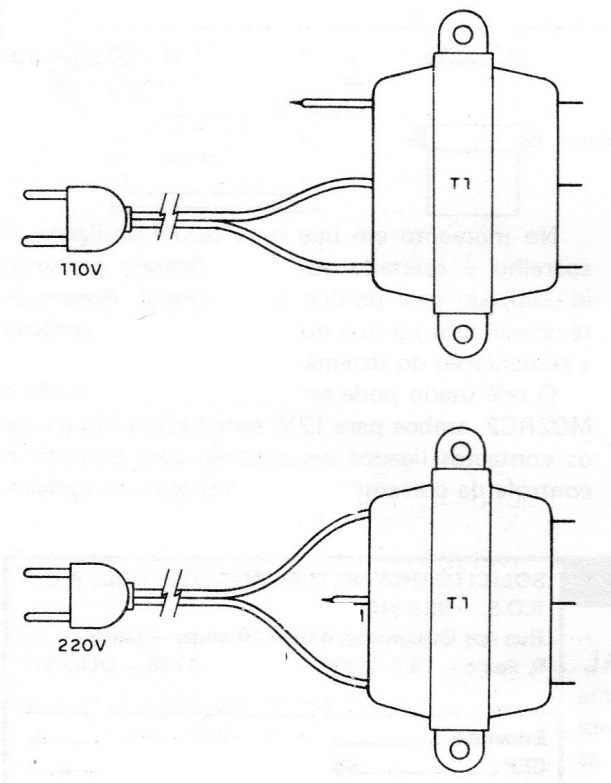
The transformer must have a secondary of at least 100 mA, and the connection of the 3-wire primary depends on the network, as shown in figure 2.
The power transistor must be provided with a small heat radiator.
Adaptation on the radio does not exist: with the use of a battery connector, but with the connections inverted, we connect directly to each other.
Note that in the strip assembly (figure 3) we purposely invert the connector's connection so that the negative (black) of one corresponds to the positive (red) of the other.
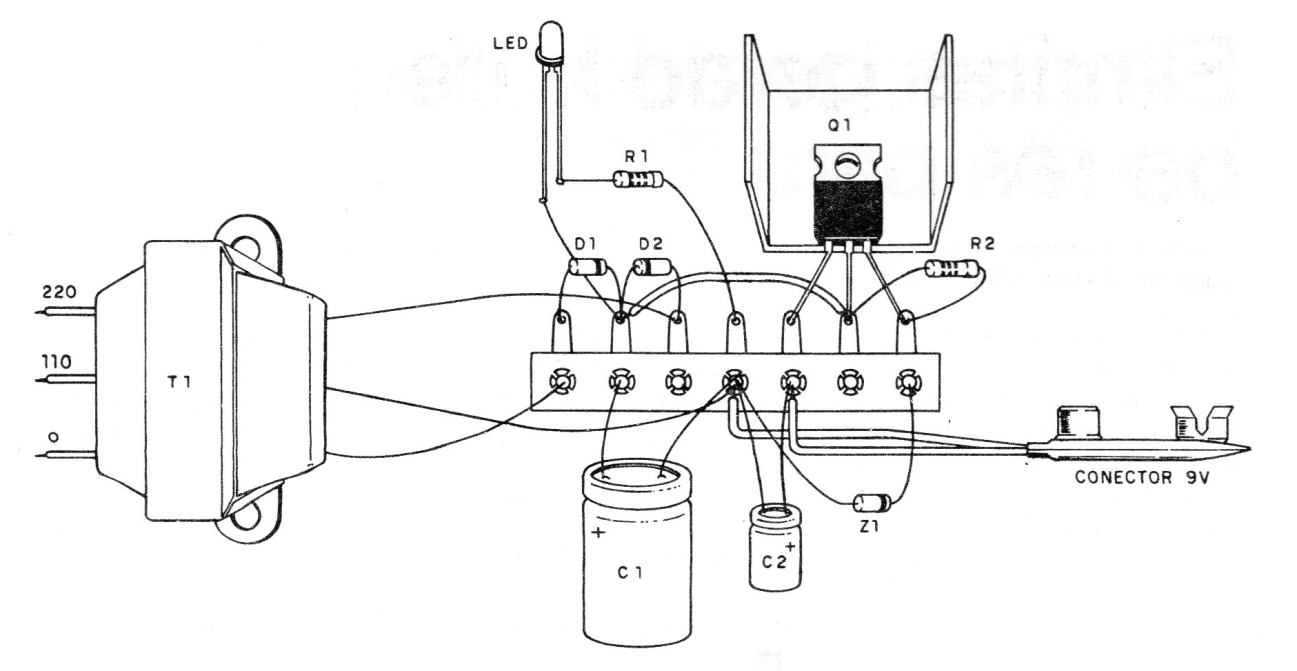
In this way, the positive pole of the source will actually be connected to the positive pole of the powered device. The connection wire from the eliminator to the appliance should not be too long, as some problems can occur with this.
If noises or oscillations occur, a 100 nF capacitor should be connected in parallel with the radio connector. As we do not use a switch to turn the power on and off, an LED indicator prevents it from being forgotten connected, so there will be unnecessary energy expenditure.


