
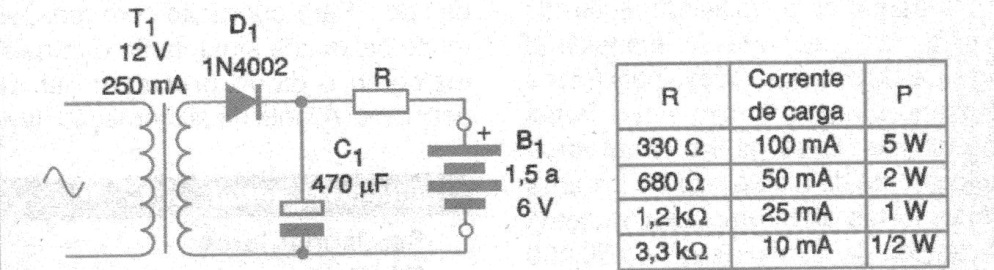
Charging Nicad (Nickel-Cadmium) batteries of AAA, AA, C, D and 9 V batteries is the purpose of this circuit. It is also used to charge small lead-acid accumulators. The complete circuit of the charger is shown in figure 1.
Utility:
• Charge Nicad batteries and batteries for general use
• Rejuvenate common batteries (*)
• Charge small lead-acid batteries
(*) The process of rejuvenating common (except alkaline) cells consists of passing a current through them in order to reactivate the existing reagent inside and favor the absorption of the formed gases. With this, the battery may still work for some time.
Constructive Details:
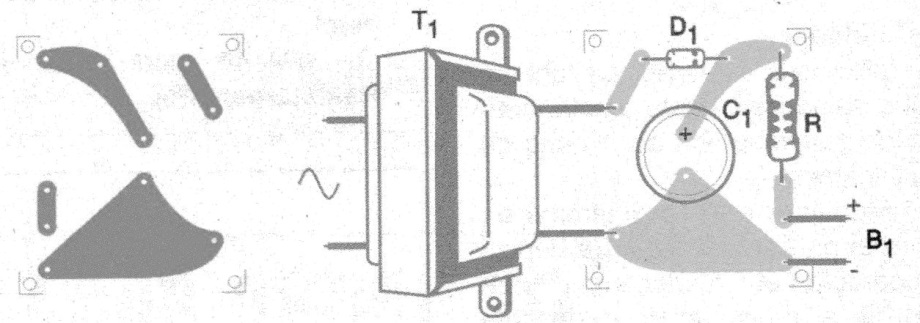
The printed circuit board for this charger is shown in figure 2. The resistor used depends on the charge current of the batteries which is usually specified in its own enclosure.
The currents indicated for charging make it possible to obtain a complete charge at times which can typically range from 12 to 16 hours. Wire resistors must be used for larger currents and a slight heating is normal.
When mounting the batteries, the batteries must be recharged. Up to 4 batteries can be charged at the same time and must be connected in series.
Material list:
Semiconductor:
D1 - 1N4002 - rectifier diode
Resistor:
R - 330 ohms at 3.3 k - see text
Capacitor:
C1 - 470 uF x 25 V - electrolytic
Several:
T1 - Transformer with primary according to the local and secondary network of 12 V with current of at least 250 mA.
Power cable, printed circuit board, battery holder, wires, solder, etc.


