
Here is an experimental circuit with only five components that is intended to allow communication on a two-person path separated by great distance using ordinary wires. You can extend the connection wires to the tweeter (TW) or piezoelectric transducer at a distance of over 100 meters without appreciable loss of signal strength.
As we do not have amplification steps and it is experimental circuit we can not expect high-throughput. This means that in operation the tweeter will be used as a telephone, next to the ear. The circuit is powered by common batteries or battery and its power consumption is extremely low. In figure 1 we have the complete diagram of the apparatus.
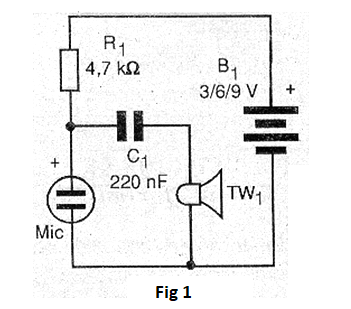
TW1 is a piezoelectric type tweeter from which the small internal transformer has been removed, connecting the wires directly to the ceramic cap of its interior which is high impedance. If a transducer is used it will be connected directly because it does not have an internal transformer. In Figure 2 we have the assembly aspect, where the few components used are soldered on a terminal strip except the remote tweeter.
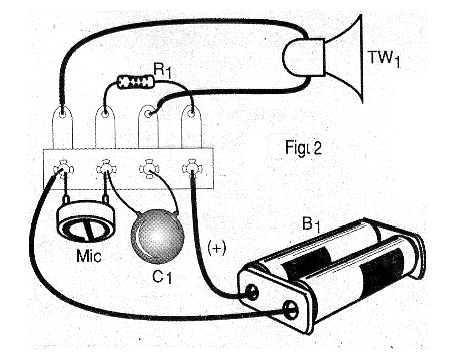
Both the polarity of the batteries and the electret microphone must be observed. The resistor R1 is 1/8 W or larger and in fact its value must be obtained experimentally as a function of the supply voltage, typically being between 1k and 10k ohms.
An interesting application for this circuit is in a secret system of communications with your friends, simply set up two equal units so that you can establish bilateral communication as on a telephone.
MATERIAL LIST
MIC - two-terminal electret microphone
B1 - 3 V to 9 V - 2 small batteries or battery
R1 - 4.7 k ohm x 1/8 W - resistor - yellow, violet, red
C1 - 220 nF to 470 nF - ceramic or polyester capacitor
Several:
Terminal strip, battery holder or battery connector, mounting box, wires, solder, etc.


