
The Nerve-Test is a traditional electronic game. The player must pass a metal ring through a tortuous wire, without letting it touch the wire. If this occurs the circuit will trip indicating a fault. Who wins can pass the ring to the end of the wire or even commit fewer fouls. The version of figure 1 triggers for an interval of time an oscillator, that emits a sound, whenever there is a touch of the ring in the wire (lack).
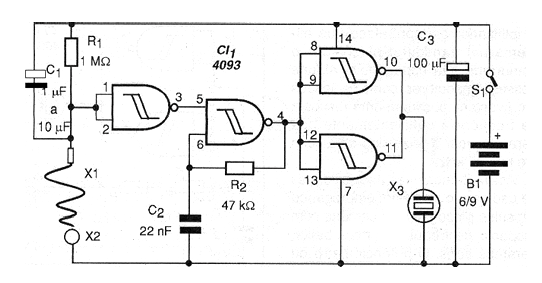
The circuit is timed, which means that no matter how small the ringing, the sound emitted always has the same duration. This duration depends on C1 and R1, components that can be changed by the assembler. The transducer is a high impedance piezoelectric capsule type and the circuit power can be made by common batteries or batteries. The consumption is very low, since it occurs practically only when the sound is produced.
In Figure 2 we have a suggested circuit board for the Nerve-Test assembly.
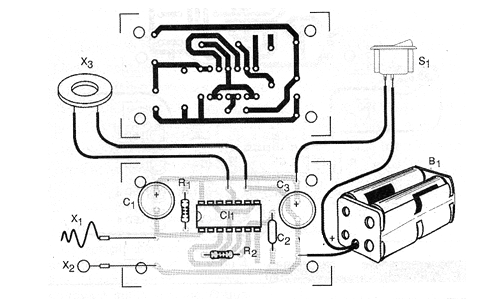
The tortuous ring and wire are made with pieces of thick (16 or 18) hard bare wire. Test the apparatus by briefly touching the ring on the tortuous wire. The unit should beep for a few seconds. If you want to change this time, change the value of C1.
Material list
Semiconductor:
CI-1 - 4093 - CMOS integrated circuit
Resistors: (1/8 W, 5%)
R1 - 1 M ohm - brown, black, green
R2 - 47 k ohm - yellow, violet, orange
Capacitors:
C1 - 1 uF at 10 uF x 16 V or more - electrolytic
C2 - 100 uF x 12 V - electrolytic
Others:
X1, X2 - Ring and tortuous wire - see text
X3 - Piezoelectric transducer - see text
S1 – On/Off switch
B1 - 6 or 9 V - 4 small batteries or battery
Printed circuit board, mounting box, battery holder or battery connector, wires, solder, etc.


