
The twin T oscillator is an interesting alternative for generating good quality sinusoidal signals in a range of frequencies ranging from a few hertz to a few tens of kilohertz. The typical harmonic distortion of the signals generated by this circuit is of the order of 1%.
The twin T determines the frequency of operation in a feedback network, and its frequency is given by the values of the components according to the formula given in the diagram of figure 1.
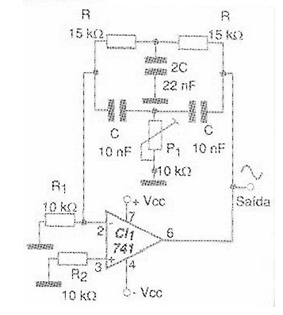
Note that the components of the double T must maintain the relationships indicated. The trim trimpot allows you to select the oscillation point. The adjustment of this component also allows the generation of oscillations damped by the circuit.
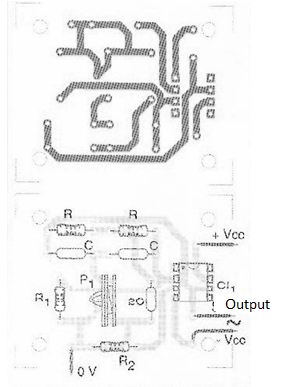
With the values of the components in the circuit of figure 1 the generated frequency will be around 1 kHz. In figure 2 we have a printed circuit board for the circuit shown in figure 1.
Material list
CI-1 - 741 or equivalent - operational amplifier
R1, R2 - 10 k ohm x 1/8 W - resistors
R - 15 k at 100 k ohm - see text
P1 - 10 k ohm to 100 k ohm - trimpot - see text
C - 1 nF to 1 uF - see text - capacitors
More:
Printed circuit board, symmetrical power supply, wires, solder, etc.


